


Hot Springs National Park is the smallest of all the national parks in the system, and, though it only gained the designation of “National Park” in 2018, was one of the first natural areas ever set aside for preservation in the early 1800s.
The place seems to have always had a mystical draw– there was written proof of its use as far back as the 1500s when Europeans arrived– and based on materials found at the sites, Native peoples appear to have used the site for 8,000 years prior to that. (Though they were run off the land in a ‘treaty’ signed before they were conscripted to a reservation).
The Ouachita Mountains that supply the thermal waters are small in area, but the trails around them are plentiful and intersecting. Given the park’s relatively small size, we rose early to head up to the trailheads.
I’ll admit — we thought by heading up the mountain, we might see a source or stream of the more natural part of the springs–not realizing that most of the flow happens deep within the mountains. Fed by rainwater, the water slowly makes its way down the mountain between faults, taking about 4,000 years to make the trip to the hot springs at the bottom. As the depth increases, so does the heat, as the rocks are thermally heated.


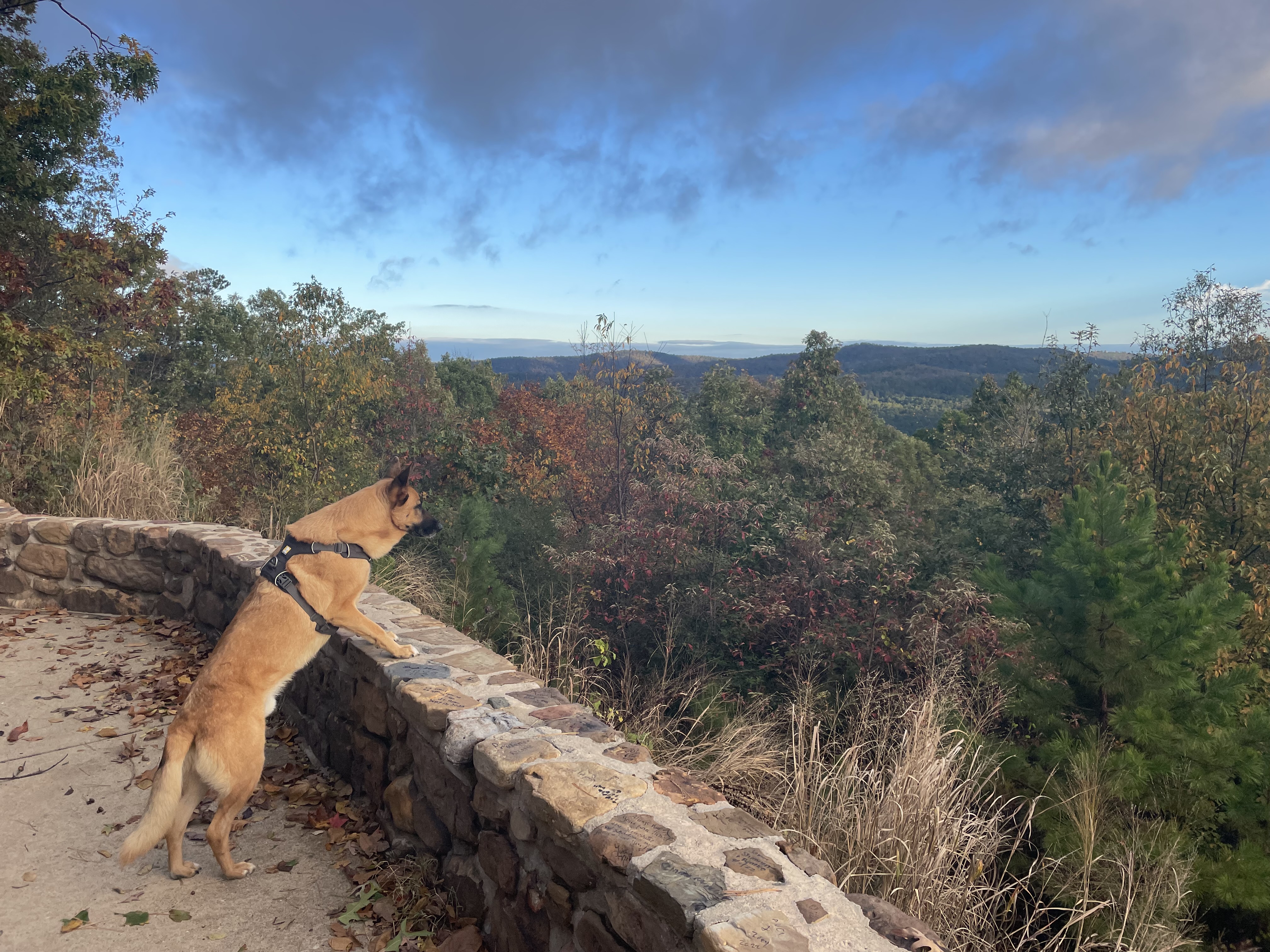
The rises and falls of the trail felt downright gentle compared to the West– where we generally refer to land masses that size as “hills”. Mac sprinted down the pathways running after squirrels, and Moon and I ambled behind him, admiring the bright yellow and red leaves dotting the green and brown landscape.
It was a picture-perfect fall day, and the early-morning air was just crisp enough that we saw a few small plumes of steam rising from gaps between rocks here or there, vents of sorts that let some of the natural heat escape into the chilly forest. That was the closest we got to “seeing” the natural hot springs that day, because the springs have been entirely hemmed in at the bottom.


It seemed strange at-first, having been to many natural hot spring pools, that buildings had been constructed to keep all of the natural waters contained– but I remembered that when previous generations happened upon natural wonders, as a first order of business, they often created buildings to commercialize them. Before our ideas of conservation shifted, utilization WAS the priority, and structures were often a part of that.
Behold– a droplet of rainwater that descended a mountain for 4,000+ years ended up… here, here, and here.


These are bathhouses– and they were largely open to the public for their long tenure on-site, but when the Park Service struggled to maintain the crumbling old buildings due to a decline in attendance, all but one were sold to private entities.
Strangely, the National Park itself was really a ‘main street’ of sorts, as being nestled in the narrow mountain valley meant one long avenue was the only infrastructure that was feasible. One or two-story buildings lined the main road, with tourist shops, cafes, bars, restaurants, and did I mention shopping? If you’ve been to other National Parks, these touristy parts of town are often NEAR parks, but never are IN them– let alone making up the majority of the space the park occupies.
It was a bit unexpected, and as groups of tourists crowded the sidewalks and 2-4 lanes of cars zipped by, you might forget you were in a National Park– rather the opposite of serene, the ambiance was that of a bustling town.


The park service Visitors Center was helpful context from which to interpret the way bathers had been enjoying the purportedly-healing waters for generations. I wasn’t prepared for what I saw.
Coming into this park, I’d had the pleasure of bathing at Korean spas, and at Japanese onsen when in Fukuoka. These bathhouses feature communal bathing in the hot mineral waters– sometimes enclosed in a structure, sometimes outside, but always bathing in pools with others. That was my expectation– forgetting American culture is far more conservative about nudity. The single-stalled bathtubs often had a door or curtain enclosing them, and photos showed patrons constantly wrapped in modest sheets when not submerged. These bathhouses featured individual bathing in an environment best described as… clinical.
In fact, it was like something out of a dated film about a strange laboratory.


These contraptions were “steam cabinets,” and those holes at the top are exactly what you think– to keep heads out and bodies in while a rush of hot steam was pushed in for 3 to. 5 minutes.
These metal and porcelain fixtures, set against the whitewashed walls of the bathhouse, looked cold and spartan, and the spaces echoed, with no way for sound to deaden. The 1950s-hospital-vibe was hard to shake off, and while I understood the context– these were perceived as healing waters with powers to aide very serious ailments– the downright frigid look was off-putting.
Nothing like the soothing, trickling water of a natural hot spring, when one is submerged in part of a thermal river, surrounded by nature. Quite the opposite, actually– I felt my tension rising as I looked at them.
I can’t speak to the experience at these private spas, as it seemed a bit anathema to me to book a reservation for a spendy, hotel-like spa within a National Park, so Moon and I opted for the public bathhouse, the Buckstaff Baths– which was also the only house in continual use for the entire duration of its existence. Moon got a manicure, and I decided to try the bathing experience.
It was one of the least relaxing things I’ve ever done.


For obvious reasons, no cameras or phones were allowed within the experience– all our possessions were locked into lockers– I was the last person out for the evening, and managed to quickly snap these photos of the waiting area above (once I was sure no one else was around).
Entry to the experience involved being escorted by a staffer to the lockers, which were all curtained in for privacy, despite being gendered. The staffer then fitted the bather with a sheet wrapped up like a toga, and everyone had a seat in a fairly-uncomfortable chair for a wait. With such individualized stalls, rather than a communal bath, it meant only a few bathers could be having an experience at one time. Such a strange thing to be so limited in space, just for modesty!
After waiting for over an hour, it. was time, and I realized the Buckstaff Baths had not changed a single thing about bathing over the years — meaning, the porcelain tubs, the white-on-white tile walls, and the metal-and-marble contraptions greeted me upon entry. I was showed to a private tub, the curtain was closed, and I was left with the hot mineral water to soak. Which began peacefully enough, until an engine-like noise began– the water pumps, pulling the thermal water in and out of the building, were loud and jarring– and even chattered my teeth if I set my head back in the tub.
It was a long 15 minutes of deafening noise, while staring at white tiles and white walls. It wasn’t my way of relaxing.
After this soak, I was given some of the mineral water to drink, unfiltered (it was safe to drink and has been for generations)– rather than the sulphuric odor of many natural springs, the natural filtering of rock and sediment made it pleasant to taste.
Then, the “steam cabinets” were offered to us at the end of our session– I politely declined. The idea of being locked in a metal box with over 100-degree steam pouring out seemed like an evil experiment in that stark setting. I was ready to go.
Here’s what I will say about the experience: it was like going back in time, and experiencing the baths just as former ailing patrons might have. As I was dressing before leaving, I thought of F.D.R. seeking treatment here for his polio, and the way his wife Eleanor often said that his empathy– which had been anemic before– grew in spades after chatting here with fellow bathers. And I had learned that Civil War soldiers often came to Hot Springs to seek treatment for both physical and mental wounds of the war, as well as countless other Americans who had seemingly tried everything else, and just desperately wanted to feel better.
Ultimately, I knew that history owed the town of Hot Springs something important, if just for soothing so many over time.


Posted by Sun


