


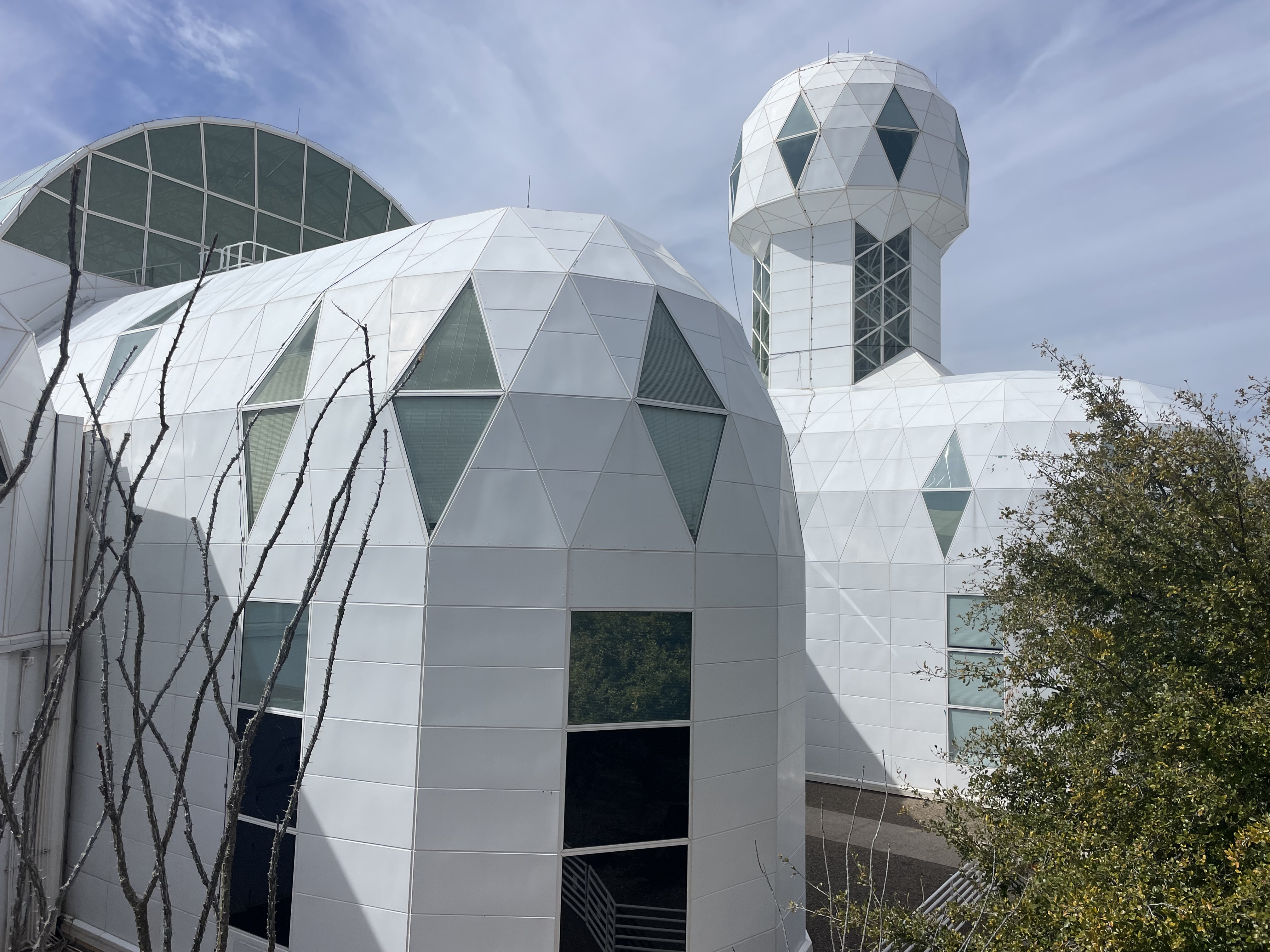
In 1991, a small team of humans entered a bio-dome named the Biosphere 2 in Arizona– and sealed it from the inside completely for a two-year-long experiment.
It didn’t go as-planned.
The drama that ensued was absolutely bonkers, from severely depleted oxygen levels to a low food supply to interpersonal flameouts, to the attempted firing of the head of the team inside it to Steve Bannon *(yes, the political operative Steve Bannon)— but, I’m getting ahead of myself.


When I first rocked up to the Biosphere 2 (outside of Phoenix), I wasn’t aware that during my lifetime, it had housed two of the most important experiments in human survival in history. But I WAS vaguely aware of the 1996 Pauley Shore film “Biodome,” which was (EXTREMELY LOOSELY) based on these events.
The Biodome— I’m sorry— the BioSPHERE— was constructed between 1987 and 1991, as a closed ecological system. Meaning, there was an entire world (of sorts) contained within that dome… I mean, sphere. A rainforest, a desert, a grassland, and an agricultural area — you could see the plants literally smashing into the glass from the inside. The sphere even had a functional ocean and coral created within it for key algae biomes! Look at it– pretty magical.


If you’re guessing this all somehow had to do with the viability of humans living in space, you’d be right— learning if the conditions of Earth could be reproduced to sustain elsewhere was stated goal at the time of the 1990s experiments. But today, the Biosphere functions as a learning tool for the University of Arizona– closed ecology that allows for the various biomes within to be changed as part of other purely ecological experiments, without manipulating conditions on the actual planet we live on (any more than we already have, of course).
Entering the building through the same airlock door that had not been opened during the two-year experiment in the 90s– visitors were asked to download an app, which served as the “tour guide” for each individual visitor. Knowing this, I had brought headphones— some, less courteous, people did not— and playing their audio from their device at a very high volume (eyeroll). Now, I’m not knocking the videos– there was some cool content on there: like the participants lost 25% of their body weight during the experiment, and they used bananas to make wine (you gotta do what you gotta do).


The walking tour had a few stops outside the sphere itself to give a lay of the land. There was something space-like about the architecture of the collected buildings, looking a little like futuristic renderings of space stations on Mars from the outside. And Lego-engineering-set interiors.
This series of structures were truly architectural and engineering marvels. One of the outer structures the tour specifically called attention to was the “Lungs” of the dome (pictured to the right below)— because of the sun’s heat accumulating and being trapped in a sealed environment all day long, the air would expand greatly. Without the lung— this building which drew out warm air and cooled it— the glass would have shattered outward daily from accumulating pressure.


Scientists and experts had been called in to determine which biomes were most important to sustain life. The different biome areas were fascinating to walk through— each section was unique, and one could feel the moisture in the air and temperature changing in each we reached. The plant life changed completely over to reflect the simulated environment, from cacti to ferns. The “ocean” area contained a living coral reef, and was by all accounts, the hardest area to manage.


Trees stretched upward toward the false sky– the domed roof made of panels that did not let much UV light through (to reduce heat buildup in the Arizona desert). One of the 8 participants wrote about how when they departed after the 2 years, it was delightful to see the sky WITHOUT white girders running every which way through it (I could not imagine this ceiling being my only “view” for 2 years).
The living quarters for the original experiment inhabitants were fascinating— looking like regular 90s apartments, these little apartments contained boomboxes, books, all the essentials (Compact Discs!!). Rejiggered for tourists, they’d added large glass windows in front of them (which had the actual ‘guinea pig’ affect), but rooms were originally closed. Weirdly, since this was both a bio and human experiment, participants later found out their phone calls were being tapped and recorded– creepy.
Interestingly, there were some displays of notes that participants kept about their experiments and their respective responsibilities within the biosphere (e.g., Jane Poynter was in charge of insects and butchering animals, as well as agriculture, etc.). The participants each had an area they were in charge of, but helped each other on rotational duties.


While efforts were made to stock the Biosphere with insects and animals, the pollinators all died, and the invasive insects (e.g. ants and cockroaches) thrived. Many animals did not make it. Despite the poor results with the fauna, the flora did well enough— most of the ecological zones survived and thrived. (*Though for those who enjoy an invasive weed, it’s worth noting that bindweed choked many of the plants as it also exploded within the environment).
The idea was that the human team would be able to live entirely on what was produced within the sphere— a good idea in theory that was much more difficult in practice. For instance, despite having the right tropical biome to grow coffee beans in, the process of harvesting, roasting, and making coffee was such intense work— coffee became a once-in-awhile luxury (once every two weeks or so).
It meant that this small team ate mostly this for two years: sweet potatoes, cowpea beans, rice, beets, peanuts, and papayas. They participants even said their skin tinged orange thanks to the amount of sweet potatoes they consumed! Bananas were their treasure for their sweetness and nutritional value, and were so coveted they were kept in a LOCKED room– the only food to be locked away.
Now, I want to express that nearly everything covered from here in this post was NOT a part of the tour. Currently owned by the University of Arizona, the tour was nearly entirely about the different biomes in the dome— desert, rainforest, ‘ocean,’ and so on. The signposts were purely scientific, and somewhat interesting— but I was far more enthralled with the human-experiment-drama I had read about before showing up that day. But of course, I wanted to know the whole story, so went to Wikipedia and devoured a book on the subject…
The humans sealed inside the sphere did not exactly thrive. Oxygen levels were falling steadily over time in the structure, which meant O2 saturation was low– close to levels equivalent to breathing at approximately 14,000 feet— and CO2 levels would fluctuate wildly in a day thanks to photosynthesis.
On a long-term, high-nutrient, reduced-calorie diet, the team began to lose weight, and hunger was near-constant. Most of the participants lost 20% of their body weight, though their vitals remained strong thanks to the nature of their body’s adaptations (e.g. their metabolisms got much more efficient at nutrient extraction). Doctors found them to be healthy, but not necessarily happy (though it’s worth noting that none exhibited symptoms of depression, just that of the same terrible mental state observed in winter at Antarctic bases).
The team did not get along once sealed inside— before the first year was out— two separate factions developed between the small group. They differed on nearly every point of order, from how the experiments should go forward to what should be eaten. They were livid with each other most of the time, with stories about spitting at one another and refusing to make eye contact.
One of the warring groups decided to eat seed stock that specifically hadn’t been grown inside the sphere— causing a kerfuffle that resulted in the attempted firing of one of these human Guinea pigs. Except, that particular person knew that unless they left voluntarily, the folks doing the firing would have to come IN (and thus, breaking the seal of the dome and ruining the experiment) to get her— so she just stayed put. Refusing to leave, she completed the mission.
The drama continued through to the end of the two-year mission, as the public and the news drummed up some stories about tampering with the experiment, once learning an injured team member left the sphere to receive treatment before returning on Day 12 (which was confirmed by the team, but was a minor treatable injury for which she returned nearly immediately). The public and press seemed intent on calling the experiment a failure, based on scrapes between the scientific oversight board and the management team for the Sphere– which was partly why it was forgotten
Despite all this nutty human-generated nonsense, and the shadow it cast on the project– the crew did finish the experiment two years after beginning it. They emerged exactly 2 years and 20 minutes after entering, and went on with their lives– most never associating with the Biosphere team again.
Not too long after, a second mission began— 7 people over 10 months— and that’s when things really went off the rails. In 1994, after their entry, onsite management was served a restraining order, as financiers and bankers fought over the financial decisions regarding the property (which reportedly was mishandled and losing money quickly).
That’s where Steve Bannon (then operating a financial company called Bannon & Co.) was called in to help run the place. This set off a firestorm— including a protest by two members of the first crew, who showed up to throw bricks through the glass of the greenhouse building, and opened all the airlocks overnight, in an effort to disrupt the entire experiment. Which worked.
Due to all the insanity, the second experiment was halted.
I bought a book in the bookstore about this titled “The Human Experiment” by one of the actual folks in the first Biosphere seclusion— and if you are curious to know even more about this beautiful mess, a documentary about the Biosphere called “Spaceship Earth” is out there for consumption online. The book is pretty wild– I could not believe this feat was pretty much discarded into the dust bin of history.

Today, the Biosphere is being used by the University of Arizona as a simulation system of sorts— manipulating the elements within (e.g. rainwater levels, humidity levels, heat levels) to be a ‘testing ground’ for changing conditions on earth. There is probably a lot of literature about these current tests out there— but I couldn’t get my focus off the human experiment of the 90s that inspired so much attention at the time: then seemed to disappear entirely from the narrative about the vaunted 1990s.
The awful Biodome Pauley Shore movie cannot be the only artifact of history devoted to the grand idea of the Biosphere— this seems like a travesty.
And yet.

Posted by Sun


