

If you have read this blog for any length of time, you know I have a firm ‘No Visiting Plantations’ rule.
In my year out on the road, I have driven right by many antebellum-style mansion homes in the South that offer tours– from historic residences like Andrew Jackson’s in Nashville, Tennessee, to the Bragg-Mitchell mansion Mobile, Alabama– no matter the significance, if they were beautiful homes that relied on the work of enslaved people, I always avoided them.
Why? Because these tours focus on the finery, the opulence, the grandeur of the homes and the families who lived in them– and they barely acknowledge the cruelty through which this wealth was built and maintained. To me, the decadent interiors are not worth seeing, especially as they sweep the uglier parts of history ‘neatly’ under the rug.
But after reading Clint Smith’s excellent book, “How the Word is Passed”– I knew I had to make an exception to my rule for The Whitney Plantation, as he revealed this was the ONLY former plantation dedicated to teaching the public about the life of slaves who were confined there.
It focuses exclusively on the lives of the slaves, not the wealthy white folks who lived in the “big house.”
Only about an hour and a half outside of New Orleans, The Whitney Plantation is located in a river valley that is still green with sugarcane, the crop that enslaved people were forced to plant, harvest, and then use to create marketable and sellable sugar for 16 hours a day, every day.


The region is still utilized to produce this crop, which was actually FAR more dangerous for slaves to produce and cultivate than cotton, we came to find in the small museum just inside the doors. In fact, the open-kettle method of production was so dangerous that Louisiana’s sugar cane fields were the only area in the South to have a negative birth rate among the enslaved.
My friend and I looked through this small museum while waiting for our guided tour to begin. The sheer number of sugar plantations in this delta of the Mississippi from New Orleans to Baton Rogue was mind boggling– only an HOUR and a half apart by car today, there were hundreds and hundreds of plantations in this geographically tight area (see below).
Which meant there had to be thousands– or perhaps tens of thousands of slaves– within just this condensed area. Which was a mind-numbing scale to contemplate.

The house was built on the plantation in 1815– and was turned into a 501(c)(3) in 2014. According to the informational cards on Louisiana slavery, from 1712 to 1795, the number of enslaved Africans in the state grew from just 10 to over 19,000. By 1860, that number would be over 330,000 in JUST Louisiana alone.


The guided tour began at the chapel on the property, and our extremely knowledgable docent introduced herself as being from the exact delta we were discussing, just two parishes (counties) down from where we stood. She began by sharing that there was no graveyard here, as slaves were not given proper burials, but often were slipped into swamps or had their corpses burned.
The next stop was a wall that contained the names of some 350 enslaved on the property– the Wall of Honor. Due to Louisiana treating slaves as property, most transactions (of human beings) were documented on official records. Thus, unlike other slave states of the South, Louisiana has a fairly meticulously-kept record of movement of enslaved people– knowledge that historians, as well as descendants, have benefitted from.
Shiny and marble, the wall was reminiscent of the Vietnam Memorial, as the reflective surface sent a mirror image of the observer onto the list. The docent picked out a few stories to tell, and there were also quotes from former slaves etched into the marble. One recounted how enslaved children were taught to say “thank you, ma’am for whipping me” to their captors after being beaten, to try to forgo further trouble. Other stories were even more harrowing, such as a woman who had 15 children by 15 different men, due to systemic sexual violence with the aim of producing a new generation of workers.


While the tour took pains not to mentioned the Haydels (the white masters), the Wall of Honor was the place to point out that a few of the slaves descended from the two Haydel brothers who ran the plantation. Yes, this was proof of more sexual violence– there is now an entire line of Haydels who are Black. And, according to the docent, the Black and White sides of the Haydel family rarely speak.
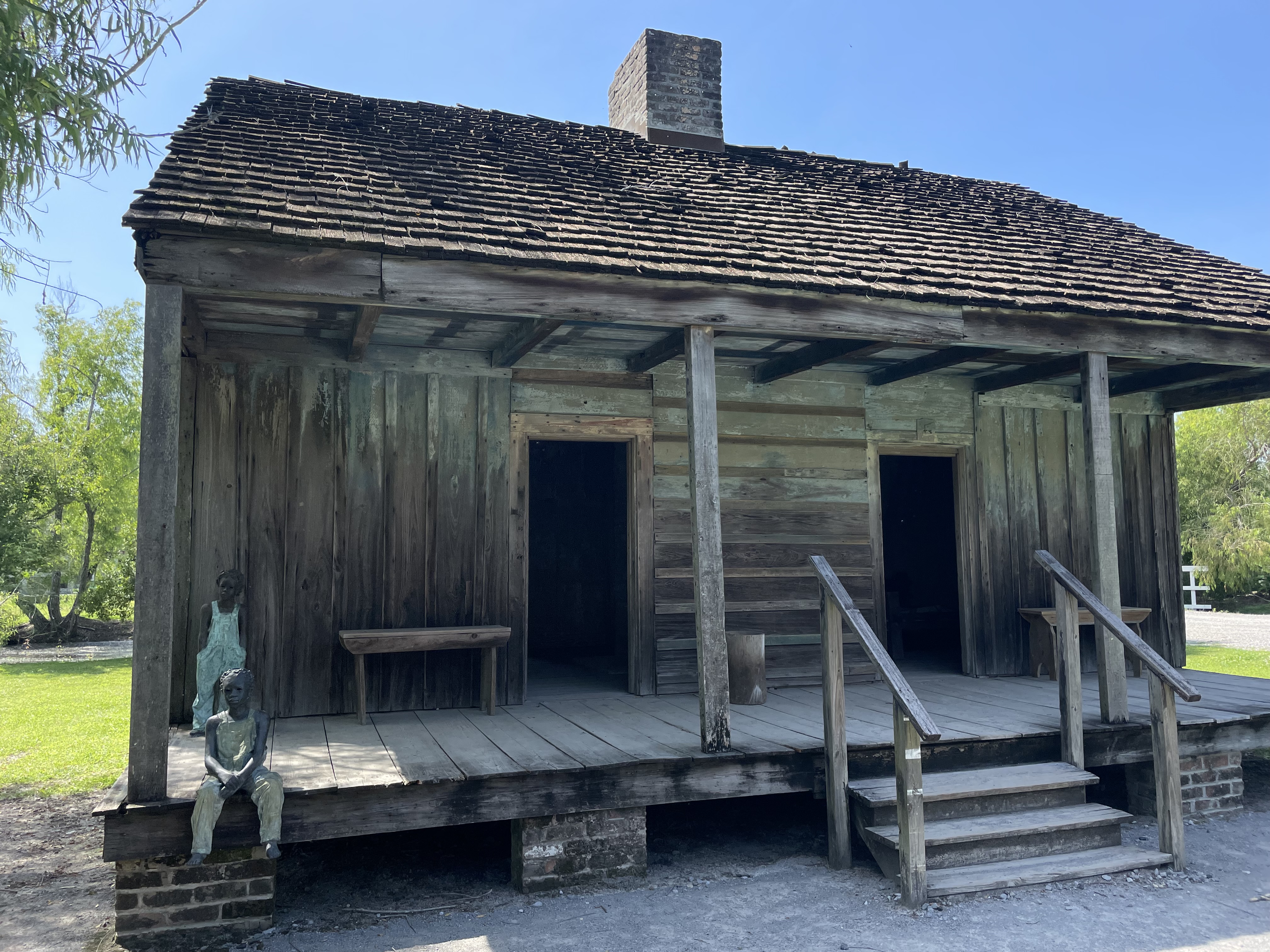
The group walked to the slave quarters nexts, which of course, were spare– nothing more than a shack or two, with not a single comfort to speak of. The quarters were just steps from the fields and production houses for the sugar, and the docent noted the shade trees had been planted AFTER its use as a plantation– meaning there was no protection from the blanketing Louisiana heat. And no protection from the cold, as these cabins regularly dipped below freezing in the winter.
Notably, these were not original to The Whitney Plantation but were relocated from nearby sites. Yet, they so resembled the originals that a former slave who returned to the Whitney said they were just as bad as he remembered them to be.
Sculptor Woodrow Nash, an Ohio artist, had created statues of Black children based on the oral histories of former slaves in the 1940s, which The Whitney had now placed around the grounds– their blank stares were powerfully haunting.


The open kettle refinement method for sugarcane was described in more detail. This work was extremely skilled, with each batch being tended to by slaves who knew the intricacies of the recipes and knew how to execute temperatures and timings down to the minute. These kettles were boiling sugar juice, and were dangerous to work with. While safer methods were eventually introduced, most plantation owners stuck with the older style– due to wanting to save money.


The docent walked the tour group past the jails, which I noted sat out in the open, central to the property– these were one of the places punishments were metered out. These cells must have been unbearably hot, and of course– slaves were subjected to inhumane punishment for ‘transgressions’ as small as eating a piece of bread, or dropping something and breaking it. A penalty for reading could be lashes or worse, an amputation.


The standalone kitchen, believed to be the oldest detached kitchen in Louisiana– sat not far from ‘the Big House’ and was run by an enslaved person named Marie Joseph. She was eventually emancipated by the inheritor of the property, as he took over for his father.


We went to view ‘The Big House’ last– gleaming white, but given all we had seen– it had an imposing look about it. Its shutters were necessary to keep out the intense sun– we stepped inside to get some relief from the heat. The Whitney Plantation left the house totally unadorned and undecorated, so as not to pay any homage to the fine things or lifestyle that the brutal ownership of human beings delivered.


The most affecting part of The Whitney Plantation was not on the scheduled tour. It was alluded to in the map and materials, and because of Clint Smith’s work, I remembered to search these two gardens out.
Neither were for the feint of heart.
The “Field of Angels” was crushing– dedicated to the memories of the 2,200 children who died in the parish (county) between the 1820s and 1880s. Far from complete, given it only covers about 60 years of a slave trade that lasted far longer. The Archdiocese of New Orleans documented the passings. The Whitney Plantation recorded 39 of these deaths, only six of whom had reached the age of 5.
The statue of the Black angel was moving– artist Rod Moorehead created it, naming it “Coming Home.” The list of names was devastating.


The last memorial was striking– one I was prepared for, having read “How the Word is Passed,” but how does one truly prepare to see depictions of heads on pikes?
This sculpture was a monument to the 1811 German Coast Uprising, the largest slave insurgency in American history. If you find it strange that John Brown and his small revolt are memorialized in history books, but this is not– you are not alone. While John Brown’s revolt lasted hours, this one lasted days– and while this isn’t a contest, the white-led uprising has stayed in the historical canon while this Black-led uprising all but faded from memory, passed down only by oral tradition for many years.
There are disputes about how many men participated– most say that 64 to 125 men started marching and burning plantations, and that other enslaved people joined the uprising as it went. Some say that up to 500 eventually participated– armed only with hand tools like axes or hoes, they marched for 25 miles in two days, before a local militia caught up with them.

Given the militia had guns, and the slaves did not — it was not a fair fight.
On January 10th of that year, 40 to 45 of the enslaved were killed in a battle that caused no casualties to the militia side. Over the next weeks, white landowners rounded up about 44 more folks believed to have participated and either killed them on the spot (extrajudicially), or tried them in court — some received a hastily-carried-out death sentence.
Only two whites were killed in the uprising.
But of course, it wasn’t the actual crimes that would be punished in a heinous way– a rebellion was something Southern slaveholders always feared, and they sent an ugly and awful ‘message’ to prevent further plots by punishing the rebelling slaves in horrifying ways.


if you are squeamish about violence, skip this next bit. Remember that white landowners were not just satisfied to kill– but often were disgustingly bloodthirsty about how they killed. There are histories that say they did so to ‘make an example’ of folks, but honestly– that is far too kind a wrapping for the raw brutal torture they subjected human beings to.
Slavery was torture, and The Whitney Plantation towed a fine line between shedding light on the dark and going overboard into sheer ‘torture porn’ descriptions of brutality. They deliberately shared stories and facts that were hard — but effective– at painting the dark picture of life on a sugarcane plantation, without overwhelming visitors with terrible acts.
As I read more about the uprising, I learned about the reaction TO it from white landowners. This was not listed on the placards at the Whitney.
One of the purported leaders, Charles Deslondes, received no trial– Charles’ misfortune was described by a local naval officer– the former enslaved man had his hands chopped off, “then shot in one thigh & then the other, until they were both broken – then shot in the Body and before he had expired was put into a bundle of straw and roasted!”. An absolutely savage way to maim and kill, courtesy of the same white Southerners that are consistently described as “gentry.”
There’s nothing kind about the way the cliches about ‘kind’ Southerners were born.
100 heads of the enslaved rioters were displayed on pikes all over the county– from New Orleans to Baton Rouge, they rotted in the open to discourage further revolts. Something literally out of the dark ages, or modern dystopian novels. About 56 enslaved people returned to their plantations, and about 32 escaped death by claiming they had been forced to join. But most were killed.
These two final monuments spoke in ways our tour guide did not– they revealed the more inhumane atrocities and tragedies that were happening constantly on this very soil.
They Whitney Plantation was a very worthy visit, and is notably, an easy day trip from New Orleans. To see an unvarnished, un-beautified version of rural slavery on the plantation was hard but necessary– the docents were sharing so much knowledge that was systematically left out of textbooks.
ESPECIALLY given today’s cultural tendency to “reframe” slavery (as the Florida schools recently did) as more ‘positive’ (!), the core truth of the matter is important to see, witness, and speak of. Now that you know these little-known stories, please continue to share and share widely.


Posted by Sun


