
I’m a history buff, but I had never been to The Alamo before.
And I hadn’t necessarily wanted to, either. History is far grayer than a hero-villain portrayal, and I’d always found the narrative of the Alamo to be too convenient, too ‘good-guy-bad-guy’ to be taken at face value.
So when Moon and I pulled into San Antonio, we went to the National Historic Park– and UNESCO World Heritage Site– of the San Antonio Missions. And for the time being, avoided The Alamo.
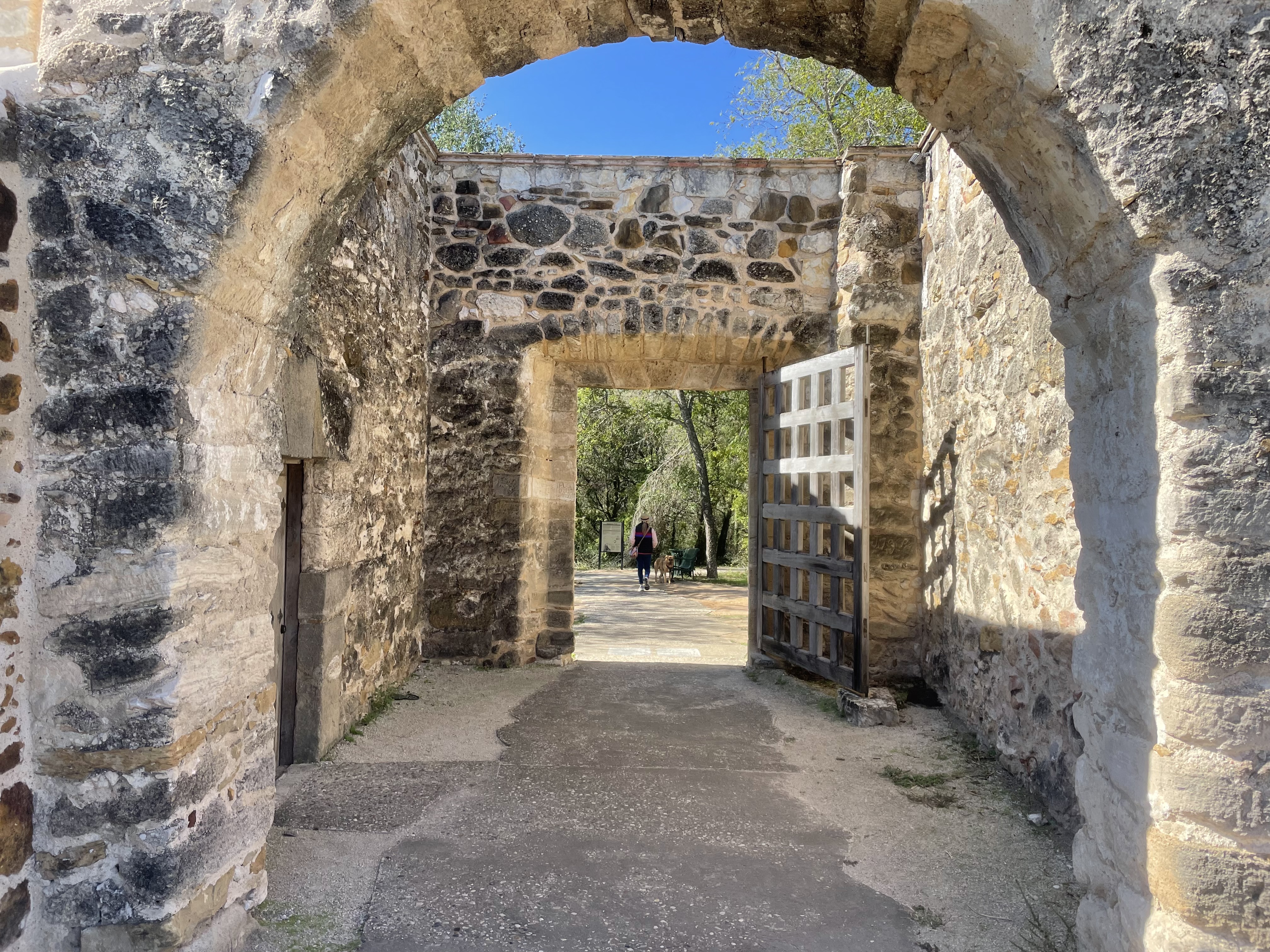
There are 4 missions in the National Historic Park– Mission Espada, Mission San Juan, Mission Concepcion, and Mission San Jose. To Mac’s delight, since most of these were outdoors, they were dog-friendly: the “Bark Ranger” was at it again.


First up, the Mission San Juan, where the visitor center got us off to a good start.
The missions– like nearly all the historic sites we have seen– tell the tale of a complicated past. Of course, the Spanish Catholics who built these missions came with the intention of imposing their will– or maybe “God’s will” if one is being generous– onto Native peoples. The role of the missions in spreading the Catholic faith in America and Mexico is undisputed– they were “successful” at converting thousands and thousands of Indigenous Americans to their faith.
Unlike the more brutal conquistadors in Central America– converting by force and murdering those Indigenous people who did not submit, these Spanish settlers offered a choice: albeit, an impossible one.
The visitors center laid out the reality of life for the Coahuitecans, who often roamed in search of unpredictable food sources in the harsh climate. For them, existence was difficult and dangerous, as territory disputes often resulted in violence and wild animals were a constant threat. The missions offered safety behind literally enclosed walls– and food security too, as they were producing steady agriculture. So the choice was: security, safety, and comfort, vs. a terribly harsh existence with no guarantee of survival.
These understandable choices made in a desert for individual survival– one by one– wiped out a culture.
One of the most haunting items at the visitor’s center was a photograph of a nun (below), among a classroom of Indigenous people in Anglicized dress, most staring dutifully forward. This moment of captured indoctrination was one of thousands that eventually make a culture cede to another– and nearly cease to exist in the process.
It was an erasure these populations never recovered from.


It was hard to know how to feel as we approached the second mission, Mission Espada. These were aesthetically-beautiful examples of communities cleverly built from very little materials, with churches at the center that were lovingly built and carefully-restored. Built centuries ago, they survived thanks to a dry climate and light restoration and protection, a feat in itself.
But knowing the future they created, these sites became a bit uglier to our view– more imposing than grand, more malevolent than beatific, and more punitive than welcoming.


The Mission San Jose was the biggest and most impressive of them all.
Built in 1720, this mission housed 350 rooms for Native converts. and the colonnade was reminiscent of Roman ruins. The chapel inside was elaborate, multiple stories high– a pale blue color that made the gilded gold and silver trim pop. The carvings on the front of the structure were restored– ornate depictions of Catholic saints. It was a work of art, and one I imagine was awe-inspiring in the time of its creation.


After seeing the historic mission sites, even Mac had worked up an appetite. We ventured down to the famed San Antonio River Walk, and found Casa Rio, a historic restaurant dating back to the mid-40s. It didn’t have to be good– the ambiance on the river was clearly what people came for: but the food was delicious.
Over lunch, Moon and I game-planned. Did we even want to go to The Alamo? Having passed it on the way, it was clearly a mess of tourists, and we’d started to dig into the writings of historians who have begun to cast doubt on the old narrative. We decided we could visit, but figured we’d fortify ourselves with a few cocktails first.
We each had a margarita with lunch, and Moon also ordered one of the “to go” cocktails as we strolled down the riverside. A one-woman stand with an umbrella served as our bartender, and she applied a sticker to the top of Rachel’s drink that announced it as alcohol– and off we went, headed toward The Alamo.


The Alamo– sigh. Thank goodness we had imbibed prior.
It might surprise some to know that The Alamo not one of the missions managed by the National Park Service. It is managed by the Texas General Land Office– which is why it costs $40 just to enter the buildings, though the grounds can be walked for free. It didn’t take us long to do the math: with an estimated 4 million visitors a year, if each paid– the ticket prices alone would bring in about $160 million per year.
Another revenue stream? The Google Reviews of The Alamo mention renting it out for “private parties.” Uh-huh.
Having been to so many sites beautifully-preserved and managed by the National Park Service, made accessible to the public for a nominal price– The Alamo felt pretty gross from the get-go. Dozens of people with tickets cramming to get inside, and hundreds without the ability or desire to pay the ticket price reduced to seeing the front edifice and visiting the gift shop.
And WHAT a gift shop it was.


The narrative of “Liberty at any cost” was all over the gift shop, and of course, is a story that fits with how Texans generally like to see themselves. Freedom and liberty are sacraments in the state. And I didn’t realize this, but John Wayne starred in a movie about The Alamo which further perpetuated the myth of a “Republic” being a vision of freedom the men had that day.
Now would be a great time to mention, there’s a growing consensus that the story of the battle is mythical to the point of falsehood. A 2021 book, “Forget the Alamo,” by Bryan Burroughs, Jason Stanford, and Chris Tomlinson, talk about how the myth of the evil Mexican general Santa Anna and his siege on The Alamo leaves out an important part of this history:
The mostly white settlers who died at The Alamo did so to preserve slavery.
The authors are clear that the rationale of slavery is hardly thinly-veiled when looking at the historical records. Two of the three most vocal leaders inside the Alamo– James Bowie and William B. Travis– were slavers, and the Mexican government outlawed it. Their own papers make clear, they wanted to break from the Mexican government for statehood in order to hold slaves.
You would not know this based on the plaques at the site:


The statue of Davey Crockett outside The Alamo is benevolent — he extends his hand to visitors.
Moon made a point of ‘booping’ him on the nose out of disrespect.
It might not surprise you to hear we didn’t give a private company $80 to hear tall tales. We walked away, not feeling we missed much despite its fame. The 4 Missions managed by the National Parks were so much more informative, while having less than 1/100th of the visitors that day. And THAT is what we will remember.


I’ll end this post with the plaque that adorns the front door of the Alamo, asking for quiet and reverence inside. As you read it, remember the “trail” these Texans blazed was only about freedom for those who shared their color– these “heroes” died for other WHITE men who aimed to enslave Black men and women.


Posted by Sun


