


At some point, I realized that I’d never spent any time in Oklahoma.
When out there on the road, that’s honestly sometimes how I decide where to go next. Where on the map HAVEN’T I thought to go? Where have I visited, but not really lingered? What place probably has a story to tell beyond the broad brush it might get painted with?
Admittedly, I was really ignorant about Oklahoma. I didn’t know much about it, beyond a growing knowledge of the Tulsa Race Massacre in the 1920s, and a vague assumption that Oklahoma had been impacted by the historical Dust Bowl. That ain’t much, and that ain’t good enough. So I headed to Tulsa.


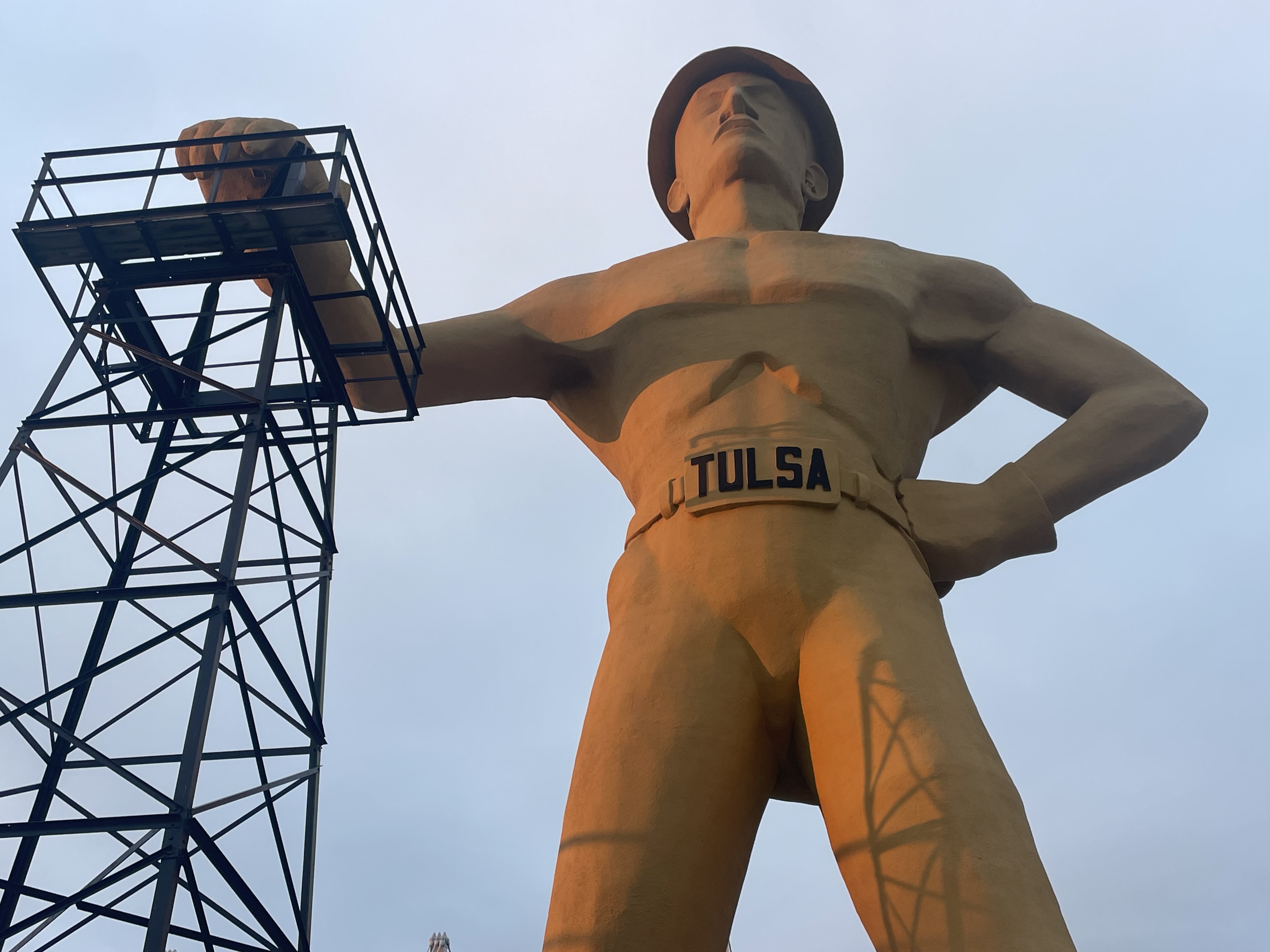
The “Tulsa Golden Driller” was a statue that needed to be seen to be believed. At 76 feet tall, is the 5th-tallest sculpture in America, and if you peer closely at the photos above– you can find poor Mac ‘doing his best ‘sniffing for scale’ at the bottom of the sculpture. This thing dwarfed me, Mac, and the van, and the symbolism of the giant oil man towering above the nearby buildings was surely a statement of sorts.
Oil was first struck in Oklahoma in 1901, and by mere coincidence, Oklahoma was made a state in 1907 (eyeroll here). One of many policy decisions made over the years due to this exhaustible resource that has caused inexhaustible amounts of political tomfoolery. (And one that caused further grief for already stricken and depleted tribes).
Speaking of grief, Tulsa might be most famous for what it is infamous for– the Tulsa Race Massacre of 1921, which put “Black Wall Street”– known to be among the most prominent Black-owned stretches of business in the country before it was burned, scorched-earth style, by a gang of white rioters.
Greenwood Rising, the exhibit focused on Black Wall Street, opened in 2021– the 100-year anniversary of this hateful moment (and yet, emblematic of so many others) in American history. I headed there and found the familiar, but still impactful, words of James Baldwin to greet me.


The museum began by sharing the activity and warmth of life on “Black Wall Street” before the terrible event that destroyed it. One fascinating way that it catalogued daily life was in a barbershop display that was mind-bogglingly cool– entering the space, visitors sat in one of the barber chairs and the hologram projected in front of the seats ‘cut’ hair by snipping around their heads. The men chatted over the news (and gossip) of the day, and the actors playing the barbers did a fabulous job of making one feel it was 1921 all over again. This could have been hokey, but the performances of the actors drew me in.


A timeline showed the various businesses that thrived, including a few diners owned by an enterprising woman named Susie Bell (and her fantastic hat!) and a hotel owned by an entrepreneur named Simon Berry (who also had a side hobby flying planes). Knowing the long odds these business owners had for success given the monumental odds stacked against them at the time, these folks had every right to feel the pride on their faces. They had built their own livelihoods and lives from the scraps offered to them by a system that did not WANT them to succeed.


As I rounded the corner from this display, I had a sick feeling in my stomach.
Like so much white violence in America at the time (including most lynchings that were documented, according to the National Memorial of Peace and Justice, which I later visited), the hatred was stoked on a LIE perpetrated by a white woman who claimed to feel threatened by a black man– a black boy, really, given he was only age 19. The ugliest of racial violence in America was (and still is) often ‘justified’ by claims to uphold the supposed purity of white women against a supposed menace of black men.
Of course, the idea of targeting, burning, murdering, and killing dozens or hundreds in cold blood to ‘uphold purity’ is the most proposterous idea– and yet, the Ku Klux Klan made this one of their foundational principles. It cloaked utter violence in morality in a way that was so twisted, it’s hard to believe that it worked– but hatred based on skin color has never really needed a strong rationale in America. Only the flimsiest ‘reason’ has been required throughout our terrible history in the country to justify the mistreatment and murder of Black Americans.


The video that told the story of the night of May 31st was projected in high definition onto broken ‘wall’ display panels that jutted all the way up to the ceiling. The video was not a violent one– but the words of the survivors describing what happened held all the violence within them.
One horrible detail that caught my attention, and has never left my mind, was the amount of bullets that were fired by the white mobs that night. Survivors were clear they remembered planes flying low and swooping the area, spraying down bullets and tossing firebombs from above– this is disputed, but was clear from eyewitness accounts that even machine guns were deployed by white mobs who overran the black neighborhood. White rioters fired bullets at firemen who tried to assist in reducing the flames until the firemen eventually abandoned the area.


Victims were never fully accounted for or identified– the count given by officials was likely an obscene undercount. And no one was ever punished.
In fact, politicians openly and brazenly BLAMED the Black Americans at the time for the riot that destroyed their lives and killed their friends, families, and loved ones. The mind-numbing statement below from the mayor at the time demonstrates this gross logic.


Spend some time contemplating the figures and the images above– if 10,000 of your community were left homeless, and several hundred were dead– and no trace of your thriving neighborhood was left standing– but no one was ever held accountable for it… how would you feel? How would you continue on? How would you ever want to try again? But also… what choices would you have?
Walking around the street that was formerly “Black Wall Street” after the museum, historians had placed plaques marking the name of each business that stood on each spot 100 years ago. The markers tended to note which businesses chose to rebuild, and which did not. Most business owners and residents fled the area (understandably so), and others risked it all to rebuild.


Notably, it took over a decade just to rebuild the street after the burning. And many of the businesses never returned to the full height of their profitability, including Susie’s diners.
And then, the city of Tulsa never mentioned the riots again in an effort to disappear this history. Only in 2002 was it mandated that the riots be taught in curriculum in Oklahoma schools as a key piece of the state’s history, finally entering the event back into the consciousness. And the search for graves of victims continues even 100 years on.
A full accounting of the Tulsa Race Massacre is on Wikipedia here below:
https://en.wikipedia.org/wiki/Tulsa_race_massacre#Tulsa_Historical_Society_and_Museum
After visiting the Greenwood area, I felt heavy, but also hungry– it had been a few hours and I needed to eat. And I felt that supporting a Black-owned business was important to do, given all I’d just seen, no matter how wholly inadequate that inclination was.
I found “SLAPS” Soulful Eats (slogan, ‘If it slaps, it slaps’)– was a home kitchen run out of a trailer just outside of town. I found it by searching for vegetarian cuisine on Google, and the Google Reviews very clearly spelled out that one needed to call in advance for the daily menu, and then place orders via phone. I ordered two meals– one for now, and one for later back at camp. I decided on the nachos for lunch, and asked him to pack Sloppy Joes with buns separated to be reheated later.
It was quite honestly some of the most delicious vegan food I’d ever had in my life. Nope, some of the best FOOD I’d ever had in my life. Chef Kevin Alvis is a genius operating under the radar in a home kitchen. What a heck of a meal.


The neighborhoods of Tulsa had a gritty-but-hipster vibe, with plenty of charm. The same fancy donut and craft coffeeshops one might find in any moderately-sized city, but with affordable rent and ample parking. The elder Millennial aesthetic was on full display, and being one of those myself– I felt quite comfortable there, and enjoyed browsing the shops.


My next favorite meal in Tulsa was at a restaurant called “Lone Wolf”– a bahn mi place that was truly inspired. Their kimchi fries (with vegan kimchee) were astoundingly good– I cannot even find the words to describe how delicious they were. The fries were crisp and fresh, and the kimchi was spicy in that slow-burn kind of way that seemed to eat at one’s throat. The faux ‘chicken’ bahn mi was good, excellent even– but those kimchi fries? Worth the trip to Tulsa ALONE.


The highlight of my time in Tulsa was a bit unexpected, as it involved: sewing. And I don’t sew.
The “Vintage Sewing Center and Museum” was a sight to behold– a clear demonstration of folk art waited for those arriving, with an intricate gate made of the cast iron parts of vintage sewing machines. Someone had clearly put a lot of effort into this, and soon, I was face-to-face with that someone.


The proprietor was a guy who’d never laid eyes on a sewing machine until 10 years prior– Allen Binger was clearly a tinkerer and loved to know how things worked. An engineer by training, he had stumbled into this when someone brought him a sewing machine asking if he could repair it. And thus began a passion for him as his reputation spread.
When I say his collection was vast, I need you to believe me. The sewing machines on display stretched from floor to ceiling, and throughout several rooms of a large home (including a basement!). There were likely THOUSANDS of machines to see, from the earliest to the most modern– which provided a fascinating look at the way aesthetics and design had changed over the years and decades.


Lately, he had begun fashioning wild paint jobs for machines he took in– using a technique and paints that he created specifically for the job, he could create a lovely motorcycle-tank-like graphic package on sewing machines by request (which you can see in the blue machine above). The skill level and attention to detail was touching to observe– he even restored an ancient music box, which he sat and played for myself and the other patrons.
This visit to the Vintage Sewing Center and Museum was a reminder about human ingenuity and the seemingly limitless bottom of human curiosity. I was grateful for my visit, which was one of the best examples I encountered of one-person-passion-projects across this country. And was further reminder that there’s something interesting to be found EVERYWHERE you look, and everywhere you visit.
I stayed at a campsite about 30 minutes outside the city that was near Osage-owned land still held by the tribal nation. November of 2023 happened to be the time the Martin Scorcese film “Killers of the Flower Moon” was being released– and while I didn’t see the film, I was diving deep into the discourse on news sites recounting the history of the Osage people, who were displaced from their lands and marched to Oklahoma during the Trail of Tears– and as if that was not enough, were targeted AGAIN– as the Oklahoma land they now resided on held huge amounts of oil.

Like in Texas, oil rigs work all around the city of Tulsa– many on private land. As I looked at the houses scattered along the suddenly-rural roads around the city, I wondered how many were owned by non-native people whose daddies or grandaddies were part of this disgusting second displacement.
And I wondered if they thought about that at all.
I ended my time in Tulsa by visiting a lesbian bar– this may shock you, but Oklahoma has FOUR lesbian bars– 3 in Oklahoma City and 1 in Tulsa. It was a gay bar that reminded me of the ‘old days’– a total dive, with not one adornment that was not provided for free by a beer manufacturer.
And for discretion (and safety), little signage out front to mark the spot.
This bar was unique in that they allowed dogs inside– welcomed them, actually, so I brought Mac along and he kept residence right next to the pool tables (people had to step around him to play). Pretty much immediately, a group invited me to join them– one of them had a GIANT Great Dane that Mac just adored (though the Great Dane was incredibly shy).


I asked the patrons about what it was like being queer in Oklahoma– and they were clear that city centers were abundantly safe, but they were very careful when outside city limits. This made Tulsa seem like an oasis of sorts– in a long, dry, unforgiving state– this one had a place for all to be at “home” (as the stall graffiti above read).
Do yourself a favor and add Tulsa to your list to visit– the people are extremely kind to strangers, and there’s a lot of interesting stuff to discover.

Posted by Sun


