

Asking people I have met along the way for recommendations has been revealing in my time on the road.
At the Rubber Tramp Rendezvous, someone we met studied bird brains for a living. Literally.
And this scientist asked if we’d ever heard of Whitewater Draw: definitely not. She said the Sandhill Cranes migrated there during the wintertime, and it was one of the most beautiful sights she’d ever seen.
She didn’t have to say much more– we were interested. After Bisbee, we made our way down the road to Whitewater Draw, not knowing what we’d encounter (other than there would probably be a lot of birds).
There were.

You could hear them before you saw them. Even before stepping out of the car, the sound was deafening– nearer to a ‘HONK’ of a goose than a ‘chirping’ sound, the vast numbers of vocal birds sounded like an tangled mass– some hitting high notes while others hit low notes– some at the beginning of their calls and some at the end– the result was near cacophony.
(Play the video below to hear the raucous noise of the birds).
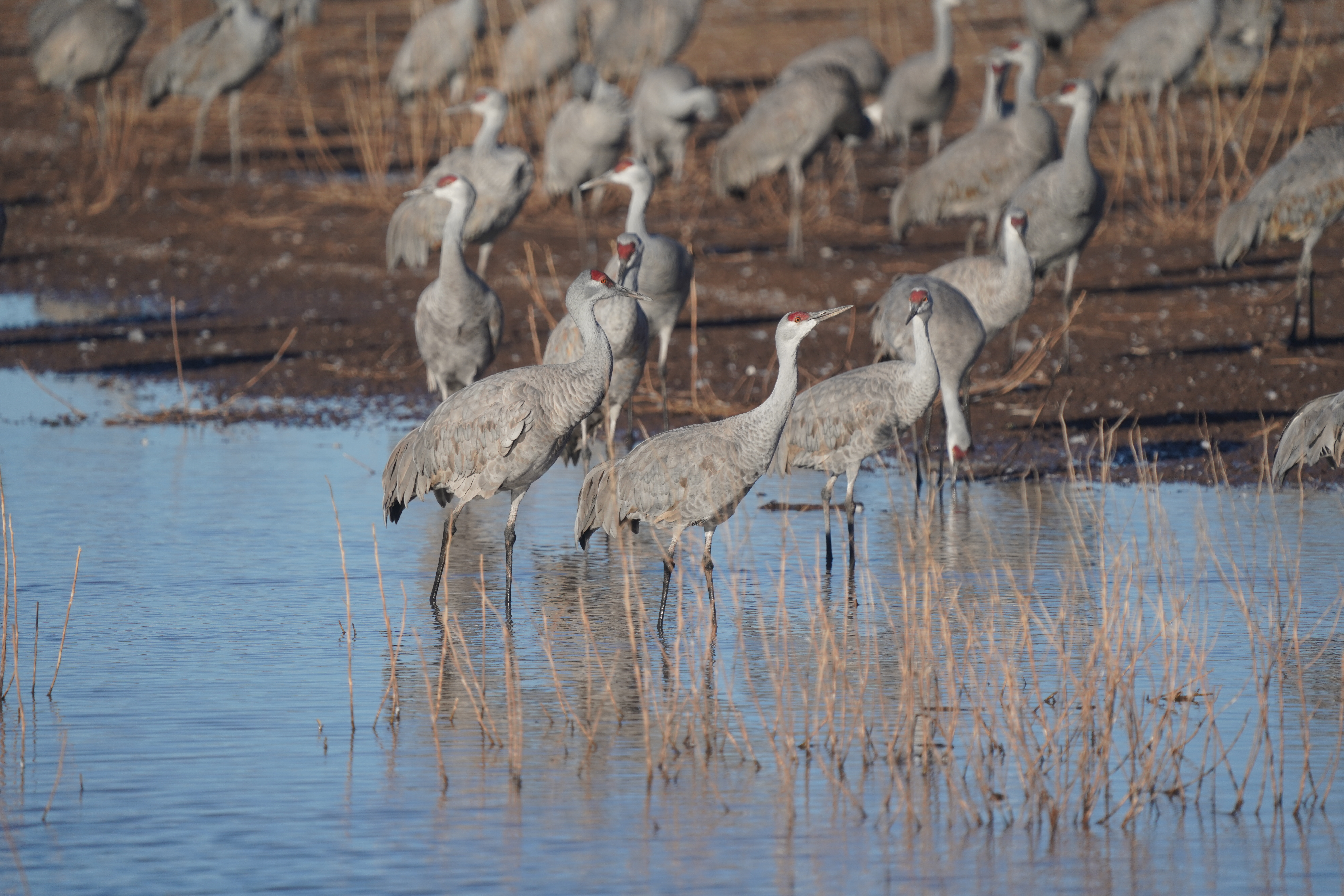
It was evening when we first walked out to the wetlands, and the sky at dusk was darkened further by birds and wings. We saw these huge-winged birds flapping their wings, spindly legs hanging down, dominating the horizon– they seemed closest to a heron in body type, for reference. It was prime time to see them, as we learned that at dusk, the birds return to the wetlands to bed down, after grazing all day. Same for the morning — they departed the wetlands to go and graze for the day.

So I went to the wetlands every morning at dawn, and at dusk with my DSLR camera and ridiculously-large lens. I had to use every bit of my zoom to get some closer-up shots of the birds, who mostly kept their distance.

The birds would fly in low, and stick their legs out in front of them as they landed– almost to catch their fall as they hit the water. They plopped into the water without grace– just folded down awkwardly, creating a splash that dragged unevenly.
It was comical. I didn’t grab a photo of their feet out, but did snap them flapping those huge wings.
Their legs seemed too long for their bodies, looking as much like flamingos as much-more-graceful herons.

Flying out at dusk or dawn, they dotted the skyline in packs– heading out with a ‘team’ of sorts to do their grazing. They formed ‘V’ shapes that were sometimes made of just a dozen birds, and at other times, contained hundreds and stretched across the sky.


The flocks would come together in the dawn and dusk into one large mass on the water– for safety, my new bird-brain scientist friend had told me. They had large red spots on their heads, and their eyes were yellow and beady. They were strange to observe– very much scrapping for space– pecking at each other and getting at one another with their beaks.

But surprisingly, the Sandhill Cranes were not the only stars of the show at Whitewater Draw. There were Yellow-Headed Blackbirds that gathered at night in swarms. Like the Avengers, they would assemble by the thousands JUST as the sun dropped below the mountains.
Being there several days, it was so clearly timed to the sun’s disappearance, that the gathering moved several minutes each day as the sunset time changed. Yellow-Headed Blackbirds, ASSEMBLE!
(Play the video below to see the birds beginning to gather).
They all came to feed in the marshes right after sunfall– presumably, on the mosquitos and other insects that woke up and got active around nightfall. They must have more success in numbers, as they chose to move as a flock– rather than spreading out.
Occasionally, they would spook and move quickly en masse– and when they did, they made a solid ‘WHOOOOSHHH’ sound. All together, thousands of winds, changing direction at the same time.
(Play the video below to hear the sound when they change direction).
And wow– WOW– when they flew overhead, I was in AWE.
It was inspiring and a little overwhelming to watch the flock fly right up into my lens– for a second, I felt like I was one of them, flying right alongside them. The swarm was so profoundly large and synchronized, it was surreal.


A few nights later, I captured the video below as another swarm reached up over my head, streaming all around me as I stood.
I have never been so enamored with birds– never cared to look up their types or varietals. But I have to say, these overhead flights– even more than the far-away flocks of Sandhills, made me feel passionate about them. Perhaps because I felt the closest to them I ever had– in both physical and emotional proximity. I felt I had a bond with them.
I honestly have never looked at birds the same way since.

There were so many beautiful varieties of birds around the preserve that I saw, it made me wonder how many I couldn’t see.

The bird watchers were there in swarms, too– crouching on the dirt and pointing their camouflage lenses at the unsuspecting ducks, who otherwise would have spooked. They were patient, and I vowed to learn some of their patience– so I slowed my gait when I was in the preserve and waited for long times with my lens poised.

Once night began to fall, the last of the Sandhills had flown away, and the Yellow-Headed Blackbirds had settled in to eat, most of the smattering of bird watchers headed to their cars. As dusk turned to dark, the quiet in the preserve was wonderful.
Elfrida– and Whitewater Preserve– was one of the most peaceful and serene experiences I’ve had traveling the country.


Posted by Sun


