
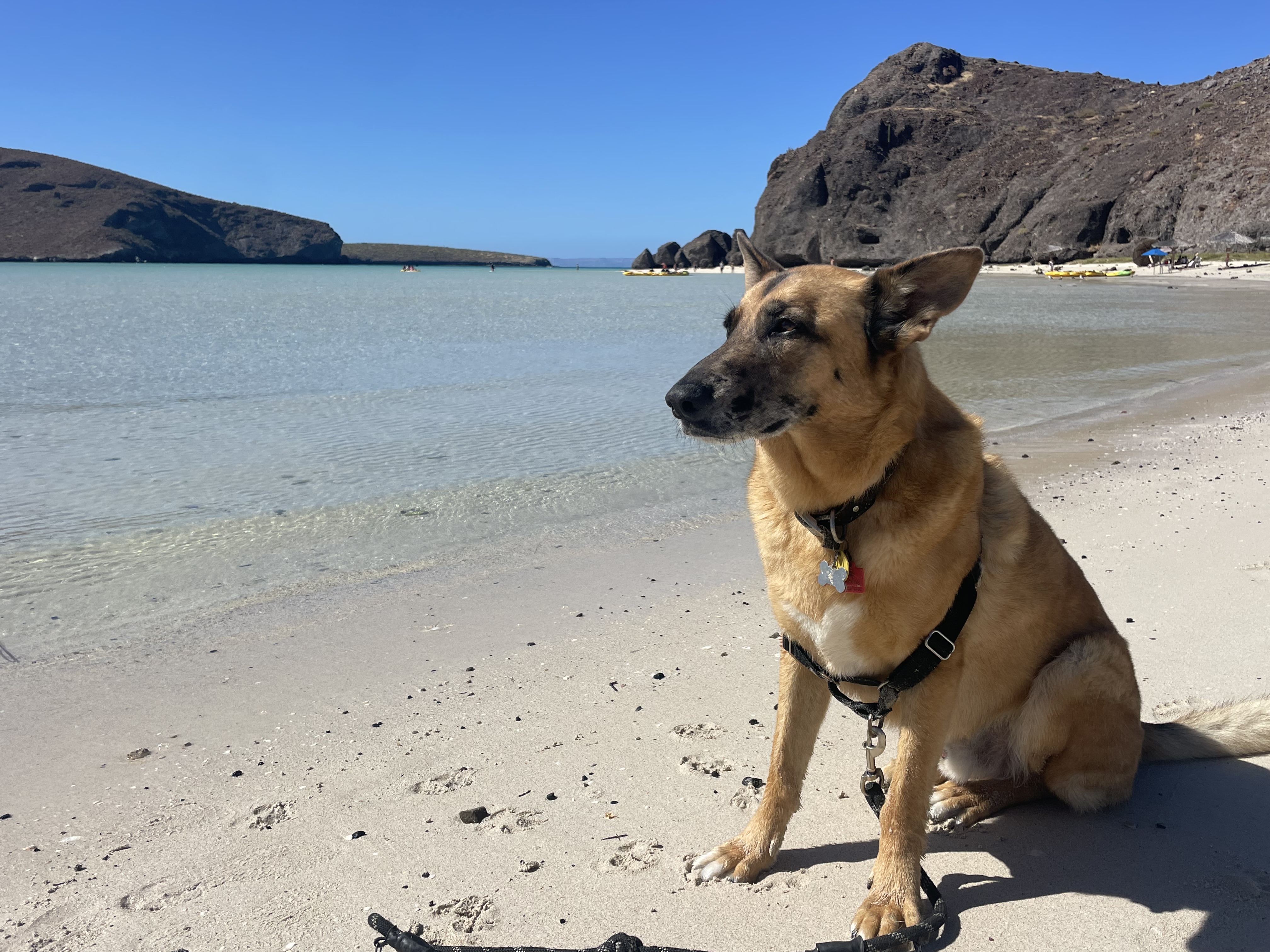


(I spent the entire month of January 2023 in Mexico, traveling down the Baja California Peninsula. This is the second in my series about the trip– check out other posts from this as well, all will include ‘Baja’ or ‘Bahia’ or ‘Playa” in the title, and will likely feature pictures of pristine beaches).
After several more hours of dusty, harrowing driving through more empty desert, an oasis.


We drove up an embankment and a large half-moon, sparkling bay gleamed up at us from below: Bahia Conception was a beauty. We could hardly wait to get down the cliffside to it.

Bahia Conception was absolutely gorgeous— and also… really, really crowded. Playa Santispac was the beach we camped on, and we quickly realized this would be a different kind of campsite.
Despite timing our arrival to try to avoid a crush of people, the January season is still the high season in Baja, and we struggled to find camp spots next to one another. Eventually, a few people gave way, and we were all able to get beachfront camping.
And when I say beachfront, I mean it. My van doors opened just a few feet from where the tide rose to.


But don’t let these serene pics fool you– this was not the kind of beachfront camping in which one wakes to the gentle lapping of the waves on the shore— nope. This was the kind of beachfront camping in which one wakes up to a gas-powered generator firing up so the rambunctious retirees downbeach could cook breakfast.
Were there peaceful moments? Absolutely. Was this a peaceful place to camp, overall? Nope.
It was just chock full of vehicles and people, and those people had… clearly come to stay awhile.


Our caravan hosts remarked about how Starlink had created a visible change in the way people utilized the camping by the bays in the last few years— formerly, they remembered— people would jostle for beach camping on the weekends but struggle to remain for long, as this remote locale contained zero cell signal. So anyone of working age– or anyone who cared about internet connectivity, could only stay a few days before moving on.
Now, enabled by Starlink, people could defy the etiquette of sharing the beaches— and simply plunk down on Playa Santispac’s sands for months at a time. Our hosts were right— looking down the row of rigs, nearly every single one had a Starlink dish attached. And some had clearly been there for months already, as they had practically set up second homes in the beach hut (‘palapas’) with grills, rugs, and surprisingly, a number of small kitchen appliances.
And due to the hardness of the sand at this particular cove, bigger rigs could park here— Class A (you’ll know these as massive tour-bus-looking-things) RVs dominated the eye. Even when taking a nice beach stroll, or out for a calm paddleboard— the metallic gleam off these massive buses was unavoidable.
This was a bit strange. Here we were in a remote and beautiful place, but with extravagant levels of brought-in-luxuries around us. One rig was so large, it had its own elevated porch that sat high above ground level— meaning its owner never had to set foot in the sand (see below).

The gross thing about the big rigs (or rather, those who drove them) was the lack of regard for the fragility of the environment around them— of course, there’s always a few bad apples that spoil the bunch. So that wasn’t unexpected per se, but in the world of RVs, this meant we saw plenty of evidence of people dumping out their grey water tank (sink disposal) DIRECTLY into the sand. The photo below on the left shows them tossing fresh sand on top to try to disperse the dump site.
And– hate to say, very few people cleaned up after their dogs, so we had to watch our step.


Worse, our caravan hosts said they had seen people dumping their ‘black’ tank (actual human waste) into the bay a few times. Not cool at ALL, but even tried-and-true people-on-wheels etiquette seemed to have gone out the window at Santispac.
It was impossible to be at this beach and not think about the fish and wildlife living in and around the bay, who no-doubt were dealing with the runoff and direct dumping of the humans on-shore. This was enough to put a damper on this beach nearly entirely for me— and for a few others in my group too. There was just too much disregard for the area, and with the Mexican proprietors of the campsites looking to please tourists– they didn’t have much vested interest in reigning in the worst behavior.
But that bay? It was exceptionally pretty.
Which meant more paddle boarding in the beautiful shallows! (Which, if facing out to the bay, looked gorgeous and serene– and if facing toward the beach, looked like an RV-storage-parking-lot).


Our caravan hosts arranged a boat tour in and around to some of the other islands and inlets in the bay, and found an isolated beach with not one person on it (but campfire evidence someone had been there). This was much, much more peaceful than our experience back at camp, so I did savor the quiet.
The clams at these shallow beaches were plentiful enough for people to just ruffle around in the sand until they came up with one– so folks collected a few to bring home and prepare for dinner. The blowfish skeletons were also a reminder to be careful when wading– not just for rays, but for spiny things, too.


Another smaller, more peaceful beach housed a lovely coffee shop that was entirely focused on serving its tourist clientele from north of the border. Nomadico was a truly quaint beach-shack-turned-high-end coffee shop, from which I ordered a Golden Latte (yep, turmeric)– and they even had plant-based milks. This was one of the constant contradictions in Baja– feeling relief at having some delicious, comforting food items, but also knowing the locals were beholden to serving our palate.


Back at our camp, there was a burgeoning market for goods at Playa Santispac– sold out of the trunks of cars by the locals, was everything you could imagine wanting. From produce, to shrimp, to clams, to empanadas, to banana bread, to ENTIRE PIZZAS, these foods were sold for extremely reasonable prices. (The banana bread was literally the best I’d ever eaten, no lie, I got and shared a loaf like 3 times).


Other beach coves in the area were much more serene— if lucky enough to get a spot on them. (Playa Coco was a favorite of mine, which I’ll cover in my return trip). Several days into camping, we got a hot tip that another secluded beach with just a few camp spots had a pop-up bar called “Hidden Bar” that was made of clapboard and would open only at happy hour— a few of the intrepid among us set out to find it.


It wasn’t THAT hidden, but the alcohol in their drinks? Kinda WAS hidden. And this brings me to THE night of puking all over my van- so if your stomach gets queasy about that kind of thing, go ahead and skip forward a couple of paragraphs.
I’m not kidding when I say that “Hidden Bar” produced the most delicious margarita I had ever enjoyed. It was mostly made with fresh limes, and frankly, must have just hit the perfect ratios of everything else— as the flavor was simple but exquisite. At only 100 pesos (this is less than $5), why not have another before we left? So the logic goes.
It was halfway through the second margarita where a truly overwhelming buzz washed over me. Still a warm, welcome buzz, which gave me the somewhat demented idea to continue drinking once we got back to Playa Santsipac.
Bahia Conception’s camp was a large enough area to have its own restaurant— opening daily around happy hour, it even hosted karaoke, live music, and bingo. Seeing a sign for karaoke night when we returned, I (unwisely) skipped dinner, and tequila-buzz-cavorted into the bar to sing. About a half hour later, most of my caravan (*who wisely, ATE DINNER FIRST) piled into the bar behind me — suddenly, a group outing had begun.


Reader: I sang many songs that night. I drank many more beers that night. Somewhere between “La Vida Loca” and “Everybody!” (Backstreet Boys), I felt the room spin a bit. I’m going to take a pause here to say that being alone in the van, and being concerned about safety in general, I rarely drank at this point.
Why was this different? Well, I knew I was surrounded by people who would make sure I was safe, but also, I think it just hit me harder with the lack of calories I’d been consuming. Being a vegetarian in Baja, I was subsisting on little sustenance, and exerting myself in the sun quite a bit.


Anyway, you know the rest. I turned in for the evening and immediately threw up all over my small, trusty, 19-foot Starship. I would not even realize I did this until morning.
When I woke up in the AM, the first thing I smelled was vinegar. Or what I thought was vinegar. I’ll spare you the details, but I had to take my van completely apart over the next several hours to make sure I got the remnants of the night before out of every crevice. And just when I thought I had defeated the mess– found the last nook and cranny where vomit could hide– I’d find something else.
I had to take an unplanned trip to Mulege, the nearby town— to use the laundromat to get through two loads of sheets and the covers of my upholstered cushions. I soaked and scrubbed pilllows, I used 400 Clorox Wipes. I finally found a shower in town that was hot (hell yes!), and only once the clock reached 4 PM, finally felt like I was no longer hungover. And like I no longer wreaked of my own stomach fluids.
Mulege was a delightful town, despite my relative misery when I was there. Quainter– no-doubt on behalf of being near some of the best beaches in Baja, it had everything a beach-loving person could need. Blankets, sunscreen, a laundromat, and importantly– a fresh water store. The purified water stores in Mexico are purifying water in sanitized conditions for cheap-as-chips prices, and Mulege is about halfway down the peninsula– good for a refill.


Mulege’s biggest building was a mission, Misión Santa Rosalía de Mulegé– to be specific. Built in 1766 by the Jesuits, this mission was on-again-off-again with the various sects looking to convert the people– from Franciscans to Dominicans, all kept the mission in good stead. It had been “extensively restored” but was nonetheless transportive back in time.


Mulege was located on a thriving riverbank– one that looked practically tropical, a true oasis with all the palms. Buildings dotted the surrounds, making this wonderful hamlet look downright nestled-in.


Was it possible to “blend” in Mulege? Absolutely not. Shopping in a bodega with enough broken Spanish and enough of a tan might get you by, but driving these luxe vehicles? Yeah, we weren’t exactly in incognito mode as we drove in and around town: walking the streets was the only way to sink into a rhythm that wasn’t a tourist beat. (PS, the tequila brand below was 20 pesos– that’s just over a BUCK).


I laid off the sauce for a few days after the Great Ralphing of 2024, nursing a few nonalcoholic beers I brought with me and looking sheepish every time one of my lovely caravan-mates mentioned the incident. (It hadn’t taken long for word to get around that I practically destroyed my van with vomit). It only took about two days or so for me to find the moment as funny as THEY did.
When it was time to break the alcohol fast, I indulged in an anniversary ‘vintage’ edition “40” of Miller High Life. Because OF COURSE I DID.


Another stopping point was Mulege Brewing Company, a Mexican-run, gringo-trap of a spot that was full of great beers and high-end bar foods Americans and Canadians would love– like fancy nachos. I filled my belly here, just happy to see vegetarian items.


It was time to move on from Bahia Conception, and from each other too— this is where the caravan would close, and people would go their separate ways on their individual adventures. I had a friend flying into La Paz, a 7-hour drive further down the peninsula, and would need to leave early. Which meant it was time to say ‘goodbye’– though, I learned that road travelers never say ‘goodbye’– they instead offer “see you down the road”. A phrase I truly loved.

It was surprisingly hard to say ‘see you down the road’ to the group of people I’d traveled with over those 3 weeks. I literally cried while bidding farewell to people I’d barely just begun to learn the names of (I’m terrible with names), as I felt the drag of being on my own again.

When I search myself as to why I was so broken up, I think it was just the crush of the accumulated loneliness I’d been experiencing over the previous months. While Mac was always a great companion, I hadn’t had real companionship in awhile— and always knowing someone would be around to chat, to share a meal with, to share a beer with, to share a small van project with— that was a warm and happy (frankly, familial) feeling I hadn’t felt in awhile.
On my last night, someone was playing music softly, and the lapping waves were peaceful. It was a good moment– a quiet moment– and I share that with you below.
Thank goodness, saving me from the crushing impending loneliness– my friend was already in-flight to meet me, laid-over in Mexico City. As I set off the next morning, I knew I’d be seeing her late that night— in La Paz, the capital, and largest city in Baja.
Head to the next post to hear all about La Paz, and the whale sharks we swam with!

Posted by Sun


