


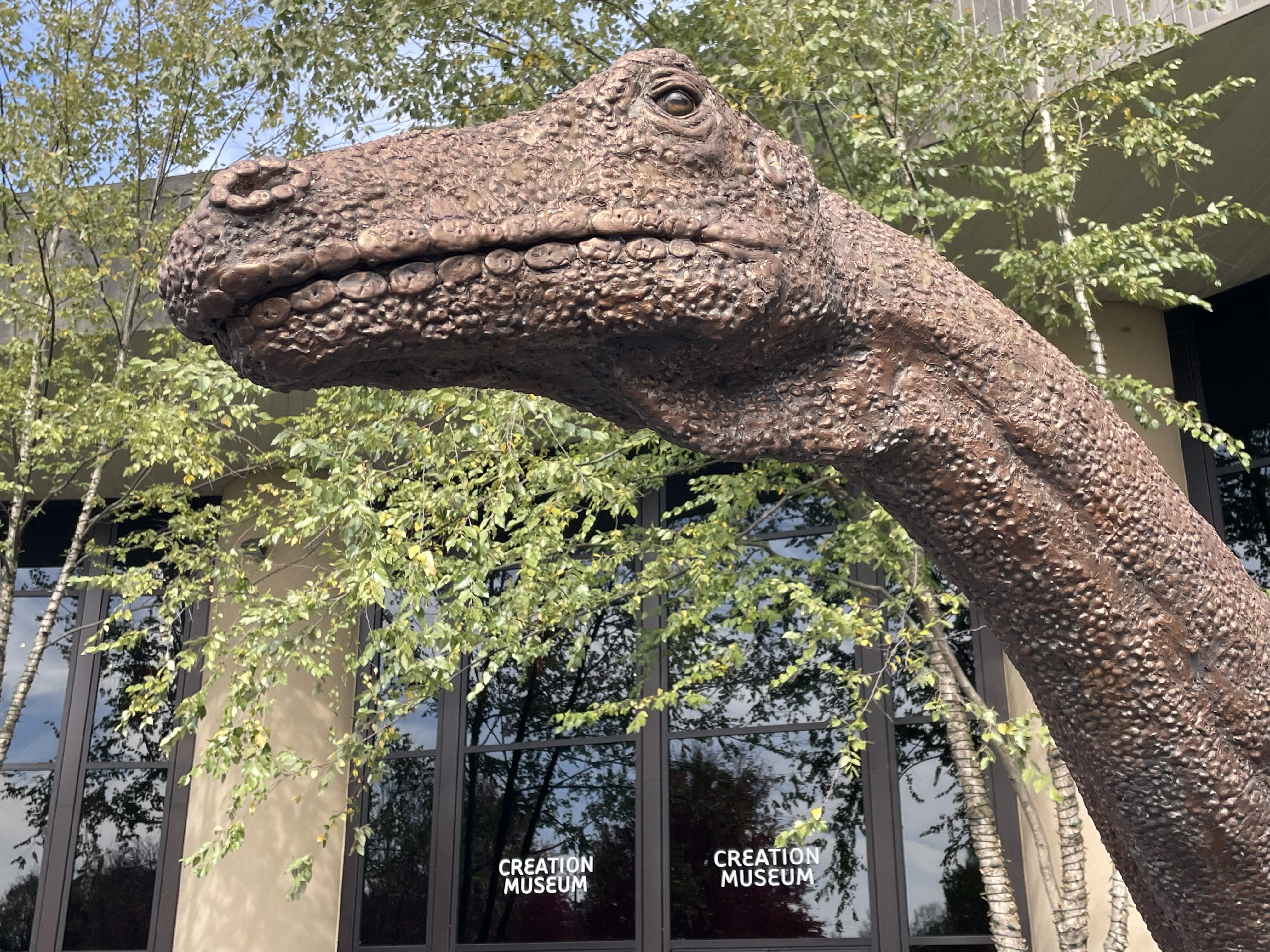
Travel is about having experiences you normally wouldn’t– and the way I see it, sometimes that involves challenging yourself to enter places that you don’t even really WANT to go. Places where people have totally different beliefs, different cultures, and different customs– and most importantly, different ways of presenting the world that we all occupy.
It might not always be comfortable– in fact, the discomfort I felt at the The Creation Museum, a Young-Earther Biblical “museum” in Kentucky, took days to shake off. In retrospect, I’m glad that we went– ultimately, I entered trying to withhold judgment (there’s no point in going somewhere just to beclown it– that’s just rude), but was quickly met with a scene that was so inexplicable, my jaw dropped open.
A diorama of dinosaurs and humans, existing side-by-side, displayed just inside the entryway.


If you’re not familiar with Young Earth theory, it’s one that most Christians and Christian scholars do not agree with. Its central premise is that the book of Genesis is to be interpreted quite literally, instead of as figurative or parable– these folks believe the writings in the Bible incontrovertibly happened as-written, and thus, the planet Earth is only about 4,800-10,000 years old. Total.
This puts the “museum” in an interesting place– it was the ONLY museum I have ever been to that operated from a defensive crouch– trying to fit the course of geological and ecological and human history into an incredibly-condensed timeframe meant the plaques and displays had a difficult job to do: it had to try to CAST DOUBT on the agreed-upon tenants of the sciences that history’s scholars had assembled over generations of research and work.
Which is no small feat.
Their primary mode for this challenge centered on the dinosaurs– and strained to explain a supposed co-existence of humans and dinosaurs by deigning that dinosaurs were actually called “dragons” in the past. This change-in-terminology allowed them to posit that due to folklore monster tales like St. George and the Dragon, Beowulf, and Marco Polo, actually referred to DRAGONS which were purportedly real-life DINOSAURS interacting with humans, instead.
This, of course, strains credulity for a huge number of reasons– but… if ALL creatures in the world needed to be created on the 6th day of Genesis in a literal reading of the passages in the book, then this commingling would have to be true. And thus, the Creation Museum portends that must be the case.


The other major premise of the Biblical Book of Genesis on which every exhibit in the “museum” rests was that of Noah and the Great Flood– Young Earth theory requires that the Great Flood be depicted accurately, despite it being nearly-impossible to map that theory to the geological and ecological formation of the planet in-fact.
The exhibits worked to cast doubt on the formation of huge elements like the Grand Canyon using a clunky analogy about rainwater in a muddy back yard, and by employing un-credentialed people with beards and British accents to narrate videos that contained statements loaded with conjecture.
One key thing a keen reader would note about The Creation Museum– the text was written in a style that was incredibly vague. This was a huge departure from what one is used to seeing in museums– in which facts are presented as just that– facts. With dates, times, and with evidence such as carbon dating, geological analysis, or other credible placement in time by comparison to other artifacts and finds.
Instead, The Creation Museum relies on presumption or belief– which one gathers immediately when paying close attention to the language they used: “probably,” “must have,” “can be,” “likely,” “probable,” and so on– the signs below demonstrate this style of writing, that always felt thoroughly wishy-washy, and did not inspire confidence.


In the chart above on the left, The Creation Museum desperately attempts to explain the migration of species across the planet– a feat which took millions of years to achieve in actuality– and tries to condense the timeframe to just 100 years. Their solution for this? Rafting. It states that once Noah released the animals, they must have utilized various floating debris from the Great Flood as makeshift rafts to float across the oceans and populate the world in a matter of weeks.
This theory clearly makes no sense, and is not supported by any kind of backing, nor does it stand up to the slightest of scrutinies (e.g., how did the animals float for weeks without food or water, how did they not get swallowed by high ocean swells, etc.)– but of course, the Creation Museum isn’t actually a museum. It’s a belief propagated by a razor-thin set of theorem.
Perhaps the most mind-bending part of the “museum” experience was observing the other patrons– who were acolytes of the theories, nodding in response to reading each exhibit. It was a little sideways, but impressive in a way.
If I could say something kind about the Creation Museum, it was that it was AMBITIOUS– trying to tell the scope of human history in a single space, with a near-Disneyland level of production. There was a ton of money in this museum, and it was slickly-produced as any major theme park. The exhibits were beautifully-made, despite their flimsy and easily-refutable content.
Exiting the museum, the fall air was crisp and clean, and I found myself breathing more deeply. I realized I had been holding in so much tension inside the museum that my chest was tight. Like any exposure to sheer propaganda, the mind and body can feel like they are fighting another, and it was a relief to be away from the clash of ideology and science.
In the parking lot, I saw the most beautiful gingko trees– perfectly yellowed by the autumn wind and chill. If one was looking for evidence of godliness, in my book– perhaps this was the best of all.


Posted by Sun


