


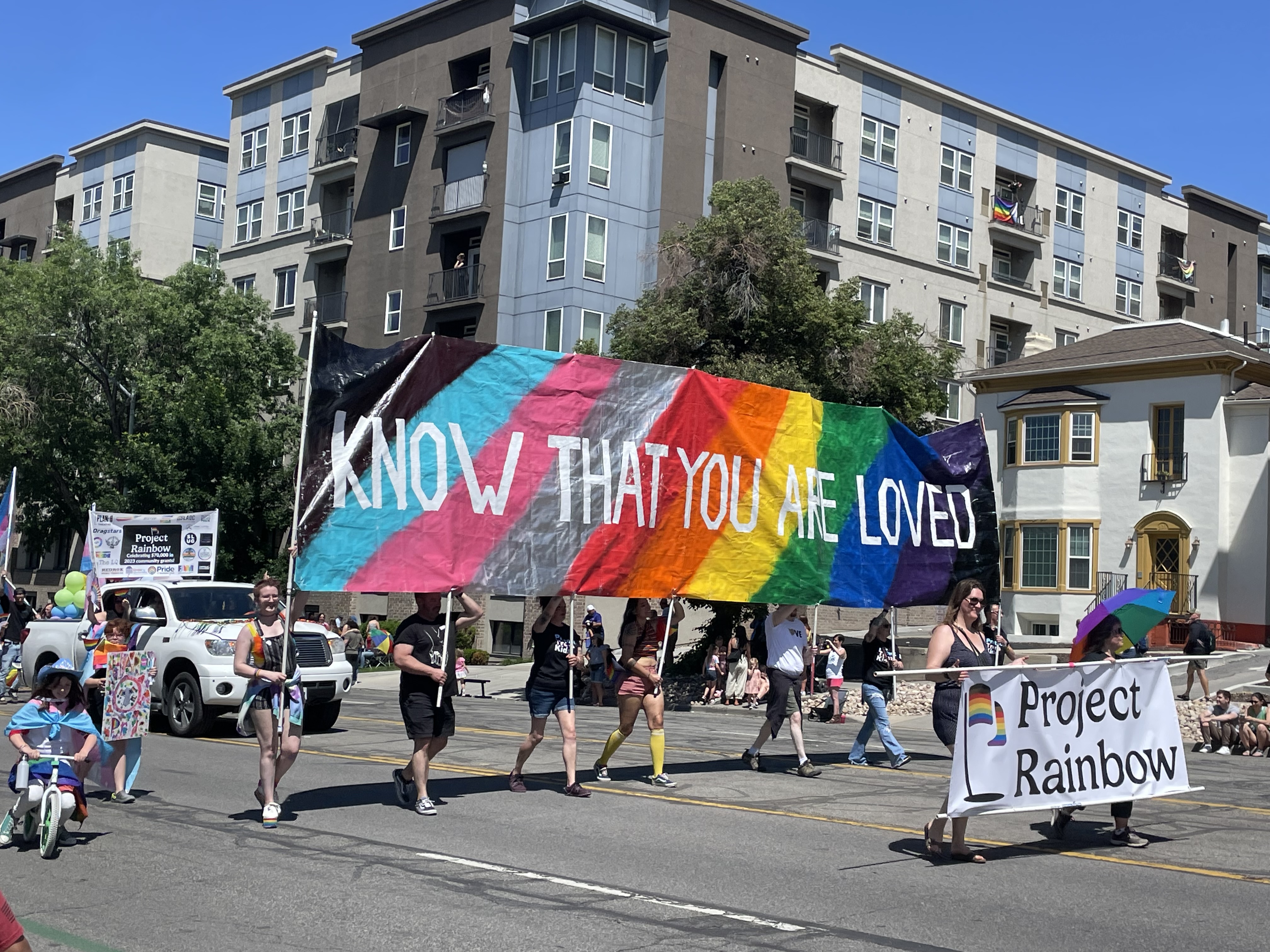
I’d only been to the Pride festivals in the past in major, progressive-leaning cities. Which, in retrospect, seemed like an oversight– and one I could easily remedy being in the van.
Driving through Idaho in June, I set out to attend Salt Lake City’s Pride event. And it was wonderful– revitalizing my belief in the absolute importance of pride events for helping members of the queer community connect, both among themselves AND among the general public.
Mac was 100% up for supporting his mommy in this adventure– and decided to sport a really cute rainbow bandana to show his enthusiasm for the events. Being new to Pride in Salt Lake, I picked up a local newspaper– a ‘weekly’ arts and culture paper– to see what events were happening, and where.
Reading it, was sobered in my excitement somewhat– all of the articles (and even some of the ads) for events featured a heightened focus on security for 2023.
In fact, the Pride committee in Salt Lake spent over $300,000 just on security for their events this year.


While it was a stark reminder that queer people cannot take safety for granted, it was not new– even the relative “safety” of pride hosted in more progressive cities could feel a bit tenuous. There is no perfect place for LGBTQ people to feel completely at-ease, especially when congregating in America– and it was not lost on me that we were in a state with a very permissive gun culture.
That said, Salt Lake City had always felt oh-so-kind when I passed through it before– that’s the adjective I most associate with the city: “kind.” The people are warm, and as a traveler, it always felt like a respite to be surrounded with friendly faces, making eye contact and even saying ‘hello.’
I decided to believe in THAT kindness winning out, and set out for the Utah Pride Festival, a multi-day event that surprisingly, took place RIGHT on the grounds of City Hall. They even raised the Pride Flag right alongside the American flag at City Hall center, which was surprising to see.


This wasn’t to say that all was perfect politically for LGBTQ people in Utah– the governor, conservative Spencer Cox, removed the word “gay” and the acronym “LGBTQ” from his 2023 dedicating remarks around the month’s festivities, instead using lukewarm terms like ‘belonging’ or ‘inclusion’ to describe the meaning of the summer season’s Pride. If that seems ludicrous — I suppose it is, but strangely, to his credit, the governor was also the ONLY Republican governor to even issue any kind of Pride-month statement when he began them in 2021.
A mixed bag, and a reminder: there are rarely 100% heroes and 100% villains.


Just like the Pride Festival itself– a strange combination of a corporate recruiting fair and a party, there were banks of tents all over the square, several rows deep. Some of those rows belonged to mega-companies like Chevron, Deloitte, and Bank of America, who were using the festival as an opportunity to… offer applications to the revelers? OK, guys.
Seemed like an odd use of their time– but when I’m confused, I always ask a local. By approaching a few folks to chat, they shared that large companies had traditionally avoided Utah Pride in the past due to political concerns, and only embraced sponsoring and attending the festival events within the last few years. The people I spoke to were thrilled the big brands were present, providing validation.
This melted some of my left-coast cynicism about seeing these companies posted up. More money for the Pride event would help sustain it– in truth, nearly all funding for Pride events around the country come from sponsorships — not ticket sales. I checked my biases and continued on.


There was a stage with local and national musical guests, and merchandise– and some of the merchandise and elements had a decidedly local flare– for instance, the “sober lounge” for younger folks and potential revelers who belong to the Church of Jesus Christ of Latter-Day Saints (LDS Church / Mormons), and a cute series of shirts featuring a cartoon Jesus declaring “I’m Cool with It.”
The event had protestors– huge amounts of them– but the city smartly permitted that protest zone on the back side of the Pride events– and they were largely drowned-out. In previous years, other attendees told me, the protest zone was right near the entrance, which created awful verbal clashes and likely restricted attendance. When I asked WHO was likely behind the protests, all the revelers were unequivocal– it wasn’t the Mormons, it was the Baptists.


(Did you peep that queer contingent of park rangers above? Amazing to see them out and marching!)
It was a hot day in Salt Lake, which meant Mac was flagging a bit in the heat– enter: random queers watching the parade. They set up a little tent to keep Mac in the shade, and as seen above– he was the only one using it for most of the time. It was an adorable act of kindness, and showed how lovely it can be to interact with strangers on the road. They really took care of Mac that day!
Perhaps my favorite part of pride parades are the proud parents– that either parent a queer child with total acceptance, or are just offering the support of a caring parental-like figure for a moment for those who can be starved of such love. The man below, walking the parade route with a sign that said “Come get a hug from a father that accepts you” was nearly knocked over by an enthusiastic person who hurtled over to him from the sidewalk, running into his arms (with force) for a whole-body hug.
The very basic need to share affection with a loving parental figure seemed to have seized that person quite suddenly, and they literally ran toward it. THAT is what Pride is about.


In talking with the other revelers about being queer in Utah (I had loads of questions), they revealed that close to the cities, life was fairly safe and welcoming. Each had stories about employers who unexpectedly stepped up– like one woman who mentioned her trans partner was consistently protected from harassment by management during cashier shifts at Walmart. And another who ratcheted her excitement to 11 when she saw her construction union had assembled queer members to walk in the parade (she was injured but otherwise would have joined them).
The parade was long– about 3-4 hours of marchers and sponsors. To see the streets lined with thousands of spectators and supporters was a boon for a city in a very red state– but I also noted the crowds were much smaller than for left-leaning areas. Notably, I walked up to the parade just about 10 minutes before start time and easily found a spot right on the curb– something that would be unheard of in better-attended parades. But this chiller vibe of a parade was also less hectic, and friendlier to solo newcomers like me.
It was a lovely Pride weekend, but rather than just engaging with the progressive elements of the city, I also decided to add balance, and see some of the traditions that made the city so famous– and went to visit several historical sites devoted to Mormon religious history.
Balancing different perspectives is really what travel is all about, so off I went to see Temple Square.


I had signed up for a free tour, and was greeted by two international guides– one was from Mexico, and the other, Argentina. They could not have been more than 19 years old, and I wondered if this guide gig was a ‘mission’ available to women of the church (it was). Demurely dressed, the young women proceeded to tell us about the “pioneer tradition” that created the site we saw in front of us.
Wait, you might be thinking– ‘pioneer tradition’? If you were expecting a story about golden tablets buried in the earth– the Joseph Smith story of how he originated the religion– you wouldn’t get it here.


We started our tour at this state– one of the many, many, MANY, MANY statues devoted to the arduous crossing of the country that settlers made as the LDS Church evaded prosecution (note: I said ‘prosecution,’ not ‘persecution’) from more Eastern municipalities and states.
The guides used the word ‘persecution’ not once, but several times, as the story of wanting ‘religious freedom’ unfolded. In fact, they were facing prosecution, but… I suppose it’s a matter of vowels.
It was clear that the guides were using language that would be extremely palatable to tourists– sticking to the pioneering ‘spirit’ of survival and grit in the face of long odds as they established a community in the middle of the desert. The guides often said “And just like everyone….” or asked the audience softball questions that would have them linking their own lives to this pioneering struggle. The ‘Mormons, they’re just like us!’ push was evident– and also understandable, as most likely view the religion as extreme.
Since the main temple was under construction, and inaccessible to the public, we visited two smaller sanctuaries– both of which held historical significance, as they were built early, by an architect hired by Joseph Smith himself. One, a large performance space, hosted music programs including organ concerts and the very famous Tabernacle Choir.


The tour guides even demonstrated the engineering genius behind the building by showing us the power of its acoustics– dropping literal pins near the lectern, we could hear them bounce perfectly at a great distance. The details were painstakingly created– these columns pictured above are not marble, but wood painted to appear as marble.
To their credit, they did offer thanks to Native tribes for saving the original pioneers from starvation, and utilized symbolism throughout the spaces devoted to the flora and fauna the early settlers depended on to keep them them from ‘pulling a Roanoke.’ These pretty, light images of flowers, seeds, and stems provided a happy contrast with the sometimes stark and frankly, bloody imagery of say, Catholocism.
The guides were gracious, and savvy, side-stepping just about every criticism the LDS Church might receive with grace. They deftly combatted common myths without seeming contentious, including condemning the radical ‘factions’ of the church that still practice plural marriage, and so on.
I left that tour feeling the narrative around pioneer-ism was a little too neat and TOO palatable– not containing enough facts about the religion itself to begin to get one’s hands around it. Nor did this narrative deign to discuss WHY it might be so misunderstood. ‘Pioneers’ is a lovely half-truth, a near-platitude that just barely scratched the surface.
I left that tour pretty unsatisfied, with more questions than answers.
Deseret Books is a massive operation, think ‘Barnes and Noble for Mormons’– with hundreds of locations, they are all around Utah, but I wanted to go to the main branch across from Temple Square to check it out in its fullest form. I wasn’t there to pass judgment or to ridicule, but to observe.
I even wanted to buy a book. No, I am not Mormon nor am I religious– but I’d heard recently about a controversial book on Emma Smith, Joseph Smith’s wife (he founded the religion). Apparently, this book had upset many religious leaders– written by Jennifer Reeder, this text examined Emma’s paperwork, writings, and that of her associates to form some new opinions on her. I was curious to see what was so controversial– and also, learn why that was the case direct from staff at the bookstore.
Heading into the store, I had to pass an art section that was really trippy– huge religious paintings of Jesus (or, ‘hot Jesus’ as seen below) were common, as were paintings that I’m sure were meant to insist on the importance of Black faith in the LDS scripture, but instead, read as pandering at-best– as the Black folks in the paintings were often in the process of being converted (by white hands, no less).
Yikes.


I inquired with the first staff member I saw about the book: “I hear there’s a new book on Emma Smith. Do you have it?”– and the employee paused to think.
“Well, we only have two books on Emma Smith…” he began. As I looked around this bookstore that occupied half a city block, I almost couldn’t believe my ears. Emma Smith was arguably one of the most important woman ever to exist within the very religion these shelves were devoted to and yet– only 2 people had ever published about her?
He went on to clarify that actually, there was only one FULL book devoted to Emma Smith, and that was the one I was asking about– but he began to caution me that it took some “dangerous liberties.” I had to ask why– and he said he felt the author ‘inserted a lot of her personal opinion’ into the text. In dissuading me so actively, he only solidified my decision to purchase it.
To be a woman with opinions written on paper is not such a blasphemous thing, in my book.
Reader, I actually read this book about Emma Smith– titled “First,” to see what the fuss was about. In it, her very strong opinions against plural marriage were made plain, as were her private urgings to other women of the church to avoid it at all costs. The author also stakes the claim that Emma was the first priestess-of-sorts of the church– elevating her duties beyond that of ‘wife’ to co-leader of the early church, who even had some ministerial and theological duties. Something I’m SURE the church was not happy about.
(Also, there is zero reason for you to read this book. If you ever want book recommendations from me, I have many other titles to offer).
Anyway… did someone mention PIONEERS? Because after Temple Square, I set off for the Pioneer Museum. If you were hoping, as I did, that the Pioneer Museum would be more than a collection of old knickknacks, then you would be sorely disappointed.


There was a statue of a pious, pioneer-like lady outside, set within a rose garden. Inside, there were just slews and slews of objects that early Mormon families carried on their journeys from the East to Salt Lake. I assume these were important families to the church as well– as portraits around the museum were likely of families with significance to the church.
When I say there was racks and racks and cases and cases of stuff, I meant it: 3 full floors of it.
What kind of stuff was there?


Mostly household or personal possessions, like reading glasses, hair scissors, hats, pocket watches, quilting pieces, darning kits, bits of currency, and of course, scripture books. This was interesting for about 10-15 minutes, then lost most of its luster for me, likely due to being the non-believer that I was.
There was a lot of “this razor likely belonged to Joseph Smith” and “these eyeglasses were worn by Brigham Young” and “this book was written about Joseph Smith by this mother” and the like. I am sure this was great for ‘stans’ of these holy men, given glory here through their objects.


My absolute favorite item in the museum was the quilt pictured above– note the placard, which reads “Pieces were from the dresses of Brigham Young’s wives”– which, on the face might be a delightful way for the family to feel bonded, but read quite literally, means pieces of his wife’s things were sewn together into a quilt for him– which can also seem a bit like a metaphor that’s a little too real.
Also notably, the wives here went unnamed by their proper names– unlike many of the gentlemen heads of household throughout the museum.


Salt Lake City loves its sweets– as the LDS Church generally advises against drinking, you could swing a dead cat and hit an ice cream parlor, a cupcake bakery, or a candy store all around the city, regardless of neighborhood. My favorite sweet in town is from Nielsen’s Frozen Custard, which has an old-school vibe, and features very good frozen custard.
Think I’m kidding on the sweets thing? Below are just a few of the sugary storefronts that beckon.


I only stayed in Salt Lake for the weekend, but there was one more prominent Mormon site that I wanted to see– the “This is the Place Monument.” It was, story goes, the place where Joseph Smith said (and I’m going to point out how literal this is) ‘This is the Place’ — designating the previously-empty spot in the desert in which the LDS Church would begin building its colony.
It mostly paid homage to… you might be able to guess… that’s RIGHT! The Pioneers.


There was a small museum inside, which I got the gist of pretty quickly– then headed out to the main event: a giant obelisk-like stone object with statuary marking this important moment in LDS history.
An ex-Mormon friend of mine once told me that Mormon artworks were incredibly literal– and having seen these, I have to wholeheartedly agree. While artistic expression could have taken them in any direction on earth, they chose to quite accurately represent the actual event: men staring out into space going ‘yeah, I’m tired of walking, so this looks good.’
See how they point? ‘There. Right over THERE.’


Perhaps the oddest part of the sculpture garden was the most recent section– devoted to three early Black converts to the Mormon faith. I understand the LDS Church struggles with diversity, and likely erected this quite recently to bring attention to early followers of-color– but this seemed a bit problematic, given two of the three Black folks heralded here for their unyielding Mormon faith were actually slaves to the families who set out on the original wagon trains.
“Green Flake” and “Hark Wales and Oscar Smith” (assuming these were assumed names or nicknames) were enslaved people who were — according to the astonishing plaques– “GIFTED (emphasis mine) to the newly-married Sytha Crosby and her husband” and “GIVEN (emphasis mine) to James and Agnes Flake.” Which to me, read like they had absolutely no choice other than to pilot wagons Westward– and while I do not question anyone’s faith choice, we do have to wonder if their conversion was a truly free-will choice of theirs, given their bondage.
Also, the plaques did liken the plight of slavery to the persecution of the Mormon faith– reading “As enslaved men, Hark and Oscar were keenly aware of what it felt like to desire freedom, even if the freedom the Saints (Latter-Day Saints) sought was that of religious worship.” This clumsy and ill-fitting equivocation was enraging, NOT because Mormons did not suffer– but because the bondage, physical torture, and brutality slaves endured for generations ought not be compared to ANYTHING else.
It was very telling that the narrative of suffering was so embedded into the LDS faith story that they did not struggle with this comparison– rather, they had no issue commemorating that equivocation in actual stone. The way stories are told is often more fascinating than the stories themselves– and in this case, it was very clear that ‘pioneers seeking freedom from persecution’ was the one Mormon culture found the most appealing, and was driving home for all its visitors — ad nauseam.
The LDS Church also did not offer the highest rites of its religion to Black believers until 1978– and in its past, even preached that Black folks would be made White after death. While the church apologized for many of its offenses on race in 2013, a rarity for the church leadership– the sunny depiction of early Black followers at this statuary garden seemed like a badly-fitting band-aid. Check out the following link for more information about the LDS Church and race.
https://en.wikipedia.org/wiki/Black_people_and_Mormonism
The heteronormative nuclear family– past and present– were big themes of LDS art– and if you’re thinking, “wow, that is incredibly literal imagery, there is not a metaphor in sight”– well then, you’d be right.


As I was leaving the site, schoolchildren were being assembled, having spilled out of their yellow buses to go to “Pioneer Village” on the site — a Disney-like village set up to resemble the pioneer time. The boys were dressed in garb different than the girls, all of whom wore very gendered attire.
This made me think back on the Pride celebration in Salt Lake– which was just days before– and feel a whiplash of sorts. It was a reminder that both of these realities contain truths, and while starkly different, that they could run in-parallel within the very same zip code was a truly American experience.
Salt Lake City was a mix of past and present, old and new, traditional and progressive– and everyone was still pretty darn nice all the time. No wonder THIS was THE place!

Posted by Sun


