

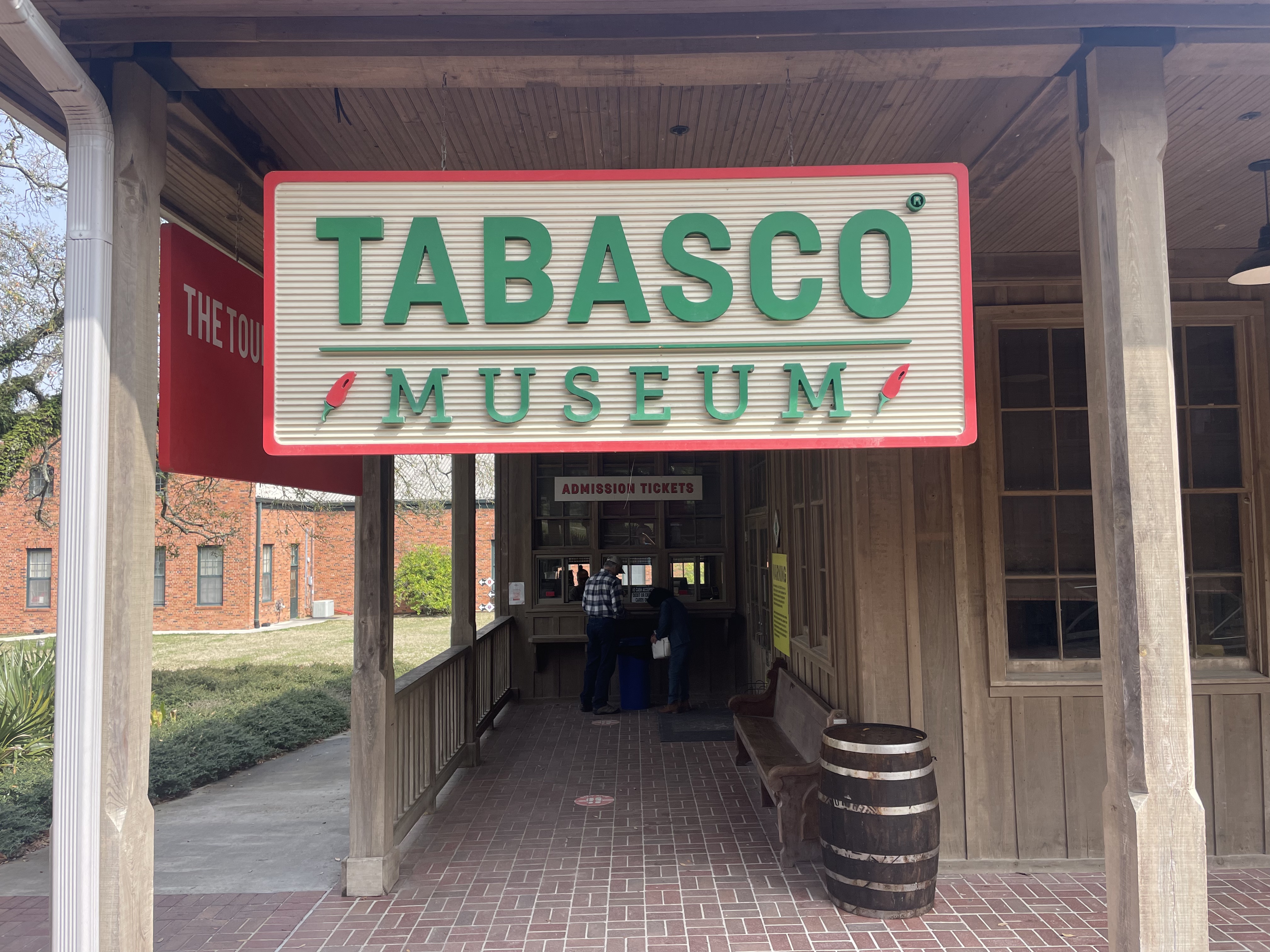
The original Louisiana island— Avery Island— that produces Tabasco sauce has been churning out the same product — made the exact same way– since the 1800s.


How about that?! Not too many American businesses founded during that time are still active, let alone— are still producing the exact same recipe that made them an institution. So, I was inclined to check it out.
This intrigue made me to drive to the very bottom of the tip of Louisiana— which, if you’ve looked at a map lately (or heard about the devastation of Hurricane Katrina)— you know is mostly low-level marshland, and not much else.
Before you get too exited, I’m going to cut to the chase: this destination wasn’t actually worth the roundabout trip to get there. Unless you are a serious lover of Tabasco brand hot sauce, it’s kinda a dud. NOT because it couldn’t be cool, but because they kinda insisted on making it really boring.
I wish I was kidding. Look, the SPAM Museum in Minnesota was pretty epic— so it’s possible to make a cool and entertaining experience out of a consumer product. But alas, Tabasco did not do that.
On arrival, the first thing I noticed when climbing out of the air-conditioned van was the oppressive heat and humidity. Mind you, it was March. (I literally cannot understand how people survive in southern Louisiana in August).


I spied a bunch of historic buildings, including the original factory (above) where they still make and bottle sauce today. Neat, but on a weekend, it was not running.
I paid for a ticket and was given a map of a few buildings around this historic part of the original factory area— and was instructed to download an app to listen to an audio tour. This would have been much more workable if I had a lick of cell phone reception (I didn’t). I began the world’s slowest app download near the gift shop to use their WiFi, and then after what felt like an eternity of waiting— set off.
Here’s why the Tabasco tour wasn’t awesome— there just isn’t much but a series of signs in each of the buildings. And those signs were pretty darn dry in their content… not ‘spicy’ at all!


Perhaps the most illustrative signage of this snore fest was in the museum area, which deigned to celebrate the family-run nature of the business. The McIlhenny family has owned the brand since its inception— something that I’m sure they were hoping stirred some kind of American ‘bootstraping’ story in the minds of their visitor. But, in that special way that brands absolutely cannot help but be infatuated with their own leadership— the museum’s footprint was largely devoted to the “family” men who ran it during various years.
To which I thought, ‘Who gives AF?!’— and reader: I did not.
These portraits of rich, white, American men were likely attempting to make these guys look like Everyman (*note the shirtsleeves), but revealed themselves pretty quickly to be patrician blue-bloods through and through. For example, this sign about a grandson named Walter: “A renowned gourmet, Walter enjoyed entertaining guests in his stately Avery Island house or on his 85-foot (26 meter) yacht, ‘The Heron.’”
As a friend of mine would say, ‘get f*cked, Walter.’
The real work of producing Tabasco is of course, done by the factory workers— not the chief executives, but there were very few placards celebrating the workers. The ones that did talked about the nice amenities they were offered ‘living on the island’ which to the careful eye, read like the Company Towns that famously entrapped and bankrupted workers— but no matter.


The pictures of historic Tabasco workers were largely Black or Creole — and I don’t need to remind you that leadership was not, given their McIlhenny roots. This got me wondering if Tabasco sauce ever used slave labor or sharcropping labor to produce their product— something these jovial displays were probably hoping I would not ask out loud.
But I did.
Turns out, the McIlhenny family supported the Confederacy (surprise, surprise). Avery Island was a Confederacy salt mine in the Civil War that employed slave labor. After the Union destroyed it (it was a target), the family bought the land and began using it to grow peppers. They used the salt from the salt mound nearby to cure the peppers in barrels (which has never changed to today). While the Tabasco brand clearly benefitted from Confederate property, there’s no evidence they hired slave labor– though I did wonder what the working wage was for factory workers (weirdly, the signs did not say).


The ACTUAL best part of the Tabasco Factory Tour was when they didn’t take themselves so seriously. A section of the museum devoted to Tabasco pop-culture references made me chuckle.


That said: the gosh darn gift shop was the sh*t. Not because I needed some of the following apparel or trinkets: honestly, though, the Tabasco boxers at least had some real charm to them, but because EVERY Tabasco hot sauce EVER MADE was there to sample.
HECK YES!


I have to say, I do seriously love hot sauce (but not always the primarily briny taste of vinegar-based sauces like Tabasco). So, my expectations were low for my sampling. But turns out, there’s some amazing varietals of Tabasco rolling around out there: case in-point, the Scorpion sauce— if you can find a retailer that carries it, GO GET IT. (Bottle in the picture at the lower right).


It’s one of their actual hottest varietals, and it’s just delicious to-boot. I quickly scooped up about 3 bottles for myself and my family, it was so tasty.
It was at this point that I noticed 3 plain-looking bottles, and asked about them. These were unreleased test products were there for guests to try and rate.
F*ck yes.

I tried one with the working name “Red Jalapeño”— and holy nuts, it was divine!! I rated it a ‘10’ and was astonished to see it for sale, exclusively at the Tabasco store. No-brainer to purchase! It’s still in my fridge, as I am savoring it!!
I guess that means that IF you’re ever in the Louisiana marshes for some OTHER reason, the gift shop might be the place to go and load up on hard-to-find Tabasco types.
As I exited the store, I headed out feeling pretty disappointed, and passed a sign for the “Jungle Gardens” on the way out. Weirdly, a lot of the draw to Avery Island is actually the “Jungle Gardens”— a very manicured botanical garden that the McIlhenny family cultivated over the years. Given this was walled and only available for a $25 fee, I passed— I’m not sure I needed to see the non-native plants these rich people imported and planted on their grounds to entertain their other filthy-rich friends.
In fact, I know I didn’t.
I hit the road, happy to have a stock of interesting Tabascos to last me a year. But overall, I was wishing I wouldn’t have made the detour.


Posted by Sun


