

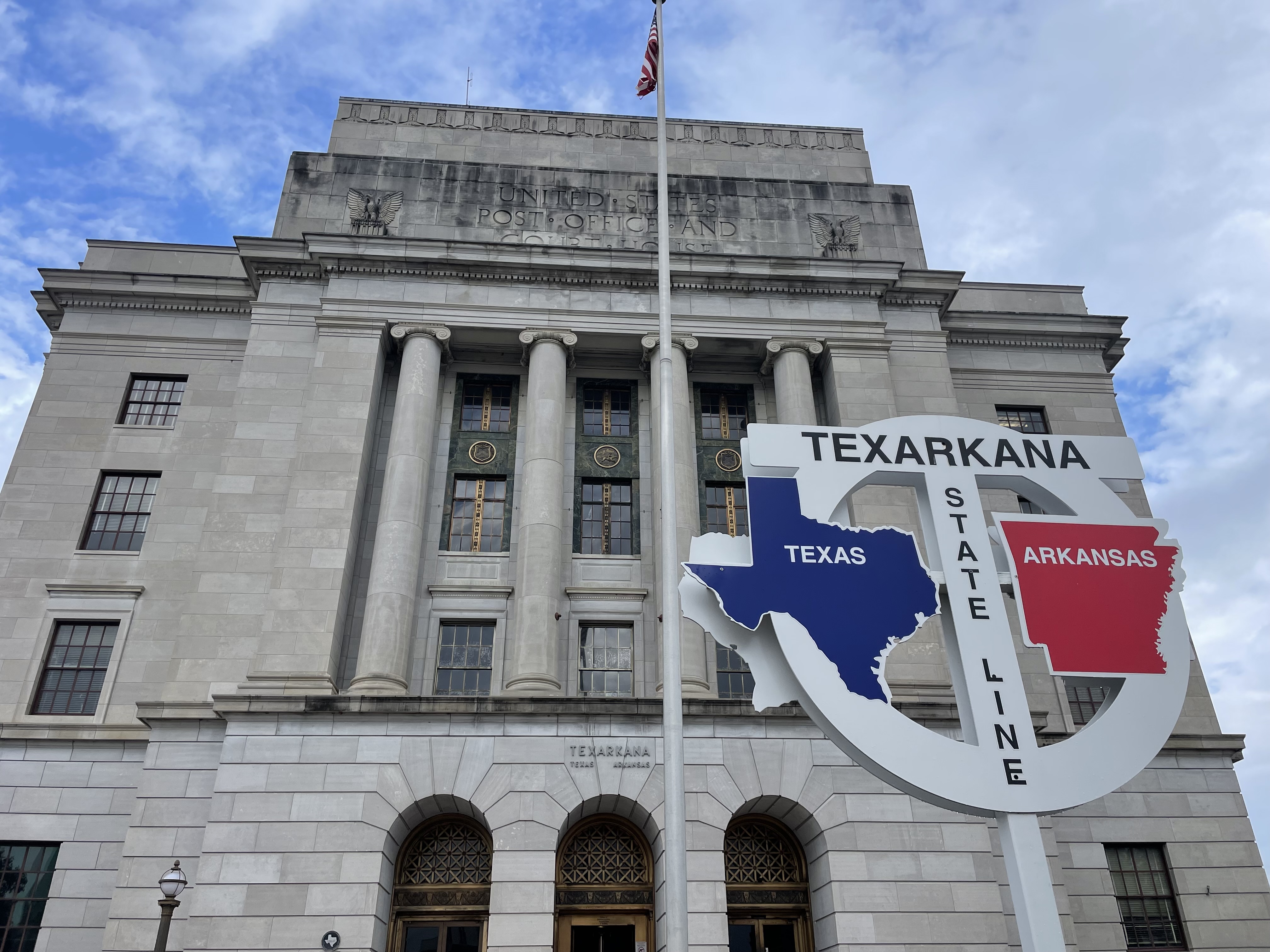
Texarkana is a city literally split in half, straddling two state borders.
Having traveled to Texas for over a decade for work, I can attest that even Texans are not big proponents of East Texas. As much pride as Texans take in their state, you get the sense that East Texas is one of the last parts of the state they lay claim to.
Texarkana had a haunted feel permeating it.
We stopped for half a day to get breakfast, and stretch our legs before getting back on the road just after lunch. Johnny B’s was a little diner that served us our “second breakfast” of the day, and we were served by a waitress in head-to-toe leopard print, who didn’t look pleased to see much of anyone inside. Fox News blared throughout the interior on several TVs.


I try not to engage in “Ruin Porn”– which, pardon the phrase, describes the way wealthier individuals often scramble to photograph places down on their luck, finding the decay “beautiful” in a way that is degrading to the locals. While Moon and I often travel through towns and cities breaking under economic isolation, we typically don’t post them due to this sensitivity.
Being from the Rust Belt originally, it is a sensibility I come to naturally. I grew up in an area that appeared very broken on the surface– but like most others like it, hadn’t broken of its own accord. The booming economy ground to a halt after manufacturers decided to relocate abroad, and nothing ever replaced the commerce. It is a pattern we see everywhere, out on the road in America: towns literally bypassed by larger highways and thoroughfares, left by greedy companies, or otherwise abandoned by– sacrificed to, really– the march of time. These places are more than a photograph of chipped paint.
I’m making an exception for Texarkana. Partly because Texarkana exemplifies many of these towns caught up in some of these economic turns of the screw, but also because it has other layers worth noting– like many places in the South, it was also was the scene of bad racial violence and discrimination that has hardly abated today.


One unmistakable thing about Texarkana was the amount locals invested in car window tinting– most cars we encountered had shaded their windows– ostensibly for the UV protection, but the impact was to make every car seem leery of the next. Not being able to see any drivers made the place feel more desolate. Even the police cars– of which their were plenty– had blackened their windows to the point of appearing more sinister.
People were not out and about, the downtown was absent of activity. Which could potentially be due to our timing, but gave the place a more desolate, empty pall.


The center of the economy (now that the factories had long-closed): a minimum-security men’s prison. The prison kept many storefronts active– lawyers, bail bondsmen, and money lending services. There was an actual five-and-dime that was still in business as well. The printed signs marking businesses– indicative of the last time investment was brought to the area– dated to the 70s and 80s, most of which sat over empty storefronts.


Texarkana had a pretty horrible history when it came to race– white mobs descended on a holding cell in 1922 to drag a black man convicted of car theft out into the street. In the process of committing the crime, an altercation had resulted, and a white police officer was killed by Hullen Owens– which had angered and incensed white folks in the city.
I’ll save you the details of the lynching– but it was as brutal as one might expect, involving torture and the mutilation of Hullen’s body. Being documented, this lynching was able to be recorded and marked in the newly-opened National Memorial for Peace and Justice (the memorial to lynching).


Right in the town center was– surprise– a Confederate monument. Directly outside the courthouse, it sent a very clear message to those walking inside. And though the town clearly struggled for resources, the monument was kept in pristine condition.
Moon and I had recently watched “The Neutral Ground”– a documentary focused on the debate around Confederate statues and their removal, done by the brilliant and funny CJ Hunt. In the film, he talked about how Confederate monuments were often erected under the guise of providing a place for grieving mothers to visit, given remains were not always returned from battlefields. This pretense allowed them to raise these statues in prominent squares, glorifying the “cause” as much as the dead.


True to form, the inscription on the memorial read “Oh great Confederate Mothers…” who “bore hero-sons”… and atop the statue, writ “To Our Loyal Confederates” — yes, that’s right. LOYAL. When I first read it, I thought it said “Local”– but no.
Disloyalty spun into “Loyalty” by chisel and hammer.
Texarkana felt like a town that was inflicted with cascading illnesses– economic hardship, old scars of unexplored racism, distrust between locals, fissures between police and those they served– it felt like an unintended, bad-outcome product of choices made by the nation long ago, from the outsourcing of jobs to the ‘war on drugs’ that led to incarceration being big business for Texas.
It was a place that felt lost– figuratively split in half as much as literally.

Posted by Sun


