


(I spent the entire month of January 2023 in Mexico, traveling down the Baja California Peninsula. This is the second in my series about the trip– check out other posts from this as well, all will include ‘Baja’ or ‘Bahia’ or ‘Playa” in the title, and will likely feature pictures of pristine beaches).
Baja’s largest city– La Paz– only had about 200,000 inhabitants.
This is a small city by American standards, but it felt downright bustling after beach camping. It even had a Wal-Mart (hey-o!), and was big enough to house the first automotive stores we’d seen on the whole peninsula (*so, if you have a diesel vehicle, bring extra DEF along for the journey).

It also had a notably tiny airport– but one of the only ones up and down the Baja peninsula that is not in a resort town. I picked up my friend at arrivals, and off we went for our adventure.
Our first stop when arriving in the city was a wheel-jerk for paletas– ice cream or popsicle-like bars that, if you follow this blog, you know are some of my favorite treats. These are (unlike many sweets in America) made of the ingredients they actually say they are (e.g. mango is made of mango puree). I got the mango and had them cover it in Tajin and a little Chimoy, for some heat– and my goodness, it was a wonderful treat to perk me up after a long, hot drive.


La Paz was a mix of real grit and polished glamour– not unlike other metropolises, inequality was baked-in, but the juxtaposition seemed more visible there. Certain areas of the city— those most catering to foreign tourists and wealthy residents— were the spitting image of design districts in Los Angeles— but most of the city was not quite as fortunate.


There are always features or architectural elements that define cities– in La Paz, it was actually the security bars that covered every parking area, window, and door of every private residence, no matter the part of town or the wealth of the residence. It was so common as to be a bit unsettling— perhaps indicative of crime rate, perhaps indicative of a populace that lacked any trust in one another. I had read that a few heads of cartels were arrested in their La Paz homes recently– so perhaps these measures were warranted. Either way, the “gates of La Paz” were the most common sight to see.


We elected to observe the same rule of not driving at night, and generally tried to be in by dusk, unless we were in the well-populated Malecon-area downtown. Most of Baja remains fairly safe for tourists– but every now-and-then I’d meet travelers who had some petty crime stories. One other thing was notable: shells of vehicles parked on the street abounded– stripped of tires or parts, often rusting in the sun. This sent a clear signal: parking the van anywhere ungated for any length of time wasn’t going to be a smart move. So, if you are bringing a vehicle to La Paz– see if off-street parking is included where you are staying– or in the case of my campsite, if a gate or 24-hour security would be on-hand.
I camped at a campsite called Campestre Maranatha, which our caravan hosts had highly recommended. Having now stayed there, I would heartily join them in singing its praises. It was hardly private— sites were right alongside one another— but it was lovely facility-wise, with hot showers on most days, and laundry. There was a large palapa at the back that offered some serenity and sahde, and highly-helpful staff who spoke more fluent English than anyone else I had encountered in my time in Baja.
While the setup was not always serene, the skies at sunset? ALWAYS were.


Our main goal in visiting La Paz was to swim with whale sharks— the bay side of the peninsula was a popular place for young whale sharks to grow into their adolescence. We’d set up our eco-tour with a company recommended by my caravan folks, the terribly-named MeXplore, which sounded like a… uh… different kind of company than an ecotourism one. We set off for the marina on our first full day.


We were outfitted with snorkels and wetsuits (though the water was barely cold). Our guide was an extremely bright young woman who clearly loved these creatures, and was fit-as-all get-out from swimming with them essentially every day (she was in the water swimming for several hours daily).
She held up an adorable plastic whale shark toy, and provided some facts about the sharks and some instructions on how to swim alongside them. Notably, this is a species of FISH; they are NOT sharks— that’s a misnomer. The whale shark is the largest fish in the world, but we wouldn’t see the largest possible ones on this day— as we’d be hanging out with youngsters, mere adolescents at 18 feet long!


On our journey out to the protected whale shark grounds, we saw a few dolphins (see above).
Whale sharks are apparently such a reclusive species, once they become adults and leave for open water, they are rarely seen again. This is why little is known about the adult life of the species— scientists do not even know how they mate (!). Like the blue whale, they are pretty rarely observed in the wild. And yet, they can reach a whopping 50 feet when they are adults!
While still teens, mostly male whales sharks would congregate and feed to increase in size in off the coast of La Paz— acting like a ‘pack’ for a few years in a shallower-but-fertile-area for catching prey. The whale shark, our guide explained, eat plankton, and as they take in water, filter it for prey and then expel the rest of the water out of their gills. This was neat, and also reassuring to know they were vegetarians.
I was glad the Mexican government was careful to protect the access to the feeding grounds for the whale sharks— our small boat went through a multi-step process of being verified both on-land and at-sea as a legal craft with legal access to the area. The tour and the government officials clearly took conservation seriously, only allowing two small boats into the area at one time.
As with all animal encounters, success is never guaranteed— which we knew that going in. This led to a concerning moment in which my friend and I were poised on the side of the boat, fins dangling out— with both the ship captain and the guide staring into the ocean, flummoxed. They spoke to each other hurriedly and in Spanish— my friend and I exchanged worried glances: what if we’d come all that way, and… would see no whale sharks?!

Tense minutes passed (that felt like hours), and then, the lookouts finally spotted a whale shark. “Get ready!”— our guide called, and we slid our snorkels into our mouths and jumped in. The captain had positioned us expertly, and the guide explained the whale shark would basically be swimming right up to us— and sure enough— out of the murky blue, suddenly there was a massive fish coming our way.
There’s something instinctual about seeing an 18-foot creature of the depths. Despite knowing they could not (and didn’t want to) harm me, my breathing got really shallow and fast. I knew how to snorkel, had done it plenty before, and still— found it hard to keep up with the speedy whale shark as we swam a few feet from it.
Luckily, that was just our first pass— we were able to go swim alongside the fish another 4 times each— and by our second time, I’d relaxed. Kicking more fluidly and breathing more calmly, I was able to keep up with the juvenile whale shark, though it was not easy. It doesn’t look much like they are speed demons, but the way they cut through the water was a tough act to follow. I worked hard during one pass to jet even a little ahead, in order to see its big, silly face coming toward me.
Something about the grin of a whale shark is both majestic and really goofy-looking. It’s got a wide mouth that when feeding, sometimes vibrates in the water a bit like it’s just done a ‘raspberry.’ It will open wider from time-to-time, and if I was anthropomorphizing, I would say it looked like a bit like a grin. I didn’t get a photo of this in the water, but you can see the big, wide ‘grin’ on sculptures and murals memorializing the whale shark around town (see below).


In the water, our guide had to capture us on video, because of course, we were busy swimming as hard as we could to keep up with these deceptively-fast creatures. She took the videos of us tracking alongside the beasts.
Because sharks eat plankton, the water where they feed can be murky — the visibility in these photos and videos below doesn’t look super-great, but remember that we were within about 2 feet of the whale sharks as we swam, so we could see them quite clearly. As usual, the photographic evidence only reveals a small fraction of the experience– but it is worth noting that some days, it’s far murkier.
We were surprisingly fatigued after keeping up with the teen versions of the world’s biggest fish, but were super-satisfied on the boat ride back to shore. We’d seen something really special, and we suddenly were very, very hungry: so off we went to find lunch.
The Baja peninsula– as I mentioned in previous posts– has plenty of fresh fish, but while the major cities have supermarkets, fresh veggies were not the easiest to come by on the rest of the journey. Which is why we lost our absolute minds at Green & Rosse, a restaurant that by all counts, was a total “gringo trap.” (Aside: you are welcome to borrow that nonsense mantra on their menu page if you want, which I assume makes sense but was just translated poorly?).

My friend was just tickled by the appearance of smoothies on the menu, and got both a smoothie and green juice to celebrate her health, or whatever that mantra said to do. Jokes aside, the food was pretty exquisite, given it was fresh— fresh herbs, fresh veggies, fresh mozzarella cheese— it was like balm to my guacamole-logged, cheese empanada-filled, spicy-chip laden, stomach.


Some of the most famed beaches in Mexico are also the ones in well-known resort towns like Cabo San Lucas. But traveling by van through Mexico, you learn that pretty much every strip of bayside sand between California and the tip of the peninsula is pretty spectacular. And just because someone plops a resort somewhere, does not make that the best beach (Cabo, notably, was only two hours from La Paz, for context). Two of the best beaches in the La Paz area were only an hour outside of the city center, so we went to check them out– and I was chuffed to find them mostly empty on the days we visited (something you’d never find at a resort).
Tecolote (or Playa El Tecolote) beach was one that allowed free camping— and other than during the famed Baja 100 or Baja 500 off-road-race events, sleeping spots can be fairly easy to find. Setting up the van in the morning, we had our own snacks, shade, and cold water for the day. It was a windy day, but the water was crystal clear and a gorgeous blue-green I had not seen since Australia.
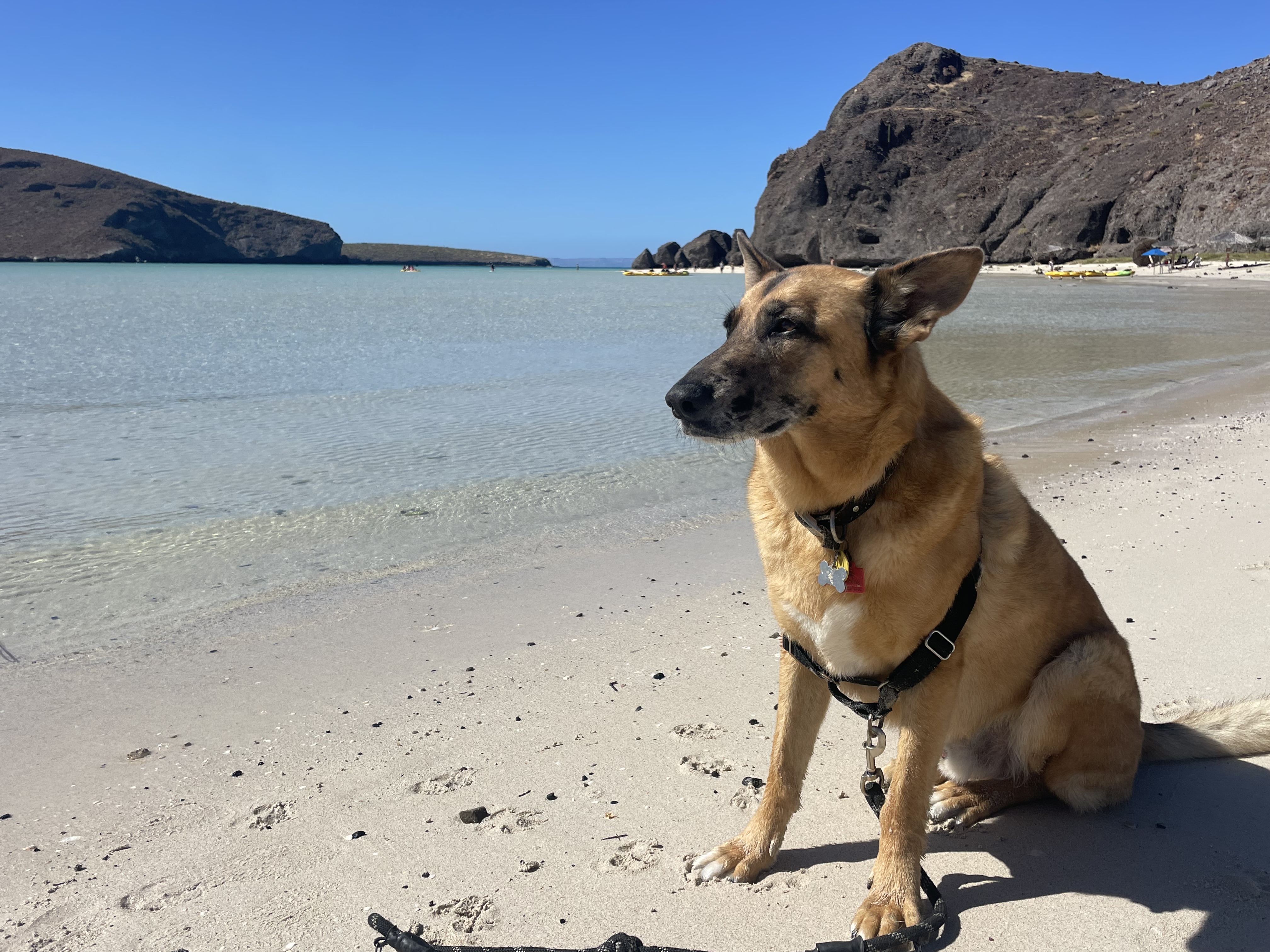
And of course, as a reader of this blog– you know Mac bounded out of the van and straight for the ocean waves, as fast as he could! Cooling his paws in ocean water IS is favorite, after all.


And a plunge was definitely needed– this far south on the peninsula, temperatures were now topping 80+ degrees in JANUARY, so it felt great to dip into the water, which was not cold itself. This water was so crystal-clear, it was almost impossible to believe it was real.


Another beach, Playa Balandra– named one of the prettiest in the world by many travel magazines, was restricted in use. The government of Mexico controlled access by permit, and one could only get in by waiting for two selected gate openings: one at 8 am, another at 1 pm. We elected to try early, and reading that there could be long lines, we arrived at the gate an hour early. We were the first car (oops, sorry to my friend who woke up quite early for this!), but at least were assured entry (and our choice of prime beach spots).


Once the gate opened, we headed into the cove. It was a sparkling blue-white hue, and in direct sun, so we heeded our reward for being early and secured a palapa by tying Mac up comfortably in the shade. We enjoyed reading and lounging for awhile, and Mac buried his chest in the sand to keep cool.


The water was shallow and impossibly clear– especially given the popularity of the beach. My friend decided to pass some time by practicing her “Instagram poses” made popular by the aesthetics on the app, while my buddy Mac did some poses of his own in the shallows. As we chilled, we observed some folks walking all the way across the bay to the other rocky side– meaning the entire bay was shallow enough to lazily walk THROUGH (never higher than waist deep).


There was a small ‘hike’ to the top of a rocky ridge to see the cove below— more of a scramble really– to see the panoramic views of the water all around was wild. As I’d seen before from a cliff above Bahia Los Angeles, Baja had no shortage of coves on coves, beautiful areas with white sands and shallow areas for kayaking, paddleboarding, and generally laying about. Plenty of travelers had rented a kayak to get out into this serenity, represented by mere yellow ‘dots’ from high above.


It was a good thing we brought snacks — including the tiniest possible bottle of Fresca. Which, when you think about it– it generally exactly how much Fresca you want, before it starts tasting terrible. Perfect portion, turns out! While walking on the beach at one point, I heard a tourist complain that the chips in Mexico were always “some version of ‘hot’ flavored”– and he was not entirely wrong. From Takis to Ruffles that burned the tongue, and everything inbetween, spicy chips reigned south of the border.


The beach day at Balandra was lovely, if a little short— the officials came around to empty the beach at 12 noon, so that we could depart by the time the 1 PM folks entered by gated entry. By that time, temperatures were sailing into the high 80s, so I was glad we’d chosen the morning ‘shift.’


Leaving, we remarked that Playa Balandra was the kind of beautiful place that was made for Instagram– but somehow remained fairly natural and unspoiled. The controlled entry and exit had made the day peaceful, where an unregulated environment could have gotten real out-of-control, real fast.
The promenade by the sea– called The Malecon by the locals, was bustling full of runners, joggers, and people just out enjoying the sunshine. Overlooking the bright horizon of the bay side, it was nice to take leisurely walks to enjoy the myriad of sculptures along the way. Occasionally, we pinched ourselves on account of this being JANUARY and all!


My friend works in the arts, and was able to find us a “taller” to visit— Spanish for workshop. Taller Arte 64 Press was owned by Daniel Amora, a printmaker and well-connected artist in Baja. He led her on a tour of his studio while Mac guarded the entryway, and while I found and purchased a lovely print the artist had done of a blowfish. The studio space was lovely and sun-filled (and Mac did a great job ‘protecting’ it). Daniel was a great conversationalist, reminding us that the peninsula was quite large: here in La Paz– we were 27 hours of driving from the U.S. border. (Which made me remember just how far I had left to go, once I turned the van for home).


We also found an artisan gallery that was full of crafted items that were original and fascinating. Casa Parra was an extremely well-curated but resonably-priced shop of creative types who made all sorts of arts and crafts that were unique (and not mass-produced). The shop was quaint, but was assembled with excellent taste– and I’d highly recommend a stop in, if you enjoy shopping with local artisans.


That day, we discovered the best restaurant that I ate at in all of Mexico– Tiger Club was not just the best food I’d eaten in Baja: it was the best I’d eaten in MONTHS, maybe longer? And I’m not the only one to think so– the New York Times did a piece on food in La Paz, and wrote up Tiger Club as part of its profile on the city (see it here: https://www.nytimes.com/2024/04/03/travel/la-paz-mexico-travel-hiking-diving.html)


For good reason– the ingredients were extraordinarily fresh– the simple dishes were well-constructed, blending together beautifully but still tastefully distinct. The cuisine was an homage to southeast Asian food, with the depth-of-flavor one would expect from that area of the world. The proprietor of the restaurant– a woman named Clementine (pictured above) who sported a slight French accent and was incredibly well-traveled– made it a point to personally invite my friend and I back for dinner. Given this invitation, how could we not oblige?
Reader: the dinner meal was even more exquisite than breakfast. While Mac couldn’t have any of the dishes, he watched the kitchen staff intently (and they might have given him a few scraps). The cucumber salad was tossed in a flavorful chili oil, and the green papaya salad was fresh and light– the most surprising was the roasted squash dish, at the bottom left– which had an impossibly-good char on it thanks to a seasoning that performed like a deeply-spiced dry rub.


Clementine was kind enough to send a complementary course or two– and I was entirely full and more-than-satisfied, downright chuffed with my meal: something I hadn’t been in awhile in Baja after eating.
The street art in La Paz was plentiful, and vacillated between terrible and excellent– it made turning every corner an experience. Most of the wall art was devoted to sea life,


After a lovely few days with my friend, it was time for her to head back to the airport. After Mac and I dropped her off– I decided to leave the more touristed area and headed toward the central shopping district, where more actual residents lived and worked and congregated.


I was still looking to understand the culture of Baja that didn’t revolve around tourism– and I was glad to experience a bit of it. This part of town delivered a much purer vibe of Mexico– bodegas, street food stands, cell phone shops, and lots of legging emporiums (lots), and not a lick of English on the menus of the restaurants. Driving down the entire peninsula, all 27 hours of it– given how sparse the towns en route were, I never felt like I encountered anything not made explicitly for tourists. So, in many ways, this part of La Paz was the first time I felt like I was able to absorb something of the people that made up the place (not just the sights of the place).


I was reminded that for all the beautiful beaches, and all of the pristine waterfronts– that to really get to “know” a place– there’s absolutely no substitute for just going where people live– and taking a long, observant walk. La Paz isn’t high on the list of tourists in Baja, as the places that cater FAR more to tourists (e.g. Loreto, Cabo, and Todos Santos) get lots more love. But, you could go to every single one of those places and not see how people who live there, really live.
Back at my campsite for my last night in La Paz, I saw some rigs that were reminiscent of “old Baja” rigs: off-road vehicles that were designed (or modified) to travel down the Baja peninsula without the use of paved highways (which didn’t exist until the 1970s!)– before that, overlanding was the only way to get from one place to another in this neck of the woods. Driving across dry lake beds, finding pathways in the packed dirt– whatever it took. This German dude and his massive dog were part of that tradition: he only stopped one night at the civilized campground before setting off again to bookdock.

If you meet people in Baja who are old enough, they remember (and talk about!) those days of traveling the entire peninsula without roads– something that sounds far more gnarly and rugged than I was willing to do. Baja was so empty for the entire 27 hours of driving down to La Paz, it really gave perspective to think about the kind of adventure it must have been to take that on without a single road or service to use. Potholes or not, at least I knew the road would not sink beneath my tires!
La Paz remains one of the only places on the Baja peninsula that one can get out some of the “gringo traps” that abound throughout, and really feel the vibe of something slightly realer– and grittier.

Posted by Sun


