
When eating a veggie burger in Amarillo, Texas, we got to talking to another home-on-wheels couple who were traveling nurses.
And we learned that day to ALWAYS listen to the advice of traveling nurses.
They asked if we’d been to Chaco Canyon, and when we said we hadn’t, they filled our ears with how wonderful they found it. They shared that Chaco Canyon was the only UNESCO World Heritage site in the States, and this was intriguing to me. Having made huge efforts to see UNESCO sites abroad, it had not occurred to me to seek them at home– a foolish oversight.
Thanks to the flexibility of living on the road, over the same meal– Moon and I were able to re-arrange our travel to head there.
Not that Chaco Canyon is really NEAR much– but it was well worth the trip. Deep into the ancestral lands of the Hopi and Pueblo tribes, the National Park Service and the native tribes have forged a tenuous partnership to protect the site. (Though, as we learned, further exploration was a contentious part of the relationship between the two bodies co-managing the area.)


While four-wheel drive isn’t required for the drive, it was a blessing to have it– the road runs along a long wash, and is unpaved and untamed dirt for about 30-45 minutes or more (depending on your speed) on the way into the site (which eventually becomes paved). As the road crossed several washes, if you go– you’ll want to be sure that rain hasn’t 1. washed out any of the road, or 2. made the road so muddy as to become impassable. With little cell service, this isn’t a place you’d want to get stuck.
Once inside Chaco Canyon’s reserved area, a series of paved roads led to 15 different archeological sites. There was a walking path (they called it a hiking path, but it was definitely a walking path) between several of the major sites that included petroglyphs, so we took that stroll to begin our journey.


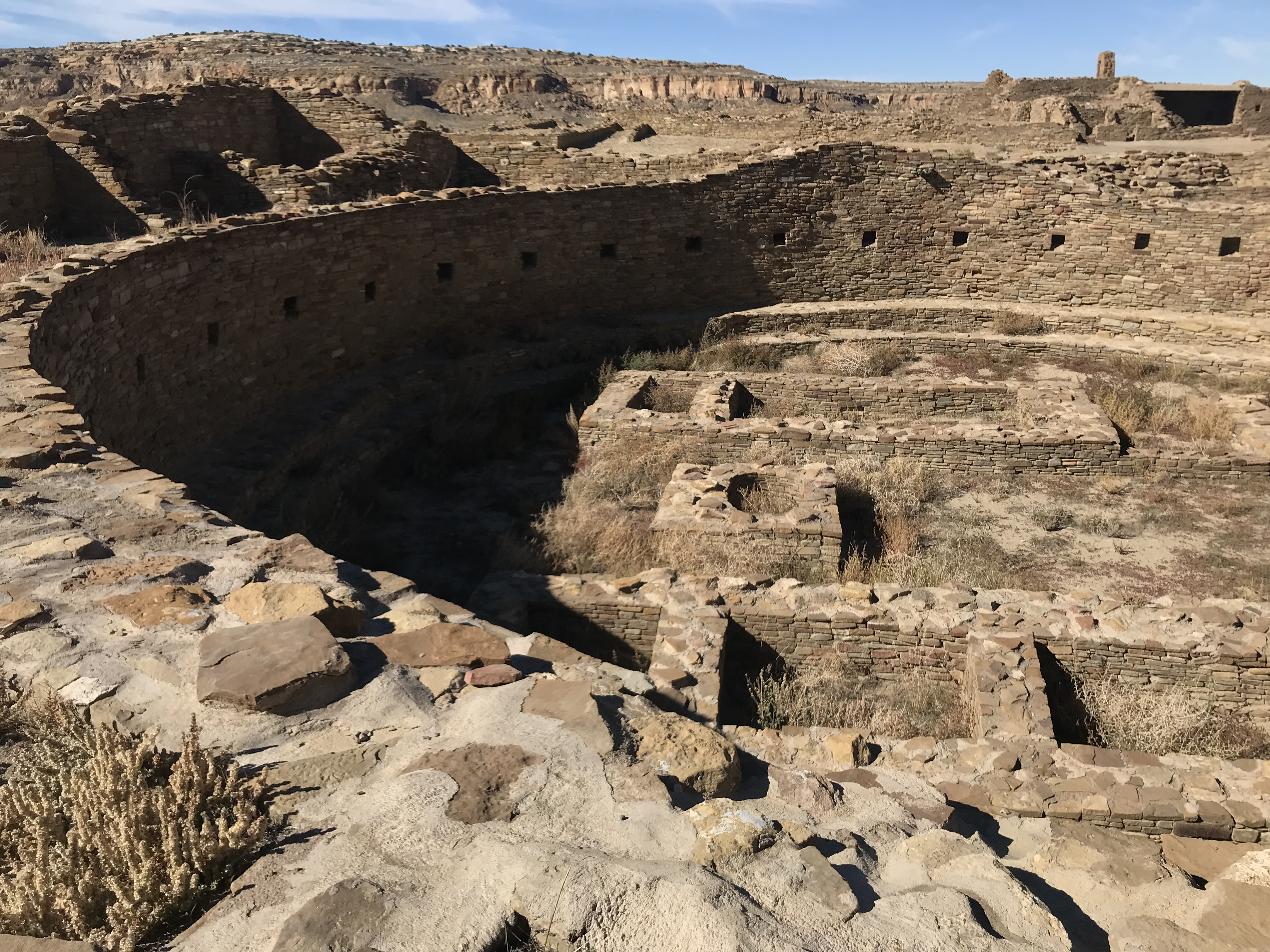
The arid desert had preserved the ruins quite well– we were surprised to see sharp corners and straight lines, as the stones had been laid between the 900s and 1100s. And the scale was mind-blowing– the size of these buildings was just enormous compared to other ruins we had seen in the Southwest. Later, we learned this is the largest collection of ancient ruins north of Mexico.
No one is quite sure what Chaco Canyon was used for– it was understood that the place had always been a stop for hunter-gathers, as evidence of long-ago makeshift campsites were found. But its evolution into a series of huge complexes is shrouded in mystery– some believed it to be a ceremonial area that was not inhabited by residents, but instead, used seasonally for trade, or annually for ceremonies. Others believed it was inhabited only by royal or high-ranking citizens. Still others think it was an agricultural trade site– its real use might contain all of these, but is lost to history.
One thing was clear– turquoise and the trade of turquoise was a major part of life for the Hopi and Pueblo citizens living there. Over 200,000 shards of turquoise have been excavated from the areas around Chaco Canyon– ever-more surprising when you see how few buildings are being actively studied, since this practice is controversial and must be approved by tribes.
Now, when I say the scale was massive– I mean it. See the picture below to try to get a sense of the size of these structures– which archeologists believe were built at-once, rather than incrementally. The circles are small kivas, or areas of worship, if that helps bring light to the monumental scope of this undertaking.


It was clear that despite the preservation of the sites, they were still vulnerable to damage– and in a few places, for safety, the National Park Service had buttressed walls to keep them from tumbling down. But amazingly, most of the remaining, shorter walls were still freestanding. It was marvelous to see the outlines of these buildings, imagining the quarrying of sandstone required to create these bricks, long before more sophisticated tools or the benefit of mass manufacture.
Some of these buildings contained up to 650 rooms– and with the required materials needing to be quarried– it was a monumental feat, multiplied times dozens of buildings. An undertaking nearly impossible to imagine.
The ranger we spoke with mentioned that the native Puebloans and Hopi work in concert with the park service, but also have been more inclined to protect the site as-is, versus excavating more via archeological digs. The park service feels there is more to learn, but given the discovery of bones in the site– the native tribes were concerned about disturbing remains. These parties would often lock horns for years ahead of a suggested dig.


The buildings were also aligned intentionally and astrologically– like other ancient dwellings– making an inverted cross sign from above. With cliffs lining the area of the structures, we realized someone could have climbed to the top of the cliffs for more of a bird’s eye view. Apparently, they lined up with the passing of the Sun and Moon at critical junctures in the seasons: which sounded right to Moon and I.
While the origin and use of the area around Chaco is unknown, historians and archeologists seem to agree on the reason for its abandonment– climate change. A 50-year drought ravaged the area, and likely dried up their water source beyond repair. This canyon had funneled rainwater downward into the valley for them for years, and then stopped– something that took a population of thousands down to none through migration and attrition.


We took a hike up the canyon walls– potentially, to see what the builders of this place looked down and saw as they aligned the complex. Mac was looking for boulders to shelter from the heat, and found a few while he waited for us to scramble up. It was winter, but the sun felt hot– the temperature swing in Chaco can be up to 60 degrees a day, with brutal highs and lows.


As we reached the top of the canyon walls, we looked down at one of the (relatively smaller) buildings and continued to marvel at the deep sophistication and work ethic required to conceive of, and build, these structures over 1,000 years ago.
If you’re in the American Southwest, don’t overlook Chaco Canyon– the town of Farmington, New Mexico, which is close to it, is also a delightful (if a little down on its luck) town to check out. While a little out of the way of the other major sites, it’s an awe-inspiring visit as it shows the way human ingenuity has always found a way to create something out of nothing.


Posted by Sun


