

We ran into lots of cool people around Arizona that recommended we visit the town of Bisbee, (I had even heard a tip from some friends in the Northwest about this spot)– but I wasn’t prepared for what I saw driving into the valley.
There was a beautiful town nestled into the hills, and seeing the charming roofs dotting the hillside was stunning in the evening light. The view was downright European in nature– an analogy I’d make more than once in this tiny hamlet.


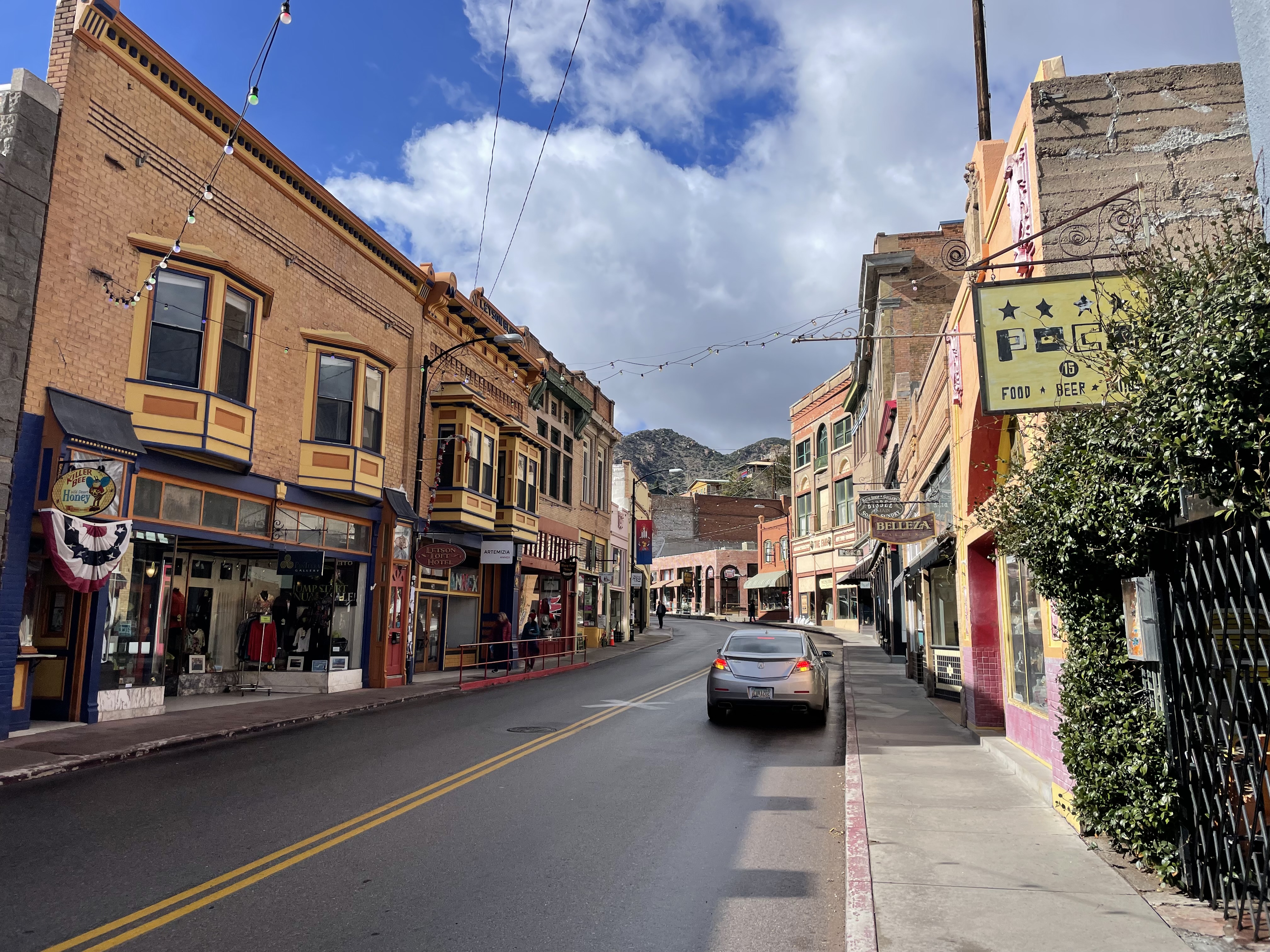
It doesn’t take long to realize Bisbee is a town full of makers– because every business was local. No chains have made it into Bisbee, and that’s by design– the townfolks let us know that the local ordinances now forbade it. The shops, art galleries, restaurants, and theater spaces were all by locals, for locals– the town’s 4,900 or so residents were only 90 miles from Tucson, but might as well be in a world all their own.
There was public art on just about every available wall– including on an actual wall! This outdoor staircase (of which there were many, if you remember the hills)– was covered in art that regularly rotated, according to the locals. The pieces were all very diverse in style and approach; it was a lovely introduction to this hamlet to see it. There were also community and creative spaces dotted throughout the town, standing as an open invitation to make something– anything.


The shops and restaurants were delightful– each was carefully curated with even better taste than the person before. The items were well thought-through, decently-priced, often made or sourced locally, and with artist work featured prominently. I didn’t take photos inside the galleries– as I always want to try to keep the artist work from getting out there on the internet too much, but suffice to say– there were clay artists, paintings, clothiers, just about every art or craft one could imagine.


The downtown itself was quaint as all get-out– historic buildings lined either side, and having no chain stores or restaurant to speak of, meant the entire town felt like JUST that– a town. Not a suburb, not a city, but a proper small town. Which was a refreshing sight to see, as a smaller town can feel like a thing of the past, not the present: it gave me hope that they still exist and can even thrive (though Bisbee had its ups and downs, like most small towns).


It wasn’t all beauty– just on the other side of town was the scar tissue of a mountain torn apart by a strip mine. You couldn’t miss it, driving alongside this gash in the earth. The copper was so rich in the soil, the soil was a reddish-tint that looked like copper was just sitting right on the surface (see below). This strip mine was active until 1975.


This extremely ugly strip mine that represented the “modern” retrieval method of copper was contrasted right across the street with the “old” way of copper mining– the (still-intact) mountain that housed the long-working Copper Queen mine.
The Copper Queen mine was the mine that made Bisbee, and it has both a celebrated and sordid past. And believe it or not, when the mine shut its doors due to the price of copper declining precipitously– people laid down their tools where they rested, and headed out of the mine. It continues to operate now as a tour– which means can go down into a dormant mine.
Being a little claustrophobic, I had my doubts about this– but Moon promised to hold my hand, and said soothing things as the little trolley made its way into the dark mine. When the heavy metal door shut behind us, you could feel it seal– and the air got very still and quiet as people adjusted to the idea of heading hundreds of feet into a solid mountain.


The most interesting thing about the mine tour is that is was given by former miners– actual workers who spent time toiling down in this particular mine. Their familiarity with every inch of the working mine area was clear, and they described the process of blasting out a wall (seen above) with dynamite in a pattern developed over trial and error– note that all the fuses are different lengths, to ensure they blow at different times. Why was that important?
The miners talked about needing to hear all 20 blasts discretely to know it was safe to return to the area and begin clearing waste away. If they (and their partner they were working with) did not hear 20 blasts, it probably meant one fuse burnt out– leaving “live” ammunition stuck in a potentially precarious situation. This work, while not quite as “dirty” as coal work– was still lethal in that workplace hazards were often collapses, explosions, equipment malfunctions, or other real risks to life and limb.
The former miner that led our tour said there’s an old slogan they would use: “There’s old miners, but there’s no BOLD miners”– meaning of course, all the bold miners didn’t walk the earth anymore, but if you were careful– you could make it to old age.
One thing Bisbee had in droves that other small towns do not (necessarily), was a nightlife. Thanks to a robust music scene, and a robust thirst for booze to fuel all those artistic dreams– there were some great bars to sidle up to.


One evening in town, we checked out The Quarry to see a traveling act from Hot Springs, Arkansas (shout out, we’d just been there this fall)– and he played banjo incredibly. Later in our stay, while Moon did some work one evening, I checked out Bisbee Social Club, where I inevitably met some instant-new-friends who I ended up meeting up with back in Tucson, where they hailed from. The Social Club had a sign out front reading: “If the red light is on, we’re here” which I thought sounded like an invitation.
The people were so welcoming and warm, it was a delight to talk to folks over a beer and get to know some new people. I met potters, painters, and others who were just fans of the culture who came to visit– then stayed.
One of the most interesting things I learned about Bisbee was just after I left– a friend of mine who is active in the documentary film scene heard I was in Bisbee, and recommended “Bisbee 17”– a film about a historical event that somehow, no one had mentioned in our time in town. .
I came to learn why that was– the Bisbee Deportation of 1917 was a painful chapter in the town’s history that for 100 years, was swept under the rug. In 1917, as the mostly-immigrant mine workers (both Mexican and Eastern European) decided to attempt to unionize for better working conditions and pay– and in the way that history can be a circle, the mine bosses called them “Socialists” and employed anti-union tactics like whisper campaigns of untruths, and impugning the character of the organizers.
The ultimate conclusion of this was the “othering” of the immigrant populations in Bisbee, and any pro-union worker. On July 12th, the sheriff in Cochise county deputized mostly white, white collar mine employees as Deputies for the day. Each deputy was given a weapon and a list of names– pro-union workers– and were told to round them up, and bring them to the baseball stadium.
The town only had 8,000 at the time– which means this unlawful posse rounded up approximately 1,300 of its own residents– neighbors, brothers, cousins, friends, and loaded them slowly onto a train car. The loved ones of the taken begged for them to be released, but the train car doors were closed– and 1,300 former residents of Bisbee were shipping 16 hours by rail to the middle of the New Mexico desert, and left there to die.
(A still image from the movie appears below– this is not my photo, but was a photo used to promote the film).

It was clear they did not know how many survived this– but many did, and were helped to settle in New Mexico. No one ever faced charges or was convicted for this act.
In 2017, the documentary centers around a re-enactment the locals created to mark the day that tore the town in two– and I must say, it was one of the most compelling, affecting documentaries I have seen. It was haunting to watch people participate in this horrible roundup on both sides, with all commemorators working hard to fight back emotions. If you are interested in Bisbee, see the film– and you will feel you know it all the more.
There mountains surrounding Bisbee were covered in the thin, reedy grass that felt similar to Montana and the plains. I initially found it calming, especially when the wind whipped through it. After seeing the documentary, the wind through that grass felt like a secret being whispered for 100 years– forcing the town to remember its former residents, who left at gunpoint.
It was cold in Bisbee in February, but I will remember the warmth of the people above all else. This town had a complicated history and difficult past, but finally reckoning with it made it feel like the future was very bright for it.


Posted by Sun


