

Craters of the Moon National Monument had become a running joke in my van.
Not because I’d been there and didn’t like it— but because I never seemed to be able to get there. I had best-laid plans to get there over the course of an entire year, but something always upset those plans.
Undeterred, I kept adding it to my sketched-out itineraries… and kept having to bin the idea altogether, either due to weather concerns or route changes. Why? Well, Craters of the Moon isn’t exactly CONVENIENT to reach— it’s one of those parks that is remote.
So remote, that only 200,000 people visit it a year.
This national monument also happens to be located in the center of former ground used for nuclear testing and experimentation. So, there really ain’t much around… except a few dying towns that formerly thrived in the nuclear age. All this to say, Craters is not exactly a park you could breeze through or drive by without a defined effort.
This fall, I made that effort— when I was leaving Washington State, I pointed my van in the direction of Idaho and set the coordinates to the park I had somehow always missed.
(See? It really was in the middle of nowhere).

But first, realizing I was crossing into Idaho– I had to hot spring. One can’t drive through Idaho without stopping at one of their hundreds (maybe thousands) of natural hot springs. Some are so tiny, you’d hardly know they were there, if not for websites signaling their location.
This one was literally on the roadside of a country road I was driving on.
You can barely see it, but there’s some mist drifting upwards to mark the spot. See it?

I almost didn’t either. But I spotted a small boot path where others had trod, and about 50 meters down was a tiny (but very warm) hot spring pool. After a long, cold night in the van (temperatures at this altitude in Idaho got into the 20s overnight in late September), this hot, thermal water felt tremendous.


Feeling warmed, I proceeded into the National Park, mentally preparing to be cold again.
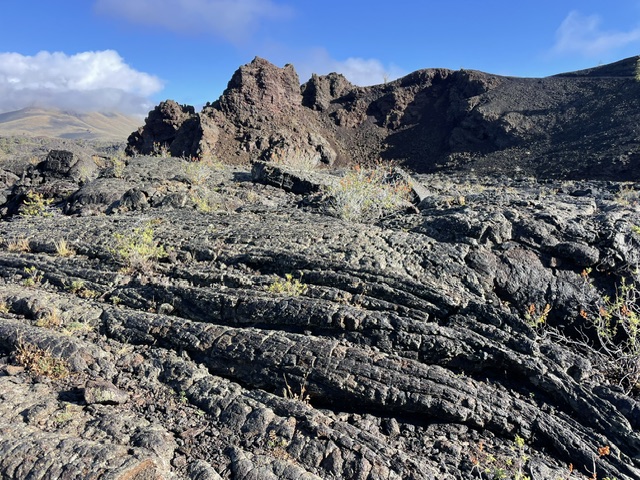
Craters of the Moon was a better stop than I expected, but also, did not contain the natural beauty that make up the postcards of the park system’s more famous siblings. That’s on account of the fact that Craters of the Moon is mostly made up of dried, crusted lava— which doesn’t exactly make for the kinds of epic, wondrous photos most people are seeking. That said, its near-black, crusty, inhopsitable-like appearance, made for a sight to see.
Especially when contrasted with the flora poking out of it on seemingly all sides.


The landscape created by this lava rock is so otherworldly, early NASA astronauts utilized the national monument to prepare for their moon missions. I picked some fresh sage, and inhaled the wonderful, damp herb in a way that felt like it healed my lungs: that, plus other greenery poking out– served as a reminder I was still on earth.

I recommend stopping by the visitor’s center in the morning, as there are some areas of the park (caves) that have a restriction on the number of visitors each day. The cave areas that contain several species of bat are fragile, and they only allow a fixed number of people in them each day— so being there right when the center opens is the best way to guarantee a spot.


Perhaps because it was late fall when I visited, they weren’t so strict on the actual enforcement of these passes— I wasn’t asked to show mine at any point. But I am sure that during busier seasons, this is likely something they are more stringent about.
The reason they require folks to ‘check in’ at the desk is also to ask about White Nose Disease, a very bad virus that is decimating bat populations everywhere. They wanted to ensure that boots and clothing had been cleaned since one had last been in a cave. Rangers pointed out that single spores of this could last for YEARS on clothing if not laundered— so they asked a series of questions aimed at making sure the humans walking through the cave would not inadvertently spread this horrid illness to the bat population.
A worthy reason for an inconvenience if I ever heard one.
Having planned my visit for after Labor Day (the busy summer season’s close), I didn’t encounter too many folks, though the small campground still looked fairly full. I could have inquired about camping overnight, but with such a small area of the park open for exploration, there wasn’t any reason that a person couldn’t knock out Craters of the Moon in just a day.
I started out with a short hike that would take me over a lava flow. Notably, there is a paved, scenic drive around the whole park– but you might not actually get to STEP ONTO the lava formations if you stick to those scenic stops and vistas. And walking out into the hardened flows was the most fascinating part– well worth the miles on the boots, rather than on the tires.
This trail, the North Crater Trail, was only about 4 miles— 2 out and 2 back, with not much gain in elevation. But, due to the visitors center sitting at about 6,500 feet— the uphill sections felt a little tougher than usual.


These rocks felt super-rough and pumice-like to the touch. It was easy to see why NASA chose this spot to train future astronauts in their program.
The hike ends at a scenic pull-out point for cars on the scenic drive. So, it might make one feel silly for hiking the trail, as anyone could see the end point of the hike without effort— but it’s very worth it to do the trail. The most scenic parts of the trail are actually in the MIDDLE of it, so while the ‘scenic drive’ is nice, it won’t get you a true sense of the wild and wooly landscape.


I’d say to bring your boots and get out there. Most of the trails are short spurts, and nothing too strenuous– but get you onto the flows.


The caves were my next stop, and even though it was not the right season to see the bats— I figured the geology around these lava caves would be pretty neat. And boy, was it.
When I parked my van at the trailhead to the caves— and I use the word ‘trailhead’ because it was like a half-mile walk despite it being a paved pathway— I was awed by what I saw. The dried lava stretched what seemed like FOREVER in all directions.


It was just mind-numbing how far these flows had reached— leaving almost no land untouched that could be seen by my eyes. Whatever flow had come through this area must have just covered it all with these lava globs, like globbing-on painting on black paint with huge, messy strokes.
This is the part that felt most like being ‘on the moon’— as the landscape looked nothing like a typical one, and there were very few trees or natural materials to anchor the vision. It occurred to me how easy it would be (if one didn’t have a paved pathway) to get hopelessly lost.
The approach to the biggest caves were dotted with smaller ones— damp and dripping due to the September temperatures, these early caves on the pathway were sometimes only as deep as 12 feet or so, but increased in size as I walked.
(*Pro tip: look for the black holes, those are the cave openings– which should be obvious, but when most of the rock also looks black, it can be tough to discern).


The final cave was the largest, and was the most impressive. Rangers had informed us that we could actually travel THROUGH the cave to another point at the end, and walk out into different terrain than we entered by. While many folks turned around, a few of us pushed onward to find the natural exit of the cave.


These caves weren’t entirely enclosed— so not nearly as dark as Mammoth Caves or Lehman Caves or others— meaning it was fairly easy to pick one’s way through them. There were natural openings atop and around, likely because the lava rock is so brittle compared to limestone (the stone most caves are typically made of).


Exiting the small opening on the other side of this cave was really exciting, and a little disorienting. The park service had placed poles designating a walking trail to get back, but these were the color of the rocks, and blended a bit into the surrounds.
We ultimately had no trouble following them, but it definitely reinforced my sense that being among relatively featureless lava rock for miles would make for a navigation challenge.
After pulling away from the caves, I headed out of the park towards ‘town.’ Hungry, I was hoping to pick up lunch in the town called Arco— though, I knew it was an under-populated town that was tiny.
Boy, I had no idea how tiny. Arco has a population of 28 people, and thus, other than a service station I used to fuel up, there wasn’t much by way of sustenance. There were, on the other hand, lots of empty photo opportunities of a near-ghost town.


Atomic City got its name from its devotion to the nuclear experiment in the 1950s— they were the first town to be entirely fueled by nuclear power. And they were darn proud of that, from the look of their signage, which had that vintage vibe of that era. It’s worth poking around both, but neither are places you will find much, except a couple sleepy businesses that may or may not be open.
I found some food, and poked around to look at the vintage signs, old architecture, and retro flare of the town. It was only 30 or so miles from Pocatello, a larger enclave— but might as well have occupied an era back in time, instead of a place in current culture.
Craters of the Moon is one to visit if you’re in the Idaho region and are looking for a diversion to something different— but I’ll be the first to say that Idaho’s natural beauty (the mountains of McCall, Sandpoint, or Sun Valley, or other spots) were for me, far more striking destinations.
The New York Times Travel Section (if you’re into that sort of thing) named Craters of the Moon one of their spots to check out for 2024– so you better plan to get there before everyone else does!


Posted by Sun


