
When approaching Big Bend National Park, I felt like I was approaching the end of the earth itself. The signs of civilization long in my rearview, the open expanse of the desert easily swallowed the minute number of structures in ‘town,’ and unforgiving temperatures added to the unsettling feeling in the pit of my stomach.
Even the Big Bend National Park materials call the park “Splendid Isolation.” Whoa. Turns out, it is one of the least-visited parks in the USA, with only 300,000+ visitors per year.
The environment was harsh— and the town at the doorstep of the National Park— Terlingua— only had a few hundred year-round residents. It reminded me of something out of The Walking Dead— a ghost town on a hot horizon line, with just a few eateries and a general store.


The good news was, instead of zombie occupants, it was full of people who are there for the same reason— to explore this national park in the middle of nowhere. Because otherwise, you’d just never set foot on the soil. That gives the people gathered there a shared purpose, and accordingly, it’s an awfully friendly town. At one dinner (at the ONLY bar and grill) the night before my off-roading began, I had someone invite me to stay in their driveway in my travels down the line (reader: I did).
When I arrived in April, temperatures were in the mid-to-high-90s, and that made it impossible to contemplate coming here later in the season. This cute skeleton setup at my campsite in town really exemplified the scorched feeling of the place, even in spring (note the little bone pile that is a dog).


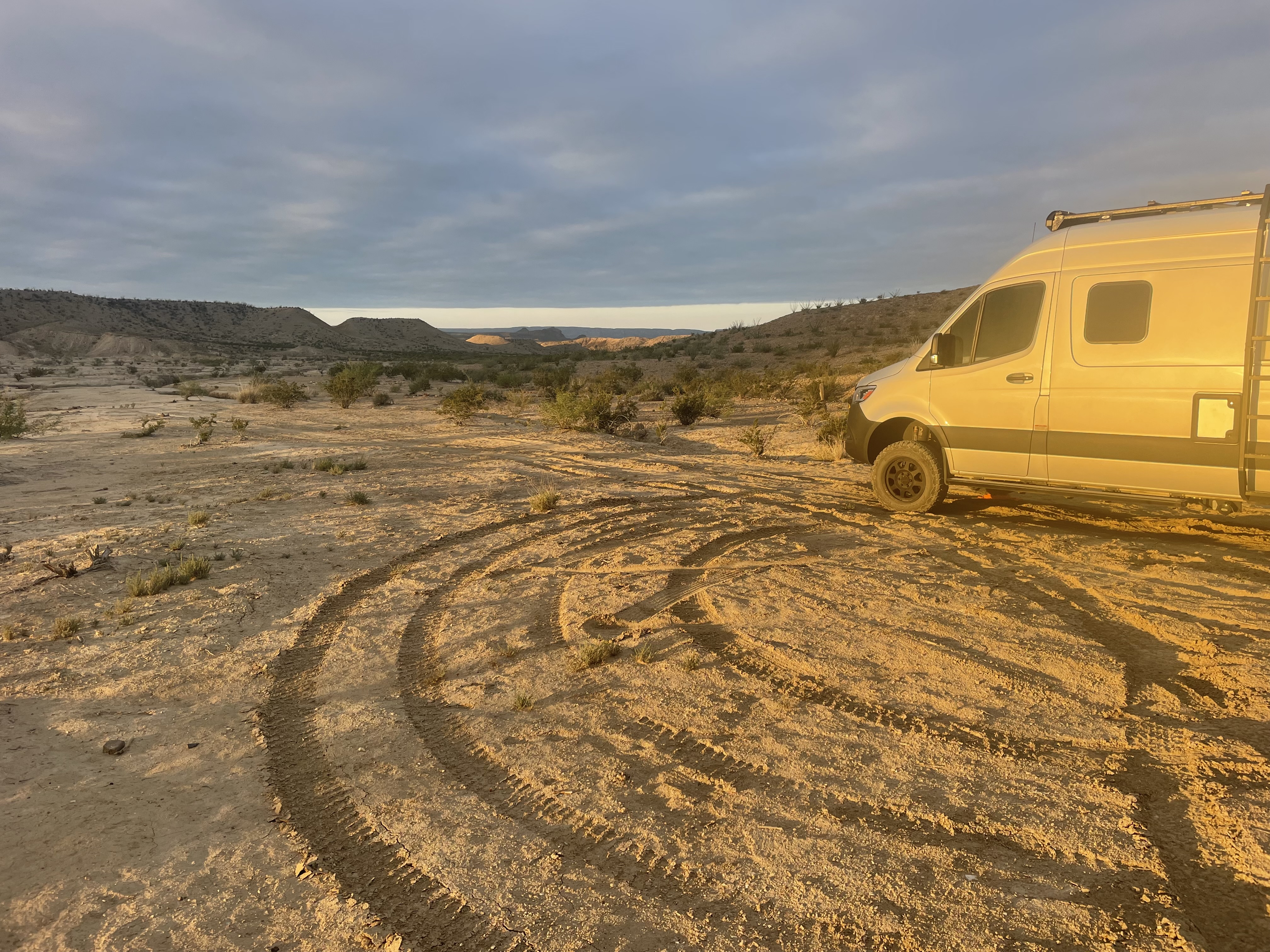
I was there to join a small caravan of other vans to off-road for a few days, with the intent of crawling deep into the park’s unpaved and rougher roads, to see beyond the basic sights of this remote park. In this venture, I was pleased to have a lead van that had driven each of the roads in advance— and had taken care of booking the primitive campsites, which I hear are difficult to obtain (though they retain some as first-come, first-serve).
The night sky remains a huge draw for this remote park– and sleeping under the stars was spectacular (when I wasn’t too tired after off-roading to stay up until it got dark after 10 PM).
Mac loved our morning walks every day, the only time that offered real relief from the sun’s rays.


The biggest feature of the park was the Rio Grande, and the canyon walls that river slowly created over millennia— so we headed there first, on tame gravel roads. The canyon formed by the Rio Grande was the thing closest to a feature in an otherwise featureless landscape. It was a National Park that was on a grand scale, but not a grandeur scale.
Down by the Rio Grande, we took one of the easy walks in the park— not exactly a hike, but definitely would have been more strenuous if the sun had been beating down that day (it was cloudy that morning for us, thankfully). The view was not diminished, and was worth the short scramble.


The walk was punctuated by more desert flowers of all shapes and sizes, doing their best to break out of the rough conditions. Some of them even held a thin coating of brown dust on them.
Luckily, we caught the desert flowering from spring moisture— everything from the cacti to the agave were in bloom, and these bursts of gorgeous colors broke up the monotony of brown hills and blowing dust. These flowers, ranging from tiny scrabbles to huge stems, were full of resilient beauty.


It was a wild and insane bloom.
It made me remember that even seemingly-harsh environments can be fruitful for flora and fauna. In fact, Big Bend has more than 1,200 species of plants, 450 species of birds, and many cougars, javelina, roadrunners, kargaroo rats, not to mention 3,600 species of insects within it.
As we took some off-road trails away from the Rio Grande, its full scale became apparent– it lined the desert landscape like a spine, for miles in every direction. The river greened the valley below.


Plenty of the walks in this National Park revolved around the longtime human activity in the park zone— it was a surprise to see in such a hard landscape — to scrape an existence out of this environment must have been no small feat. Evidence of early dwellers was everywhere, barely eroded over time thanks to the dry heat. Apparently, people had business there for over 10,000 years!
The most mundane of these was a small homestead, which still contained old and rusted items like tins that used to hold goods. People had presumably found them, and piled them near the old hearth.


The strangest of these man-made structures was a previously-operational factory— a mercury mining and processing ‘plant’ called Mariscal. Despite the signs and warnings, my little group of vans disembarked for a walk around the grounds (and yeah, I let Mac come too– he’s careful).


We were careful– not just around potential collapse, but also understood that items in the area were likely contaminated. We kept to the edges while exploring these ruins, and as a precaution— wiped down both the soles of our shoes and the paw pads of our pups’ feet to rid them of the fine red dust once we finished looking around.
The towers were eerie, and the site contained the remains of everything from rail lines for mining carts to bottles to broken glass to old shovels. The entrails of a formerly-great production were spilled everywhere in the form of the bricks the plant created. As in all abandoned spaces, there is always a sense of unease, and even within the bounds of a national park— the mine entrances were surprisingly accessible and fairly unguarded (so not a great place for little ones to explore).


It was impossible, in the beating sun, not to think about the workers who toiled under these blistering conditions in this old factory. All the workers were Mexicans who had walked into Texas to avoid the revolution going on in Mexico. Mining mercury, creating 1,400, 76-pound flasks of mercury — which amounted to 1/4 of total production in the USA– and then having to cart this out into the more populated part of the world.
The Park Service has a helpful article about the mine here: https://www.nps.gov/bibe/learn/historyculture/mariscalmine.htm
“The work of digging cinnabar ore by pick and shovel from the depths of Mariscal Mine and then heating it to render mercury was both difficult and unhealthy. Many miners succumbed to mercury poisoning from handling the ore. Those who worked around the Scott Furnace often ‘salivated,’ meaning they produced abnormal amounts of saliva. Most veteran furnace men had no teeth and developed chronic respiratory problems from mercury fumes.”
The operation only closed in 1940. As they walked, the Boomers in our group were talking about how the toxicity of mercury was a slightly newer revelation, and they could remember being given raw mercury as children to mold and shape for science projects in class. As they chattered, I wondered how today’s plaything could often become tomorrow’s toxin.


This was just the beginning of our off-road exploration. The roads within the park that were unpaved could be fairly empty, save the green-and-white trucks of the Border Patrol. The remoteness of the back half of the park— far from the two main features (the Rio Grande gorge and the Chisos Mountains) made the adventuring fairly desolate.
Our lead van had selected a few off-roading trails that would escalate in difficulty, with the final challenges being way tougher on us and the vans. Luckily, camp was always a soft landing point for us (and Mac, who was tired of holding his balance as the car jolted around daily).


We camped that night in a grove of brushy, bristley trees— a bit knarled by wind and dust, these trees were nonetheless lovely to the eye— as they provided some of the life the eye can crave in desert settings, and also provided some much-needed shade from the sun.
While setting up for dinner, we heard the thunder of hooves, which shocked us a bit— until we saw the source of the ruckus— a handful of wild horses roamed, eating the tall grasses that formed near the water’s edge. They seemed fairly fearless around humans, despite having some foals among them— signs that they might have been domesticated at one point, or perhaps had an owner on the other side of the border who would round them up eventually.
We’d wake up in the morning to their hooves scuttling by to get to the river bed, and once, Mac and I accidentally startled them while taking an early walk. (Well, I’d say ‘accidentally’ but Mac chased one that began to run, OOPS– don’t worry, he did not get far).


There were yet-more manmade structures to see– this one, a farm that had long ceased to exist. With barbed wire fences that went nowhere, and a strange assortment of thick, broken pottery vessels, as well as the remains of a staircase poured in concrete that Mac checked out. It was an eerie selection of goods from a homesteader who had a ranch that long ago faded into dust.


We navigated an old mining road that ended in this fascinating wash area. Here, the rock took on an almost curvilinear flow, thanks to the carving of either ancient or seasonal rushing water. The feature within a mile walk were deep pools— strange in color thanks to the rocks around them, these pools were not to be loans. eapt into (as there would be no way out), though I am sure an Instagrammer once tried.


On this hike, we saw fossils and other evidence of the seabed that used to be this very same desert. We also saw a juvenile rattlesnake curled underneath one of the rocks. It was tiny, and would have looked like a small amount of dung to the unfocused eye. Spring is the season that the rattlers ‘wake up’ from their winter’s sleep— so, if you’re in the park at any point past March, it makes sense to carry a snake bite kit.


Our caravan saved the greenest and most featured part of the park for last— given it was also the most accessed park of the park— I was glad that we did. We’d gotten so used to having this National Park to ourselves for a few days, that it was a little overwhelming to see so many visitors gathered around the lodge and hotel in the Chisos Mountains.
Interestingly, the Chisos are a very small range, which makes them the only mountain range to be completely within the boundary of a National Park.
While it was a bit crowded, it was beautiful to see the verdant and healthy landscape within the canyon, where water must be far more plentiful than around the rest of the park. There were a few short walks around this area that were well-worth taking, and ironically, provided some of the best “viewpoints” in the entire park, despite the easy access to them (pretty sure those walks were paved!).


I typically do a mid-length hike in National Parks I visit, and had some regrets upon departing that I hadn’t managed to hike more— but I must admit— the few short walks we managed in Big Bend could be draining. Despite all of the walks being less than 2 miles, without much elevation gain, the hot sun was unrelenting— and with nearly zero opportunities for shade, it was clear the landscape was a little too harsh for ‘proper’ hikes. (In fact, just a month after we departed, a few hikers did die of heat exhaustion while out in Big Bend– so be careful if you decide to walk very far).
Mac has mixed feelings about off-roading– while he’s very capable of it, smartly leaning into turns, and staying spry on all 4 paws to keep from jostling too much– he’s not always a fan. As always, he was a champion about it.


Pulling away from the park after my 4 days there, I wasn’t sure that I would make the effort to return to the area— in the end, Big Bend did not have a strong draw to me. I’d been in far more beautiful desert landscapes before, and while the off-reading trails were a blast to conquer in my van, nothing was beckoning me to turn back as the park receded into my rearview.


Posted by Sun


