
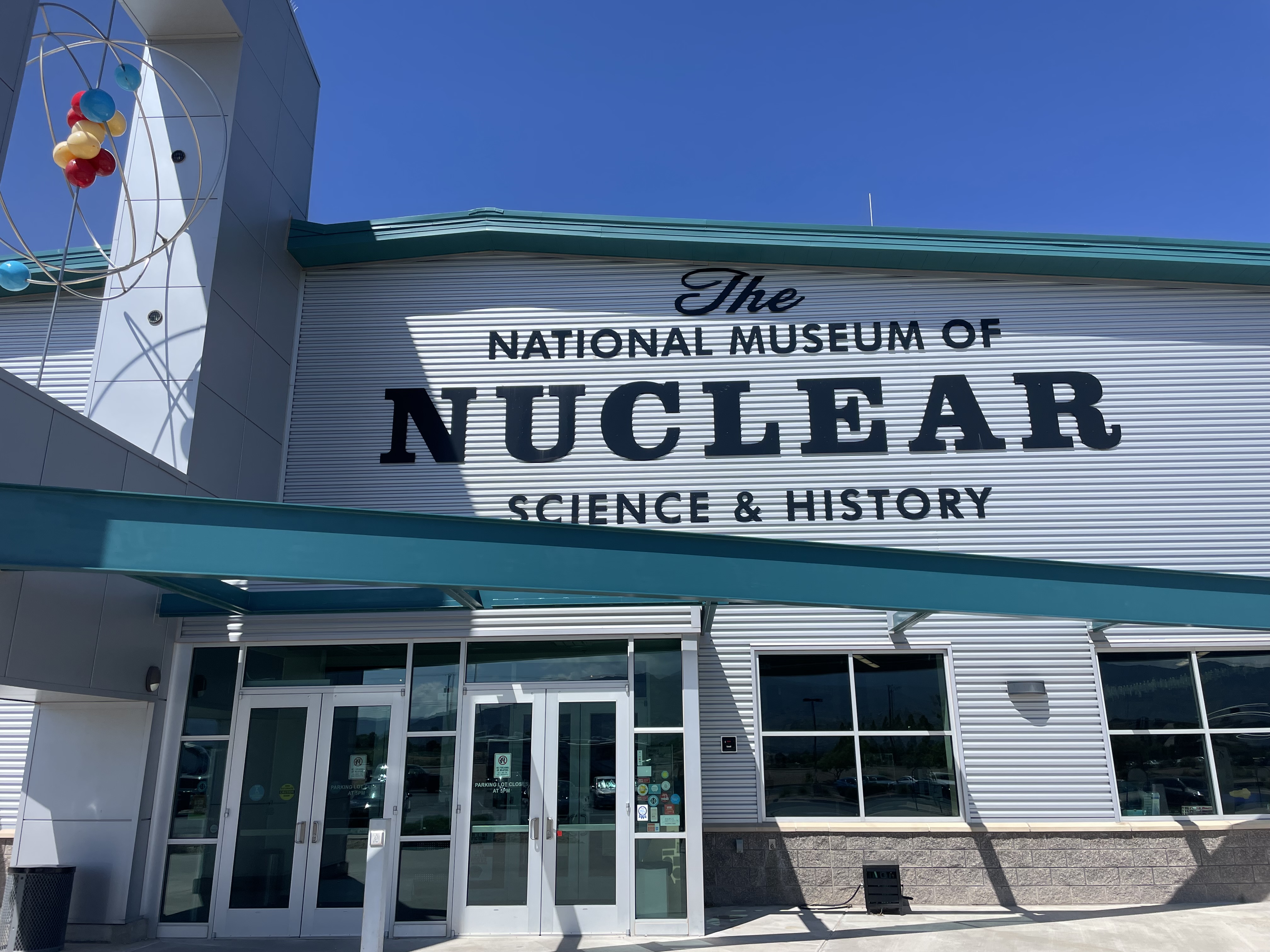
I had no idea what to expect when heading for the National Museum of Nuclear Science and History outside Albuquerque.
And when leaving it, I still wasn’t quite sure what to make of it. It was a total head-scratcher.
I had originally assumed the museum would focus on pioneers of the science itself– which it did, in one large, interactive panel at the beginning of the museum. I enjoyed flicking through the electronic kiosk and basically, spent my time highlighting all the women that were looked over by the gaze of history, despite contributing mightily to the advancement of nuclear discovery and development.
Like poor Lise Meitner, who helped discover nuclear fission in Uranium and got zero credit.
So far, so good. But…


After 1-2 panels on scientific development and discovery, the museum made an extremely abrupt turn into weaponry and war, where it squarely focused for the rest of the exhibits. I realized pretty quickly that I’d walked into something that should have been named: ‘The National Museum of Nuclear Weaponry’– a topic that I have mixed feelings about– and might not been as inclined to show up for.
In the end, it like a bit of a bait-and-switch.
Even though I understood New Mexico’s role in creating and testing the atomic bombs (there’s still active missile ranges in the state)– I did not expect the entire museum to be devoted to nuclear weapons. Not just their development, but also, to some degree– their glorification.


A replica of the Los Alamos outpost was created, as well as a discussion about where the uranium was enriched for the two bombs, named “Little Boy” and “Fat Man” (Hanford, Washington played a huge role here– for those Washington State residents). There were replicas of both bombs, next to which I saw more than one parent pose their kids for photos (a choice I did not understand).
The museum focused entirely on the creation of the bomb by the collected armed forces, focused on highlighting the generals and politicians who green-lit the program and the bombing itself, and gave lots of space to the advancements in weaponry (the short version– smaller weapons, bigger impact), as well as paid close, patriotic attention to the pilots who dropped the weapons on Japan.
A good amount of the words and videos in the museum repeated to the visitor why the bombs were so necessary and crucial to ending a long and terrible war, and very much took the perspective that without the bombs, the loss of life would have been worse as the bloody war would have been extended.
Which might be the case– or might not be. As the museum was still leading up to the dropping of the bombs, I suspended some disbelief and moved on.
There was an airfield outside which contained the evolution of nuclear-enabled bombers, and inside were a huge assortment of nuclear-enabled missilery, most of which (of course) had never been used. But their presence and descriptions set my teeth on edge.
SO many different iterations of mutually-assured destruction. All pointing at you. Dwarfing you.


There was so much oversight in the story that was told– mostly due to omission.
I happen to know a few activists that focus public attention on the once-and-continued impacts of nuclear bombs in Japan, and I also have seen Native American art that focuses on the testing of bombs (unannounced and unwelcome) on their lands, as well as read accounts about the storage of toxic waste materials in their terrotory– all which had (and continue to have) huge impacts on people.
The Shoshone people are considered ‘the most bombed nation on earth’ as it was their land that was turned into a nuclear testing site (though perhaps the Vietnamese would like a word). The people of Nagasaki and Hiroshima are still dealing with generational health impacts from these bombs– and of course, 200,000+ Japanese citizens were killed when the bombs dropped (mostly civilians).
Those people and peoples on the receiving end of these bombs and their materials had ZERO time or attention paid to them in the museum.
The National Nuclear Science Museum devoted one single 8×10 photograph to the victims of the bombing– a girl named Sadako Sasaki who was diagnosed with leukemia ten years post-bombing (a disease that struck so many it was called ‘the bomb disease’ locally), and took on a project to fold 1,000 paper cranes in hopes based on folklore, that it could help heal her. She completed her cranes but died just after the last was done. She now has a statue in Nagasaki, and is clearly a symbol of the tragedy, but also represented the solitary mention of the impact of the bombs.
Which in my view, was far too scant. Considering how much time and buildup had been devoted to their creation, this seemed like a deliberate miss.
(For reference, my friends in the space recommended the short book “Hiroshima” by John Hersey, which followed 6 survivors of the bombing).


One of the less militarized aspects of the museum was the way nuclear atoms, radiation, and bombs became a national obsession after the war. There was a replica bomb shelter, which became the craze for people who were (apparently) worried that others would do unto us, as we did unto them.
This section included a ‘Family Radiation Test Kit,’ Red Fiestaware that utilized uranium oxide to make the glaze, as well as a device that helped add radon to a household’s drinking water (in retrospect, not a good idea). Movies abounded about nuclear weapons and war, for which posters were displayed– playing into the nation’s fears and fascination with atomic particles. The assumption of curative or helpful properties of radon (gas form) reminded me of the obsession with Radium (liquid form) during the same period, documented in the classic book ‘Radium Girls.’
We were both attracted to, and repelled by uranium and its affects.
If one needed any more indication that the American military was being uplifted mightily by this public-private institution, the restroom door provided some clue of its leanings. Advertised prominently was an upcoming showing of Top Gun (the new one), which– while related somewhat to the war theme of the weaponry onsite, was not entirely without a splash of pro-military propaganda.
Perhaps this film screening was just a coincidence. Perhaps not.

Either way, I left The National Museum of Nuclear Science & History with lots of information weighted to the military’s side of events, and having a firm grounding in the tale as they might wish to tell it. But did not feel I understood the science and history of ‘nuclear science’– as the name would have suggested.

Posted by Sun


