

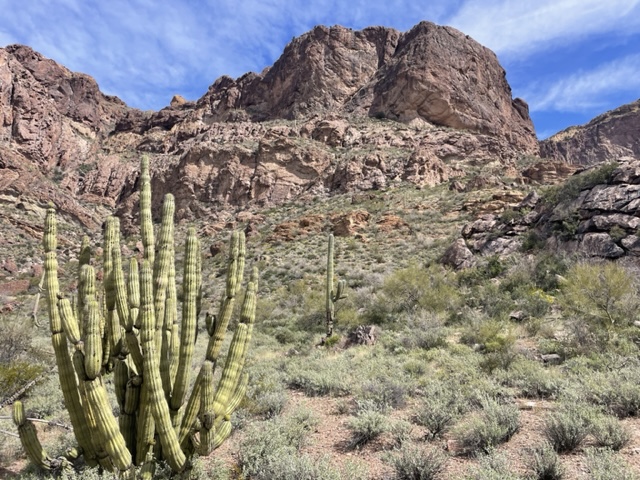
Organ Pipe National Monument is the only place in the United States where the Senita cactus (the organ pipe cactus) grows, because it is directly on the border with Mexico (where most Senitas grow). Only about 224,000 people visit a year, perhaps because of this park’s remoteness.
It’s technically in the Sonoran Desert, the hottest place in the country, which meant even in the springtime, Organ Pipe National Monument was HOT as all get out. It reached into the 90s during the day, which was stunning given how early in the season it was.
But after the winter brought rains, it was also wildflower season. Which created a blanket effect in some places, bathing the desert floor in colors. Clumps of yellow, orange, purple, and white were popping out of the seemingly-barren earth everywhere, making the drive from Why– (yes, the nearest town is named “Why”)– quite funny in its own right.
But I was there to see a strange cactus varietal.


The Organ Pipe cacti were scattered throughout the park, dotting most sunny-side (South facing) hillsides with hundreds, if not thousands, of these alien looking plants.
The ranger later revealed that people often express disappointment after driving into the park, as they are coming in from the North– and the Organ Pipe cactus prefers the southern face of the hills. Meaning, people vocally complain to the rangers about not seeing enough Organ Pipe cacti along the drive as their first act of entering the park.


The cacti were so bizarre looking– the tall, thick, stately Saguaros provided a heck of a contrast to the spindly arms of the Senitas. Each of the cacti seemed different, with no distinct pattern to their growth, other than to settle at a distance into a shape that often resembled a hand reaching upward.
And, they were far bigger than I expected– dwarfing Mac when they got to their largest.


Hiking at Organ Pipe felt exponentially harder than I expected strictly due to heat– I picked a hike with some altitude gain (the highest altitude gain in the park was only 800 or so feet), and yet, both Mac and I were panting within the first mile. With about 4 miles left to go, I was just glad I brought lots of water for both of us. There was *ABSOLUTELY* no shade to be had in the park– unless you were willing to crouch under a bush with a rattlesnake (no thanks).
As I climbed in altitude, I don’t mind saying I was hands-on-hips tired. My body hadn’t entirely thawed out from the winter, nor was I in hiking shape yet. That plus the heat… and well, I made it to the end and barely paused for photos (if that doesn’t tell you how dog-tired I was).


The flowers were wonderful companions on the hike, surprising me around each corner. Their blooms were at their peak, with no signs of wilting so early in the season. While one doesn’t normally associate the word ‘fresh’ with the desert, the flowers brought this word to mind for me– a clear sign of renewal after a long winter.


The campsite at the park also had some brilliant displays of color, which Mac promptly laid his belly down in, to try to bring himself closer to the earth to cool off. Here he is, lounging in the wildflowers, doing anything possible to feel slightly cooler.


One of the strangest parts about Organ Pipe National Monument was revealed at the ranger talk I attended– they mentioned that the newly-built border wall cut right through the park. And while the impact was immediate on some wildlife (particularly the migratory deer and pronghorns), the impact was lesser for the winged species (who simply flew over it).
The rangers and biologists who work in the park were still figuring out what the true impact would be on the animals– an ‘experiment’ in-progress. They mentioned some of the dirt and sand roads of the park ran right along the border wall, and I figured I’d take the van to see it.
Why would I want to see the border wall, you ask?
Well, it’s a part of us now (whether we like it or not). We built a giant metal fence through one of our own natural reserves, in an effort to make a spectacularly-large political statement. And large it really was– the wall sliced through the desert like a spine (you can see the black ridge below).


The sight of it running along the entire horizon took my breath away. It felt foreboding, and ugly… but maybe that was part of the point. There were signs posted everywhere reminding folks to be careful, and stating the criminal nature of picking up migrants, and in fairness– there was real (deadly) violence in the park in the past, when a ranger was murdered.
Before the pandemic, it was named the most dangerous of the National Parks. (Which is pretty stunning, considering that Yellowstone is absolutely teeming with great-big-giant-wildlife and idiots who get too close to them for photos).
The Border Patrol trucks along this road were numerous– between the giant rusted wall, and the white and green Border Patrol pickups– it felt like a militarized zone.
Because in some ways, it was one.

I’m not an expert on the efficacy of fences, either for physical security or deterrence– and though I have my political opinion on all of this, I won’t go into that now. I CAN say how it FELT to see this scar running across the natural lands: it felt gross.
The contrast to the wild and colorful nature of the wildflowers that sprung from nothing was hard to ignore. The flowers demonstrated that beauty grew in unexpected places, and the wall was a reminder that ugliness can often be right around the corner — no matter how beautiful the place.
I don’t want that image above to be the last in the post about Organ Pipe, which I thoroughly enjoyed (for the most part, minus the heat). Instead, I’ll post a small gallery of the most strangely-shaped Senita (Organ Pipe) cactus I saw on my journey: it looked like a bad hair day had come to life.


Mac seemed leery of the thing, which I can’t really blame him for. It had such a random splay to it, it almost felt like it could reach for YOU at any moment. (I took a few photos and quickly retreated).
Having lots of downtime (there’s absolutely no cell signal or internet at Organ Pipe), meant I took in the surroundings more fully. I grabbed my large-lens camera and walked the trails, looking for the birds I kept hearing every morning and evening. Their signals and calls were so varied– and even more magnified due to my lack of ability to play music.


Staying in the campground at Organ Pipe was both a treat, and really sweaty (thank goodness it had very, very cold showers– no hot water, be aware). The quietest part of the experience was getting the chance to see sunrise and sunset over the desert landscape– sunset striped the sky with pastel colors.
Organ Pipe continued the trend of National Monuments continuing to be as impressive as their National Park brethren. But if you go, be aware of the temperatures– Organ Pipe’s campground and facilities are closed for many of the summer months, as the weather is nearly unbearably, inhospitably, hot. Keep an eye on that mercury as you make your plans, above all else.


Posted by Sun


