


“I have a Biblical question,” someone on my tour asked the park ranger.
The ranger on-duty patiently waited…
“If the Earth is only a few thousand years old, how do you explain these skeletons?”
The ranger gave the most diplomatic answer I had heard in some time, saying that he didn’t know his Bible very well, and instead pivoted to the facts at-hand. These mammoth skeletons beneath us were between 10,000 and 1 million years old, likely living 68,000 years ago.
It may not surprise you, based on this opening, to hear that Mammoth National Monument is located in Texas— Waco, specifically. I dropped by to see this small site on my way through the area, and hoped to see the largest intact dig site for mammoth skeletons in the country.


Discovered flukily in 1978 by a few teens out for a walk to search for arrowheads, this site was literally stumbled upon. The teens ended up pulling a bone that was 3 feet long out of the ground— and realizing it was too big to be bovine, they took it to Baylor University to assess.

A student at Baylor asked for permission (it was found on private land) to do more discovery, unearthing 5 skeletons in his undergraduate work. More bones were to-come! The 5-acre site took until about 1997 to fully excavate, given the treasure trove of bones inside (16 total mammoths were found: bulls, juveniles, and females).


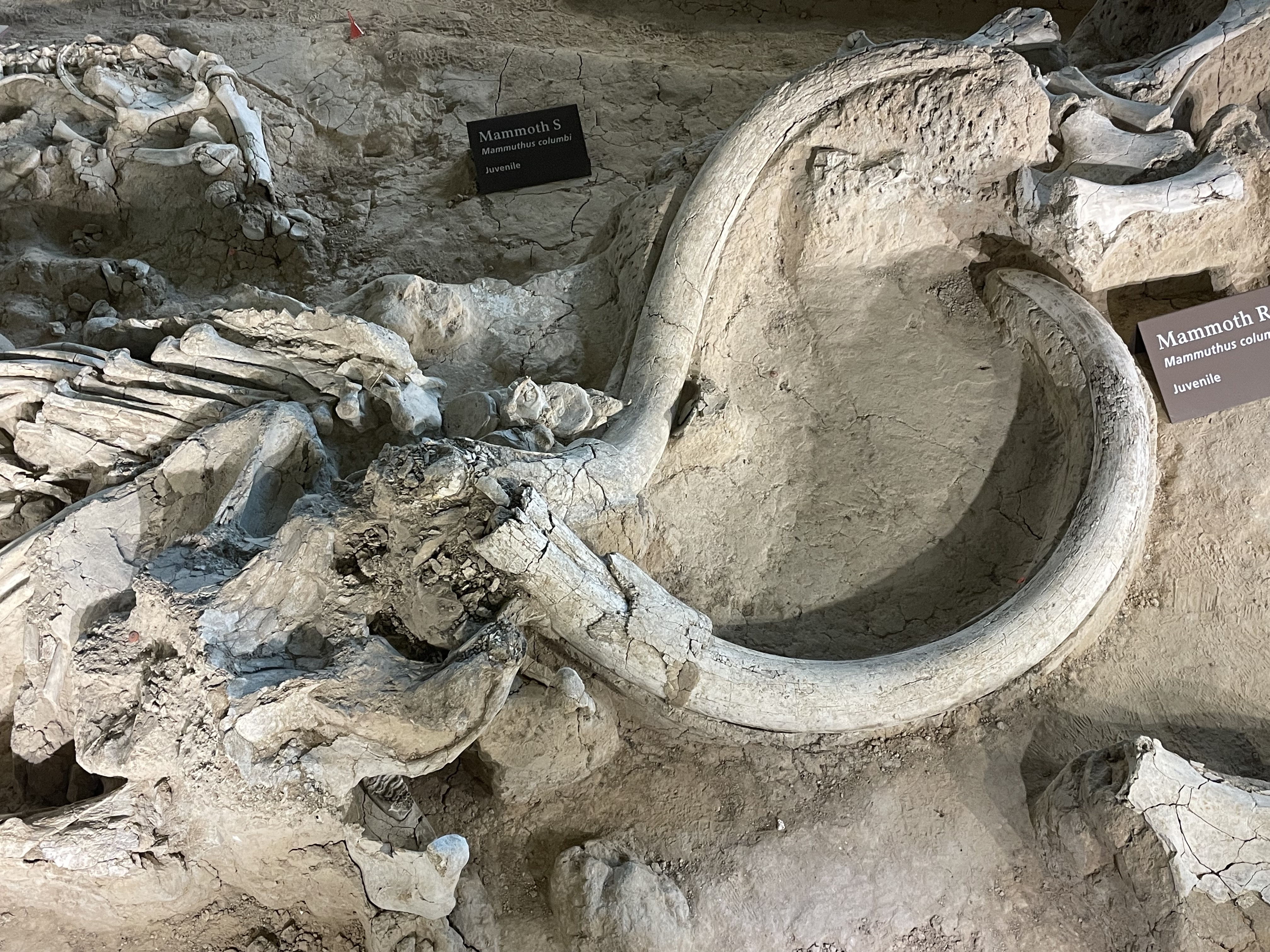
There wasn’t a ton to see at Mammoth National Monument— the site essentially consists of one main building (above) that covers over and protects the dig site. Not unlike Dinosaur National Park, many of the skeletons had been removed to send to other institutions, so just a few remained onsite. Those that DID remain onsite were shown right where they were found, to give the viewer a sense of how these digs progressed.


As we entered the building, the ranger explained the mass of skeletons found here— in such close proximity to each other— was an indication of a mass extinction event. While science has not yet determined what caused the 16 mammoths here to suddenly perish, the site’s proximity to a river suggested a flash flood might have taken them by surprise while in the river channel. With the channel sides getting muddier, they might not have been able to scramble out in time, succumbing to the rising water.


Interestingly, Columbian Mammoths— the sub-species— was an incredibly rare find. This site became the only site of their remains in the country, and while the differences to typical mammoths would not be discernible to our eye, one would be obvious: they weren’t furry.
Most of us picture a “wooly” mammoth when we think of mammoths— but because this site in North America would have been quite warm back then, the Columbian Mammoth would not have needed all that insulation.
The other main difference was Columbian Mammoths were actually LARGER than other mammoth species— averaging about 14 feet tall. That’s much bigger than an elephant. If you look closely at the photos of the site in which a painting is on the wall— that painting represents the actual size of a Columbian Mammoth (peep the chair and doors for scale).


As part of our brief tour, we got to touch some replica mammoth teeth (purely grinding teeth, as evidenced here). And then, as quickly as it started, the tour was over.
Walking into the Texas spring day, I was struck by the new growth in the area. Winter was not over in the rest of the country yet, but here— the leaves were already sprouting. And I mused about how this all could have remained hidden, if teens hadn’t been out hunting arrowheads in the late 70s.
Originally, Mammoth National Monument was just private land, that was then put into trust by the property owner when he died, and was subsequently run by the state park service. Only in 2015 was National Monument status sought and received, making this one of the newest parks in the system.
For such an ancient site (60,000 years old!) to be so newly-discovered gave me a bit of a thrill. Clearly, it’s never too late to make an epic discovery.


Posted by Sun


