

Dinosaur National Monument is aptly named.
I’d never seen as many dinosaur bones in my entire life as I saw there (!!!!!)— it was a surreal experience. This national monument, straddling the states of Utah and Colorado, is one of the planet’s richest-known fossil beds, which date from about 150 million years ago.


Dinosaur National Monument also offers awesome natural beauty that feels pristine and untouched: especially when off-roading to get there and around it. Over 90% of this national park is managed as wilderness, meaning paved access is really limited.
It’s fair to say that I underestimated this park big time— coming in, I hadn’t heard much about it, and couldn’t have named much about it, other than seeing it was really OUT there– away from civilization.
Since it was remote, I made sure to fill my diesel tank at every opportunity, never letting the gauge drop below half. In retrospect, I’m really glad I did that, as services and towns were few and far between in the approach to the area, and even beyond it.
Getting the map from the ranger as I arrived, I found that Dinosaur National Monument is indeed massive— and due to ongoing exploration, the area is seriously under-developed— making it a dark-sky park, and one of the better places to view the night sky.
I also found an array of hikes and walks I was keen to do, and the rangers were helpful at pointing-out something I hadn’t seen at first glance— a 14-mile off-roading dirt path that would lead down to the bottom of the most gorgeous valley in the park. But more on that later.
My first stop was that of many who visit— I wanted to see the giant array of dinosaur bones housed in a building not far from the visitors center. With shuttles leaving every 15 minutes, I hopped aboard and was pleased to find the shaded top of the shuttle protected us from the hot afternoon sun. No joke, even in late September, it felt boiling in the direct sunlight.
(This guy in front of me was apparently wholly uninterested by the view from the shuttle, instead focusing solely on his cell phone the entire time).


Though it was September when I visited, it was about 80 degrees. Dinosaur National Park has a reputation for searing heat in many seasons— the rangers, hiking guides, and reading materials about the park warn about lack of shade and high temperatures that can soar throughout the day. Like many patches of high desert, the morning-to-evening temperatures could swing considerably, and this apparently can catch people unaware— dangerously-so.
We arrived at our destination and disembarked.
The building that contained the dinosaur bones was not what I expected at all. I had imagined the same arrangement as Natural History museums of my childhood— complete sets of dinosaur bones, faithfully arranged into skeletons of whole animals. I couldn’t have been more off-base.
Instead, an actual hillside was encased by glass– like a mausoleum built around dinosaur bones RIGHT where they landed. At least a football field in length, and over two stories tall, it was hard to imagine that this building only held a fraction of what might lay around the layers of rock beneath. This HUGE plot of dirt had dino bones scattered all throughout it.
(*People for scale in the pictures below, to show you how large-gymnasium-scale of this building).


Dinosaur National Monument got its name from this incredible stash of dinosaur bones within its layers— mostly from the Jurassic period. Explored in the 1910s, the very first Dino-bone-payload-archeology-site was here, in front of us. There were an immense amount (over 500) dinosaur skeletons that had been somewhat uncovered in a cliff face, but the dig had halted after harvesting and collecting the most valuable bones and skeletons from within.


So, the thousands and thousands of individual dinosaur bones suspended in the dirt in front of me were right where they had always been– archeologists had LEFT this massive wall of dirt and stone I was staring at, uncovered but otherwise untouched. I didn’t realize we’d be looking at a cut of a real dig that ended after the best bones were taken.
How cool is that?!


Where were these ‘most valuable’ bones that were previously removed, now? There was a display indicating what museums around the globe that bones from this very site had been shipped to, and they were among the most famed museums in the world, including the Field Museum in Chicago, the Royal Ontario Museum, and many others.
I WISH my photos could do this site justice– but alas, they do not. The collection of bones in these photos look flat to the eye, and almost disappear into the brown earth if you squint your eyes. But in-person, this jigsaw puzzle of bones looked surreal.


At the front, rangers offered a written guide to the boneyard wall for $1– an easy purchase. The written guide helped bring some order to what otherwise would have been a literally unintelligible jumble of huge-and-tiny bones with no rhyme or reason.


The written guide pointed out skeletons that had fallen on top of one another, places where mostly intact (but scattered) skeletons were poised within the rock, and places were peering closely might reveal big indicator bones like hipbones or skulls. This brought a degree of fun to the wall— it felt like a hunt, and a tricky one at that— as the naked eye wasn’t always good at picking out features within the morass for the 10 different species entombed.
Wildly, they also let you TOUCH the dinosaur bones in the wall, which of course, I did.


While it would have been easy to spend hours staring at the bones, it was getting near evening, and with unreserved campsites being first-come-first-serve, I wanted to secure one. So I headed further into the park, to the Green River Campground.


It was a really beautiful site— nestled among a grove of Cottonwood trees that cooled the area considerably, I parked and leveled the van out and proceeded to cook some dinner.
The stars must have been spectacular— but I was fast asleep by the time they arrived. In order to hike without enduring the worst of the heat, I wanted to get an early start for hiking.
On the trail by 7 AM, I tackled the 4-mile Sound of Silence trail first. I set out with boots and hiking poles, despite reports of an easy trail, as there was some patches of sand, and I figured my boots would protect my feet in case of any encounters with snakes, which I had my eyes firmly downward to search for.


This hike wasn’t a visually spectacular one at the beginning, as it mostly snaked along a wash among large rocks in the valley floor. But the trail opened up as it rose, and the last half of the hike was much more featured than the beginning— with vistas in many directions.


The final ‘optional’ ascent in the trail guide was a fun (and terrifying!!!) one— a giant slab outcropping appeared right as the trail came to an end. This giant slab went slashing upward into the sky at a fairly steep angle— but the trail guide said the brave-of-heart could carefully ascend the flat rock for an even better view. Now, I like a view… but…
Ya girl is afraid of heights.

I set out anyway, walking up the rock slowly, tamping down anxiety by repeating “Just Keep Swimming” out loud— yes, Dory’s phrase from Finding Nemo— for reasons I don’t totally understand. The mind works in mysterious ways, I suppose.


This mantra enabled me to put one foot in front of the other as I ascended without paying too much attention to the sheer drop off on all sides of me. One misstep would make for an awfully long slide downward, without much to stop momentum.
Reaching the top felt amazing, and the view was incredible. I snapped these photos, including a selfie of my elated face— before realizing that now, I’d have to descend. Which was going to be much more difficult, since I’d be able to see (and feel) the sheer pitch downward.


Time to call on my Dory mantra. I lost count of how many times I repeated that stupid phrase as I made my way downward. But at least this phrase was PG-rated, as honestly, the only other thing I probably would have done was to swear repeatedly to steady my nerves.
Of course, I made it down safely. But I was still a little weak-kneed when I got back to my van, a full mile’s walk later. If that doesn’t tell you it was a bit harrowing.
I wasn’t done hiking for the day, though. I had my eyes on another short vista walk, a 1.5-mile out-and-back at the top of the grandest valley in the park. But due to how undeveloped Dinosaur National Monument is, going to this next hike meant 1. Leaving the park completely, and 2. Re-entering at another entrance about 40 minutes down the road.
Sure.


I re-entered the park via a dirt road and found myself on a scenic loop overlooking the valley, which wasn’t just one valley geologically. It seemed like a collection of different habitats thrown into one, with every mile seeming to change ever-so-slightly as I climbed into more and more greenery.
The vista trail I hiked offered some lookout points that were striking— honestly as beautiful as far more famed spots like the Grand Canyon of the Yellowstone, or Grand Staircase Escalante. Reddened patches of rock and dirt emerged, and the sharp descents photographed exquisitely. But the walk itself was pretty exposed, and now it was getting on noon— so I didn’t linger too long as I made my way out.


It was that moment when I spotted a dirt road headed into the valley, at the junction of the rivers— and putting 2+2 together, figured out that was the 4×4-only, off-road dirt path the ranger had pointed out and suggested I take. I remembered him saying there was a campground at the bottom, and prepared for the steep crawl down into the valley.

I put the van in 4×4 mode and then dropped it into Low Gear to arrest my momentum, as a 10,000-pound van heading straight downwards can tend to gain huge amounts of getup otherwise. Using my paddle shifters, I maintained a low gear but varied the speed to ensure I didn’t ride my brakes too much.
It always feels satisfying to put to-work all the skills I learned in my van off-roading courses.


This road was hardly technical, but there was definitely a steep downward stretch where I put my full attention on the task of shifting. Luckily, the road itself was hard-packed dirt, with few impediments like stones or downed tree branches along the way, making the initial descent the toughest part.


As I reached the valley floor, I could not believe the spectacular layers of color around me— a truly breathtaking scene that went on for miles. Unlike driving on the pavement above, this felt much more like taking in the park on surround-sound or on an IMAX screen, with the saturation turned all the way up.


The road was fun to drive after the hairy descent, and only had one nasty obstacle— a deep sand pit right near the end. The ranger had warned me about it, and boy, was it a doozy— I followed the advice of my fellow off-roaders— in sand, momentum is your friend.
I popped right into and out of the deep hole, on three wheels by the end— but made it. In retrospect, I am sure I could have taken that a little more slowly. But I had arrived.
There was a campground at the end of the road called Echo Park Campground, and it was encircled by stunning cliffs. When I picked my site and got out, the silence that enveloped the area brought some peace to my heart, which was still fluttering a bit from the sand trap situation.


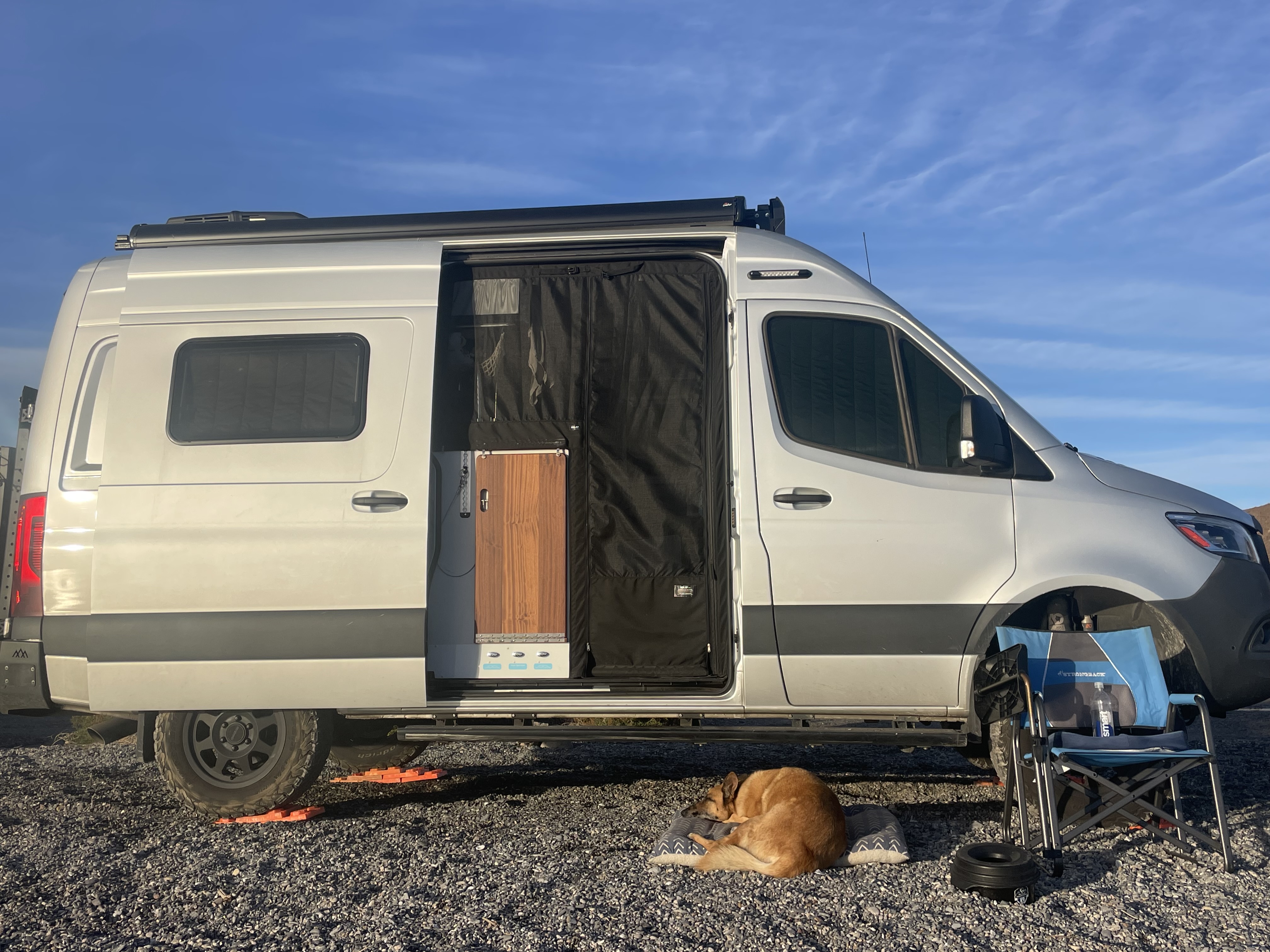
Mac immediately got out of the van and went to lay in the shade. He had been bounced around quite enough for the day, and so had I.
At sunset, Mac and I took a short walk— no more than 500 meters, to the site that I had admired from the vista point— the connection of the Green and Snake Rivers: the famous Steamboat Rock.
It was mind-blowing to see up-close.
A small rafting party was setting out for a multi-day rafting trip, and I included the photo of their dinghy here for scale. This rock was MASSIVE and ancient, having been carved over millions of years by rushing waters of two rivers that are now among the most critical to the West.


As the sun set, and began to toss shadows upon the cliffs, I felt like I was seeing something primordial— the walls of the cavern had been so clearly carved out by the river over years of pressure, and the affect was humbling. The walls were so great, the rock carved out by time was so great, and I felt so small by comparison (in the best kind of way).

I stayed the night feeling completely peaceful. As only a few folks had off-road vehicles or vans, the campsite was hardly crowded and very quiet. I cannot recommend using a 4×4 vehicle to reach this Echo Park campsite enough— it’s one of the prettiest and most contemplative I’ve visited. And I can’t imagine “seeing” Dinosaur National Monument without seeing Steamboat Rock up-close and personal. The vantages from the high-above cliffs just don’t do it justice.
On the way out of the park a few days later, I was thrilled to have visited Dinosaur National Park. And while Mac was a little weary from all that off-road bumpiness– he agreed.


Posted by Sun


