


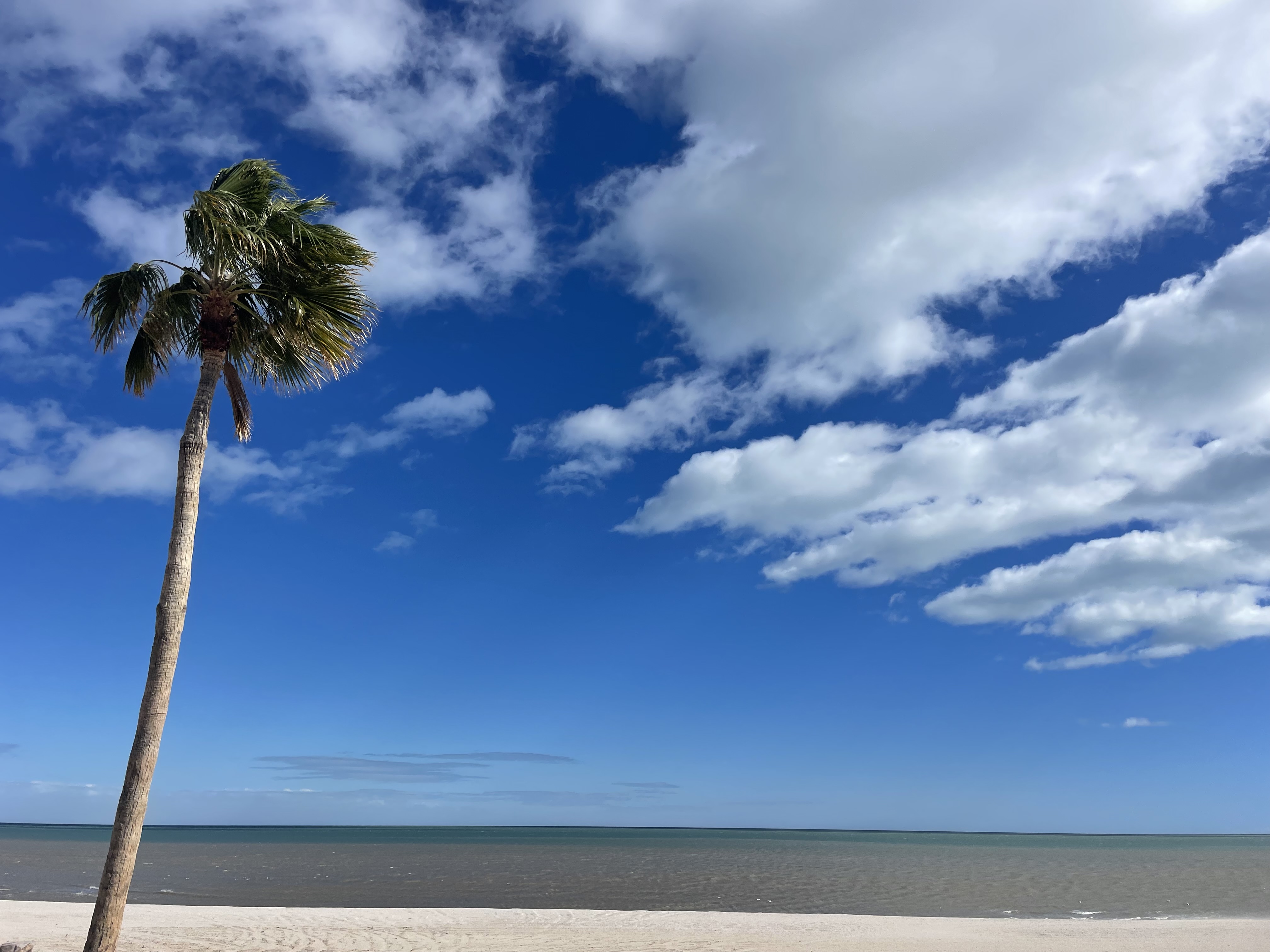
(I spent the entire month of January 2023 in Mexico, traveling down the Baja California Peninsula. This is the first in my series about the trip– check out other posts from this as well, all will include ‘Baja’ in the title, and will likely feature pictures of pristine beaches).
I’ve learned from every place I have been in the van. But…
Baja has the distinction of being where I learned how to clean my own (tequila-based) vomit out of my van after a long night of singularly delicious, strong margaritas (*it took 3.5 hours of nonstop cleaning to take care of it the next morning, if you were wondering).
But that’s a story for further into this series of posts about Baja.
Since I was in Mexico for an entire month, I broke up the blog post about it into smaller parts. I’ll document my time there as chronologically as possible, so you can get a sense of route (though, there’s limited routes to use in Baja in general).
I didn’t go it alone– I met up with a caravan, some experienced travelers throughout Baja, and some novices that had never crossed into Mexico. They sent coordinates for a meetup spot just an hour from the border, asked us to bring a list of supplies and a walkie-talkie, and just like that– Mac and I arrived ready for our adventure South of the Border.
Luckily for Mac, there were other dogs that could keep him company for the trip. Unlucky for Mac, they were younger than him by several years– and would not stop bugging him to play.


“Baja is life, and the rest is waiting” our caravan leader was fond of saying.
He and his family spent about 7-9 months in Baja every year for the last several years, but his sentiment made it clear that even practically living there was barely enough for them. They LOVED Baja, and their enthusiasm was contagious— even overriding some of my trepidation.
Look, I’ve traveled extensively abroad, beyond the bounds of what most people would call ‘safe’ areas— but Mexico’s reputation happened to be in a particularly bad place in the last few years, as newspaper headlines painted a picture of nothing but violence and crime.
Thus, every person I told about my upcoming trip looked at me askance— especially my father, who was not pleased that I was going somewhere so ‘dangerous.’ Reassuring him that I’d be with a group, and that Baja’s main source of income was tourism (providing some level of protection in itself), I set off to meet my caravan-mates.
After meeting the fellow travelers who joined the caravan (truly, the nicest people I’d encountered on the road and some lovely dogs), our leaders covered some basic things to know about safety in traveling to Baja. To get the bummer-stuff out of the way before the good stuff, I’ll list those super-helpful tips here:
- Don’t drive at night for any reason— this is when most violent vehicle crime happens in Mexico, so staying off the road from dusk onward is the cardinal law of the road there. This was reinforced as we traveled, and I realized the long roads between populated areas were completely desolate and totally unlit, a place where you wouldn’t want to meet harm-doers
- Get gas (petrol!) before you leave every place that has a station — when I say the roads between towns have absolutely no services on them, I mean it. On the longest stretches in Baja, this can mean driving 200+ miles without seeing a gas station. Understanding your fuel tank’s capacity and even filling cans once you arrive in Mexico can be an insurance policy of sorts. Also, not all gas stations will even have gas in-stock: so be aware of that.
- Potholes can strand you if you’re not really watchful— the roads (nay, road), in Baja (we used the Highway 1 and Highway 5) are marked by deep potholes. These are not dinky, United-States-potholes, but absolutely wheel-shattering drops into legit abysses. Importantly, the roads also provide no shoulder for the majority of the time, which means steering around potholes can be tricky, or even problematic— our caravan heads said that people can even pop a tire as they swerve off the pavement to avoid deep potholes. So, bring a spare tire and know how to use it.
- Military checkpoints— these come up fairly often on the roads, and require pull off for inspection *(much like Border Control stopping points in the U.S.). Sometimes, one will get waved through, and other times, you’ll have to stop for heavily-armed (AR-15s) guards, who will walk through your vehicle (it’s wise to never take your eyes off these guys as they do their walkthroughs). Intimidating? Yes! Ultimately for your safety? Yes! Go slow, be respectful, and know that most of the military won’t speak any English, so have your translator apps ready.
- Insurance— a rule of crossing the border into Mexico is that one must carry some kind of vehicle insurance. These can be purchased last-minute near the border in bodegas, but we transacted online— a myriad of companies exist, but since our hosts had previously filed a claim they had some preferences. They had used– and recommend– ‘Baja Bound Insurance’.
After handling this housekeeping, the conversation turned back to itinerary.
We’d cross the border in the morning at Calexico, a crossing that our caravan hosts preferred, as it was not as crowded or prone to backups as others they had experienced. Of course, timing matters when crossing— avoiding the rush hour morning or evening commuters coming or going for work would mean a smoother process, especially with multiple vehicles.
Very FEW officials at the Mexicali crossing were fluent in English— ultimately, even broken Spanish would be a big help if you could manage a little study before embarking. The apps also help— our host recommended the ‘Hola!’ app — which offered a free level of use.
Obviously, I didn’t take a ton of photos of the border, but I did snap one. Oh, and there’s a shot of those dang potholes!


The border agents had us fill out a short visa form, just a few blanks including our name, passport number, and destination (we listed our first camp in San Felipe). Each vehicle had to be inspected– this is something to get used to, as any military checkpoint in Baja might have armed officers board your vehicle to look around and through it. Generally, they have you open cabinets, drawers, and pepper you with questions (which is hard with little comprehension between languages, but they point and search until they are satisfied you are not carrying anything illegal). After a short delay while each of our 7-8 caravanned vehicles finished up inspections, we crossed into Mexico in the city of Mexicali.
Our host had warned that Mexicali would be a bit intense from a traffic standpoint, and that was absolutely the case— one of the biggest cities in Baja, this border town had plenty of lanes, highways, and stoplights to throw at us, a bunch of newbies just trying to stay togetrher in the line with the rest of our party. This is where walkie-talkies came in handy— if you are going to Baja with other vehicles, it’s worth the $20 (plus batteries) to be able to communicate if you get separated (cell phone service is never a given there).
Once out of the city, I was astonished at how quickly the landscape just became nothingness.


I’m talking nothingness— at some stage, there were no real buildings or landmarks to speak of, as the desert took over the surrounds. In many places, the desert was as featureless as deserts might come— just brown dirt and rocks. And in other places blessed by water, some greenery or cacti dotted the environment. I’d say on the whole, the featureless former was more common— which, if you’ve ever driven through South Dakota or other featureless horizons, you know can make a person feel drowsy.
I kept snacks (including some sugary ones) within my arm’s reach in the van to fight fatigue, since I was driving alone (many vehicles in our caravan had more than one person to drive). Of course, the constant vigilance for nasty potholes also helped keep me alert.
Speaking of snacks, I will say again that even gas stations or bodegas don’t come frequently at all on the Highway 1– so hot tip– stop for snacks each time you see civilization. Chances are, it will be hours later when you are finally able to stop again.
After a few more hours of driving, we reached the destination of the first few days of our trip— at a camp outside of San Felipe called Pete’s Camp.


I was astonished at how close to the water we parked. This was clearly a “luxury” campsite experience compared to some of the crude beach camping sites we’d seen en route, offering paved spots, optional hookups, hot showers (most of the time), and even a restaurant! (Even the trash service at Pete’s was fairly posh for the peninsula, as most places were pack-in, pack-out).


Looking back, it was a nice transition into some of the more primitive camp areas later on— and after a tiring day with lots of new stimulus, a border crossing, and white-knuckle driving with no road shoulder, it was nice to just head to the restaurant for happy hour margarita pitchers, heaps of chips and guacamole, and churros. Everyone was keen to buy for the rest of the group, and thus we had the ‘not-a-problem-but-a-problem’ of too much booze. The evening sunset was a soft mix of pink and blue, and the palm trees were silhouetted in a way that looked like a Jimmy Buffet album cover.


After sunset, I was suddenly absolutely exhausted. This is when I was introduced to the term “Baja Midnight”— which translates to the not-that-late hour of 9 PM! Because we were up with the sun each morning, and because of the exertion in the sun that comes with Baja, the body just begins to get into that tidal rhythm, similar to how one does when at any beach.
Up with the sun, down just a few hours after the sun disappeared, and the fire pits warmed up. That became our collective mode in the caravan. Sure enough, when I would begin to feel overwhelmingly exhausted, I would check the time and inevitably find it was just about 9 PM: Baja Midnight was not just a phrase, but was a very real feeling.


The next day, I could not have been more chuffed to wake up with the sun literally streaming into the window of my van. I was just as pleased to watch Mac absolutely RUN HIS FACE OFF in maybe the most epic Beach Zoomies of all time! He got a huge head of steam up, and was joined by another dog from the caravan for extra zoom-tasticness. A few times, they ran so far down the low-tide beach, I could barely see them until they came bounding back!


Pete’s Camp was a perfect transition into the natural ebb and flow of Baja living— waking up to the sun rising right into the van, multiple daily beach walks, (beach Zoomies, according to Mac), a few hours of work, beers at happy hour, and a chill sensibility that made even these workdays seem relaxing. (Cell service was still active at Pete’s Camp, but I’d later have to rely more on my Starlink for any kind of internet. *If you need to work from Baja consistently, you’ll need Starlink. Period, no getting around it).
You can’t really beat the desk setup right on the beach, given it was JANUARY and a freezing spell was working its way through the States. It wasn’t hot-hot in San Felipe, it was only about 65-68 degrees during the day, but that felt wonderful in the strong sunshine. It was awesome to not be running my heat all evening and night just to stay warm– like the misery of January in the contiguous 48 states last year.


We did make several trips into San Felipe, a town-sized city that made most of its income from fishing and tourism. Standing by the shore, one could see constant activity of boats being lowered into the water or coming out of it. There wasn’t a set schedule, just a constant changing of the guard— mostly searching for ‘camarones’ (shrimp). If you love shrimp, you’ll find it easy to eat in Baja— and locals who sell them out of car trucks will even shell them for a small price.


Of course, you may remember that I’m a vegetarian, not a pescatarian— so I could struggle from time-to-time in such a seafood-heavy area. That said, tourism abounded, and Italian restaurants, pizza parlors, and other places generally had vegetarian options. Plus, there was always guacamole. I ate roughly a million pounds of guacamole. And cheese empanadas.
Eventually, I found a guy at a gas station that sold tamales out of his car trunk– and was lucky to find he had jalapeno-cheese tamales. These were the best tamales I ever ate in my life, and I returned often to see him– it seemed like if the gas station was open, he was there. The coolers contained big plastic trash bags full of different tamales, and they were always somehow hot.


Enterprising folks in the nearby town would often come to Pete’s Camp offering a variety of services for a relatively scant fee (comparative to U.S. prices). One of the Airstreams in our caravan got his entire rig washed and detailed for just a few hundred bucks— speaking from experience with just a 19-foot van, prices in the USA for this stretch into the thousands. Other necessities were also brought— from camp wood to refills on bottled water to empanadas, the locals knew their audience, and knew how to keep the tourists comfortable and happy. Having pesos is key to being able to support the locals and get some much-needed supplies– and ATMs are FEW on the peninsula. Thus, make SURE to go to the ATMs in San Felipe, and get more cash out than you need.
One thing to know about Baja is that tourism IS the industry, other than fishing. The peninsula– from stem to stern– really catered to ‘gringos’ nearly exclusively. If you wanted to have an authentically-cultural, local-based Mexican experience– let me say now: you won’t really find it in all of Baja. Better to go to Oaxaca, Mexico City, or the like on the mainland. The census showed that most residents of Baja are Canadian and American– and that’s NOT including the thousands and thousands of people who live on wheels, and ‘snowbird’ to Baja every winter.
Case in-point? The breweries that popped up along the way, offering American-style IPAs, and higher-end “pub grub” that travelers would crave. This brewery in San Felipe was absolutely delicious– but clearly was created, built, and every detail conceived with ‘gringo’ tourists in mind: including the slogan (in English)– “No Bad Beers.” At one restaurant, country music television played loudly in the background. You gotta hand it to them– catering to their paying crowd. But for me, it was both an oasis of familiarity, and a reminder that I wasn’t exactly getting to know the ways of local folks, either.


Our caravan leader also suggested a small excursion– not too far from San Felipe was a Mexican National Park of sorts— “Valle De Los Gigantes” — housing some mind-bogglingly large cacti, which were fittingly called ‘Cactus Gigantes.’ Now, if you’ve spent any time on this blog, you know I have spent a LOT of time in the desert Southwest— including with the famed Organ Pipe cactus and Saguaros, so I was a little skeptical that I’d be impressed by these cacti: reader, I was so wrong.


I only THOUGHT I’d seen large cacti in the past. These dwarfed even the largest Saguaros I had seen— I’m not even sure poor Mac, who tried his hardest to provide scale for these photos, was even successful at relaying the sheer size of them. As our group wandered in and out of these massive living things, we were pretty awestruck. I mean, LOOK AT THEM (and peep the people for scale)!


As we left the area, I reflected that it had been a further reminder: as a traveler– just when you think you’ve seen everything, you’re reminded you’ve seen nothing yet.
Being just a few hours from the border, San Felipe was not as warm as the rest of the peninsula — January highs were just over 65 during the day. We’d need to push further south for the 70-or-80-degree days we sought, so while San Felipe was a final stopping point for some travelers (especially seniors from Canada in huge RVs), it wasn’t ours.
We pulled up stakes after a few days and headed further south: this time, for the area around Bahia Los Angeles. From now forward, most our destinations would be named for the glorious bays (“Bahias”) that –if lucky to snag a spot– we could camp directly on.
Keep following along to my next Baja installment for more!

Posted by Sun


