
Racing is not a regional sport, or even a national one— the majority of car races in America are local, and a great way to experience this sport is to find a dirt track near you.


And before you say, ‘hey, sure, but there’s probably not one near me’— there are dirt tracks everywhere in America. Traveling in back roads in the van, I see them all the time, sometimes just 20-30 minutes outside large cities, where one might not expect to find them.
I even have seen a few tucked back onto reservation land, and some right in the heart of wine country— so seriously, you can find a dirt track or tiny oval pretty much anywhere in the states.
One of my favorite racing experiences is the dirt track found at Skagit Speedway, up near Mount Vernon, Washington. It’s hard to put into words EXACTLY what I love about it— it’s a very specific vibe, and it’s hard to describe— and much easier to just experience.


This was made clear to me when a friend that I was bringing up to the speedway asked what she should see, or expect to see, when we got there. I was pretty flummoxed and short on words in response— a rarity for me (as you’ll know if you read much of this blog).
I think the best I can do is to say that local car racing venues are a microcosm— they are a micro-culture that is intensely engaged in a very specific hobby that they love. In circuits that are this regional or local, the drivers often do mechanical and body work on the very cars they race. There isn’t anything glamorous about the driver role, unlike the bigger circuits.


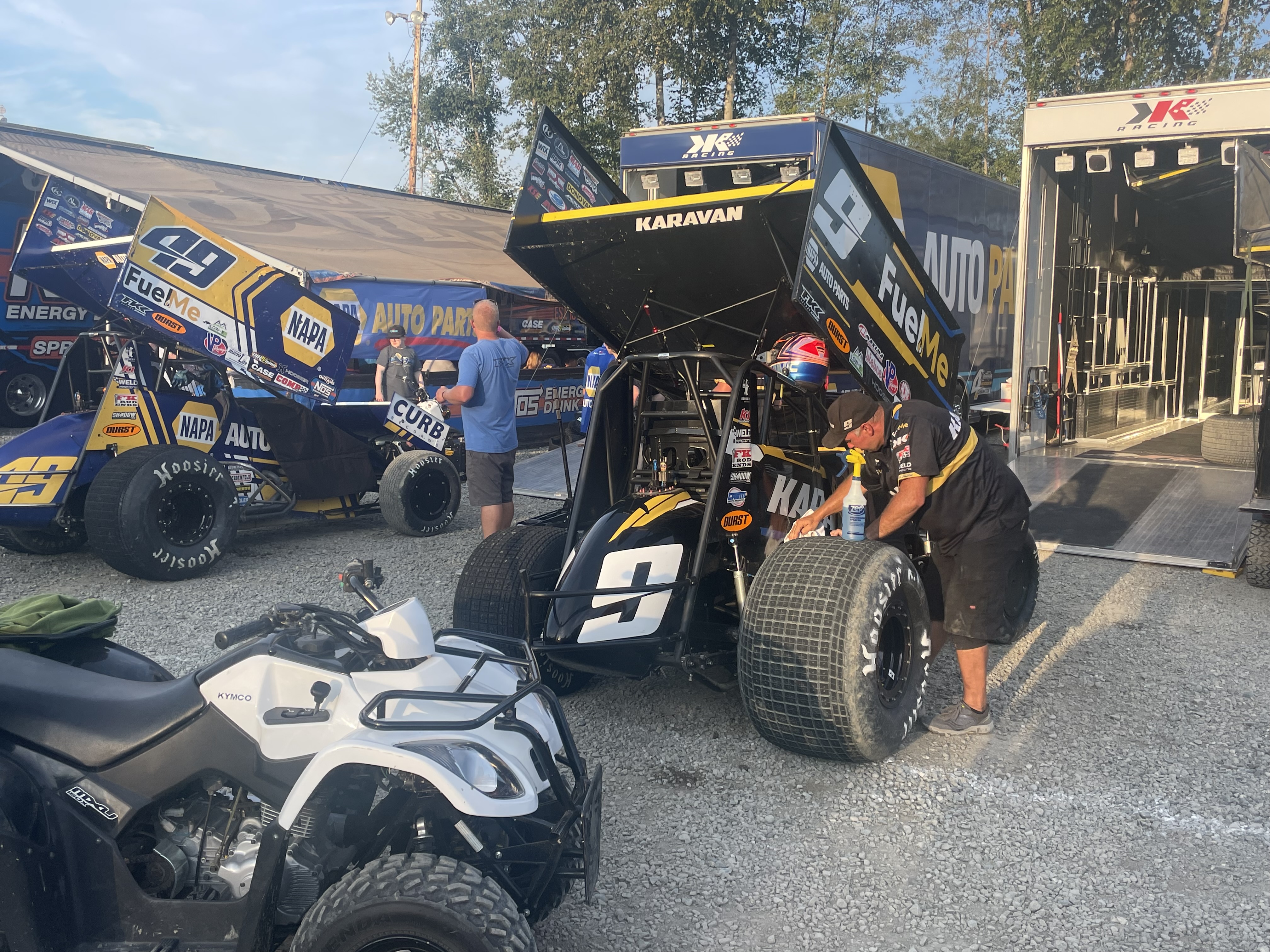
And their pit crew? Well, it’s often their family and friends— when walking through the pits, I saw mothers unspooling rolls of duct tape, dads turning the wrench, cousins with their heads bent to give the drivers advice, and so on. Even drivers’ wives got in on the action— one was even the head mechanic on her husband’s team— this is a family sport, often passed down from one generation to the next.


And where cars are involved, the entire family often HAS to get sucked in— because the finances of car racing are such that you’d have to adore it to participate, as it often requires drawing down your savings or spending any extra coins on car parts. Winnings, even for the few that win, can be paltry— so the whole family has to ‘buy in’ literally and figuratively to being a part of these teams.
The festivities at a race track always include some kind of homage to the military and the reverent playing or singing of the Star Spangled Banner. This opening ceremony is a great time to sit back and observe the culture you’re immersed in— I snapped the below photos at one such moment, as the drivers and the ‘trophy girls’— yep, the gals in sparkly dresses that award the trophies— bowed their heads contemplatively.


Dirt track racing also has some really cool features— like the tendency, once the track is full of cars in the higher-speed heat races and finals— for dirt to be thrown up into the air, and thus, to rain down on the crowds. That’s right, dirt will likely rain out of the sky upon you if you are perched even in the highest point of the stands.
People combat this tendency in different ways— some just embrace it, and don’t modify their attire at all— others wear plastic work goggles over their eyes, or bring blankets to protect their clothing from the inevitable dirt shower. (Note the fine particulates in the air below, making the picture appear cloudy or blurry– also, this gentleman in the photo below went the ‘hoodie’ route– placing his hoodie high above his forehead to prevent dirt from getting in his eyes).

It’s good policy to cover one’s open beer can with some kind of topper when not drinking from it, as some dirt always rims the edge if you don’t, letting you know that some got inside.
Seasoning.
At Skagit Speedway, for an extra $30, you can buy a “pit pass” which gives you total access to the staging area, where cars are being frantically worked on prior to the beginning of the races. This extra cost gets you 1. A wristband and 2. A pledge not to drink alcohol— as nobody in the pits is allowed to purchase alcohol at the venue, ostensibly for safety reasons (you wouldn’t want your crew chief to be tipsy, would you?).


This access is worth paying for, if you’ve got a couple extra tenners in your wallet— this allows you to get pretty darn close to the vehicles, which from the stands (small as the venue is) can feel like distant hunks of metal that fly right by. Just walking up and down the rows of vehicles, you can easily see what attributes separate one class of cars from the other, and get to watch the mechanics in-action while they prep the cars for the track conditions (which change from qualifying to the final).


How sensitive are these cars to track conditions? When the sun goes down and tucks behind the mountains, the track instantly gets wetter and more tacky— meaning the decisions made to make the car faster switch up, all within the same evening of racing.
This means the job of the pit crew (again, mostly people’s families) is never really done, but evolves over the course of the night. Especially if the driver experiences a wreck that does not totally incapacitate the vehicle— that’s when crews jump into action in an effort to get the car to return to the track, since valuable circuit points are awarded just for finishing.
When it’s finally time to race, the revving of engines begins as the cars take practice around the track, falling into their starting order assigned to them. But if you think you were ready for the sound of the engines based on the warmup, well, you’ve got another thing coming.
Once the green flag is waved, and every car on the track ‘guns it’— puts the pedal to the floor, the sound is immense. I’d liken it to the largest hive of killer bees you’ve ever heard, or imagined— the buzz is enough to rattle your teeth.
And the speeds they hit while jostling for position are just outrageous. Watching the cars scrambling around the track, desperately hunting the checkered flag, is entertaining as hell.
Don’t believe me? Just watch (said Bruno Mars, and also me, about the video below):
Especially since some of these cars are little more than a few hunks of metal from the scrap heap that have been welded together, painted (sometimes not well), and sent out to the race track with not even a single sponsor.
Sure, there are real professionals in this circuit, too— people who have tons of stickers on their cars announcing local or national sponsors with pride. These cars have elaborate paint jobs, and at-times, seriously cool graphics. Racing is one of the places where having a bunch of pink or yellow neon on one’s car is totally ‘manly’— though to be fair, paint jobs featuring blues, greens, and blacks are more common.
The food is exactly what you might expect— fair food. Hamburgers, hot dogs, French fries, and ice cream novelties— as well as Super Ropes, if you’re a licorice fan (I am).
Though, promise me this— if you ever go to Skagit Speedway, GET THE KETTLE CORN. It’s the best kettle corn I’ve ever eaten in my life. They must sprinkle delicious track-dirt right on top of it.


A night at Skagit Speedway will vary in length— depending on the number of yellow flags (crashes and resets), a single race can take awhile, or go quite quickly. But you can count on several rounds of qualifying heats for each class of car, across about 2-3 classes, and then a semifinal or final heat for each to determine the winner.
There is real beauty in tight communities, especially as they fade from life in other major ways. A night at a local or regional raceway will show you that collective pursuits still bring people together as powerful glue. Most of the fans wear some gear from their favorite racer (which must be purchased DIRECTLY at the pit stall stand for that driver), or proudly wear the name of the speedway on track merchandise– some of which is… well… NSFW?


It’s not uncommon to see the DRIVERS themselves up in the stands, right among folks. Sometimes, carting the trophy they just won moments before. They blend pretty anonymously up there, except when a few fans might recognize them and reach out for a handshake.


Are there parts of a speedway experience that are a bit on the more conservative side? Absolutely. In addition to the Star-Spangled Banner, there was always an invocation (read: a prayer) to start the event, spoken by a local preacher who usually failed to keep it non-denominational.
This decidedly Christian-bend can be a prominent part of racing culture, up to and including the evening I showed up to find it was “Ladies Night” at the speedway– meaning, every woman got a rose when she entered– AND a free pink ticket, which was good for raffle baskets including manicures, pedicures, facials, and other incredibly gendered prizes.
This particular night was also full of gendered jokes from the announcers and emcees, who pronounced gratitude that the ladies in their lives continued to support their addition to the races. How charming. Look, it’s not how I choose to define things for my life– but if we spend time with people who don’t structure their philosophies in the same way, we only stand to learn and grow.
I like to remember when spending time in communities that I don’t necessarily agree with politically or socially to treat them respectfully first and foremost, even in the moments where my first (often defensive) instinct might be to scoff or be dismissive– this isn’t a human zoo, nobody is observing to ridicule– instead, I am joining with the intent to show respect and to gain understanding. This approach serves me well as I travel through the country, and might serve you, as well.


Going to a speedway is a truly great way to spend a summer evening— for a fun adventure full of octane, find a dirt track near you.


Posted by Sun


