
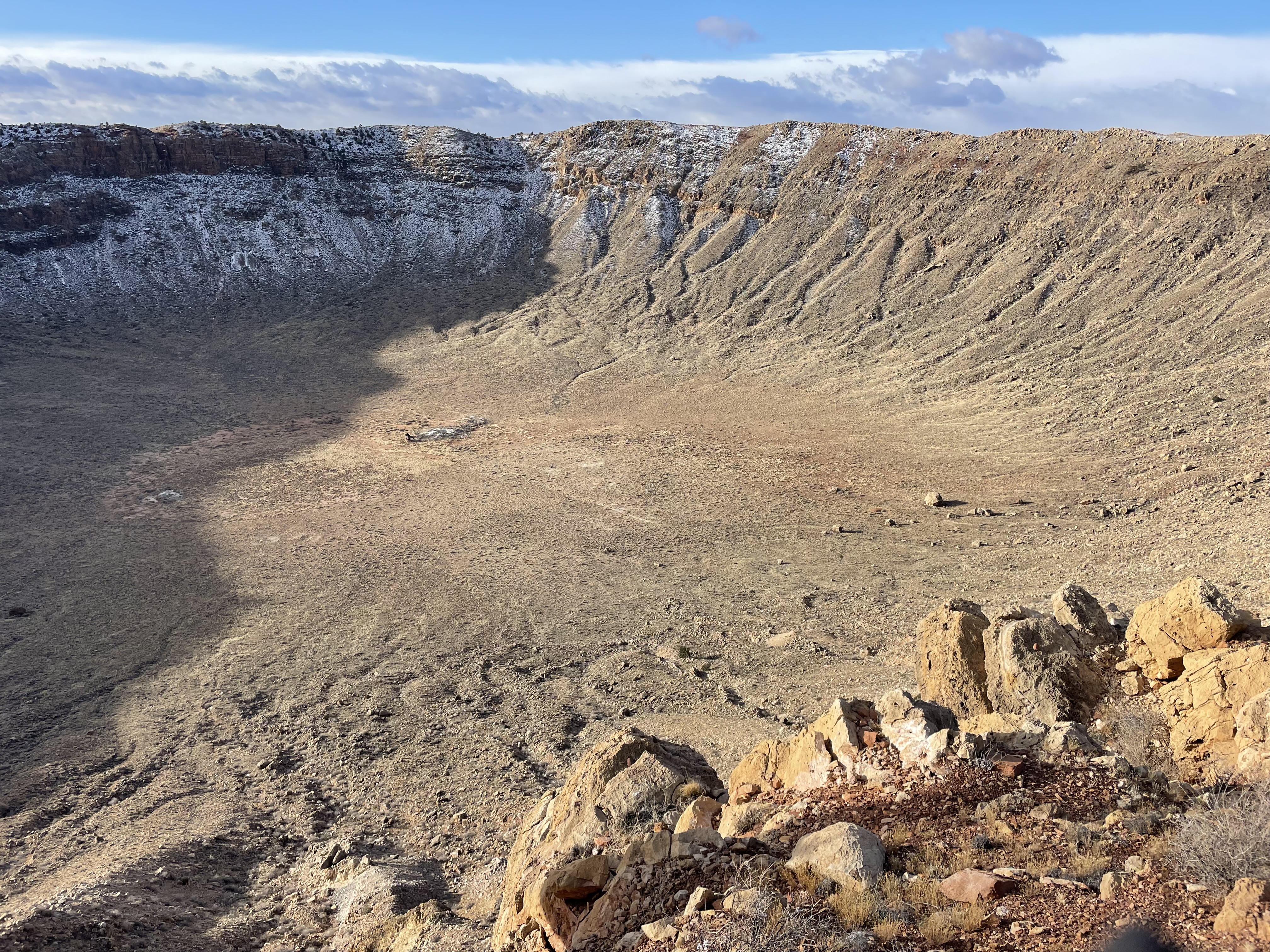
There is a privately-owned meteor crater in the middle of the desert in Arizona.
On the way to Flagstaff, on a staggeringly windswept stretch of arid desert, lies an impact zone– this crater is over 500 feet deep, and nearly 4,000 feet wide, and was definitively caused by a meteor that fell from the sky.
When I say windy, I mean it– gusts that day were up to 60-75 MPH, and in the dead of winter– without the handrails, that might have been enough to knock you off your feet. The wind was bitingly cold– a snowstorm was concurrently layering on the fluff in Flagstaff, so the bitterness of the wind meant deploying every layer possible against the bluster.


The Meteor Crater is not a national park, nor a national monument– remember, it’s in private hands. So the effect was more like ‘Space Disney in the Middle of Nowhere’ than ‘Scientific Discovery Site’– though NASA has trained on the site.
The commercial aspect of Meteor Crater was unmistakably loud. Sound effects in the entrance of the ticket office, a fake flight simulator for the kiddos, a bustling cafe, and a gift shop teeming with merchandise.
There was even a First Mate Space Jackelope Mascot (of sorts)– but if you’re a grown adult, and not a group of school kids, you can skip through all of this and head right to the crater, which lies beyond all of it. And once you emerge from the commercial wonderland of space hype, it gets… much… quieter.
And vaster.
And emptier.


The earth was pummeled 50,000 years ago by a meteor of unknown size– but about 2 1/2 feet of it (pictured below right) was all that was ever found. And originally. nobody believed that it was a crater from a meteor strike. Convincing them took some doing.
Daniel Barringer (of the family that still owns the site today) was a businessman and miner, who realized that if he could find the meteor buried deep below the surface of the impact point, that he could potentially make millions or billions selling the parts of the meteor for iron ore. To do that, he had to locate it.
Over his lifetime, Barringer spent about $500,000– or the equivalent of $7 million in today’s dollars– on trying to find the remnants (or the payload) of that meteor, only to come up empty after 27 years. In 1907, science hadn’t yet adopted the knowledge that most meteors are vaporized on impact– so, poor Barringer was looking for something that simply wasn’t there.


He was desperate to prove the crater was truly the result of a meteor strike– as most posited it was volcanic, as other similar geologic finds had been. Evidence of Daniel’s attempted excavations lie at the bottom of the crater– a mine shaft that was dug, and then abandoned– some ordinance from attempts to blast earth away to find the elusive meteor. The materials left by a man possessed with an idea are visible by spyglass from the rim.
Ultimately, long after his death, he was proven to be right– as the science advanced enough to definitively show the trajectory, speed, and impact of the meteor that caused this crater. But in his lifetime, he was ridiculed and worse for his belief.
It was the determination of Daniel Barringer that eventually paid off in the crater being designated one of the “best-preserved craters in the world”– and even though he didn’t live to see it proven– his doggedness was something to celebrate. Even though he looked in all the wrong places for proof, Daniel’s crater still exists for people to admire and tour today.
If you’re on the road to Flagstaff, the road can be pretty desolate– the evidence of which is below. You might do yourself a favor and break up that drive by visiting Meteor Crater, and skipping right by the Space Jackelope to see the awe-inspiring crater.


Posted by Sun


