

Marfa is one of the only places in America in which there is still an unsolved mystery– a natural phenomenon that has been occurring for 100 years that nobody can explain or account for.
The Marfa Lights so intrigued James Dean, that he bought a telescope and sat by his hotel window for hours and hours each night. (He had been in town to film the western movie “Giant”). These lights are not always visible, so seeing them is not guaranteed– but, more on that later.
When I say Marfa is fully in the middle of nowhere, I mean it.


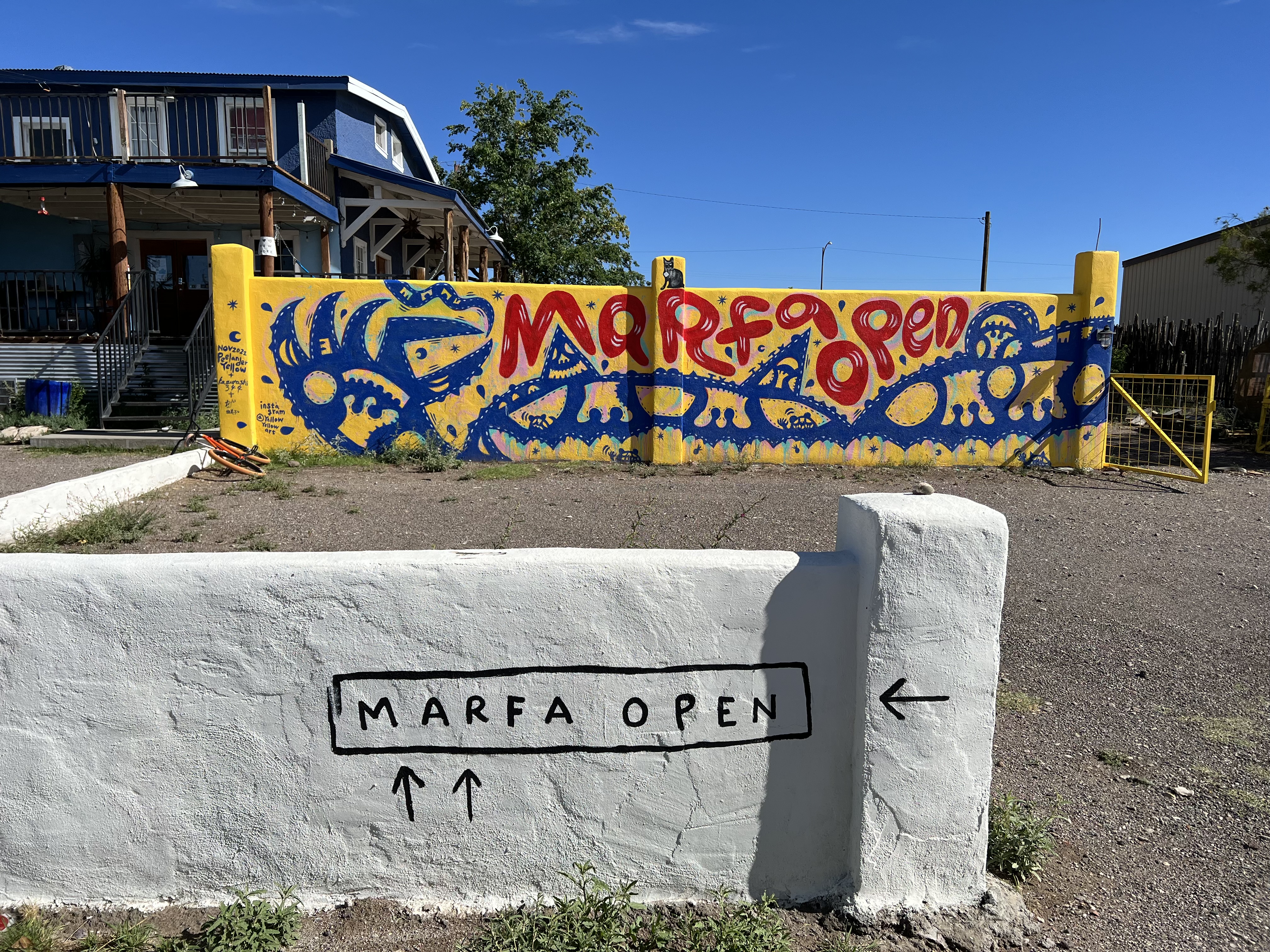
Marfa is an artist community, first and foremost– and due the popularity of photos of the town on Instagram, I worried the place would be overrun with tourists seeking a perfect social media photograph. But I was happy to see that remoteness suited Marfa just fine– though the weekends involved more foot traffic, it was largely very chill during the week in early summer– living up to its relaxed art-hamlet reputation.

The downtown was quaint, and not in a manufactured way– it was a historic downtown that had been modernized, while still keeping the vintage vibe. The shops that lined the street were full of locally-made goods, handmade jewelry, and art created by the artists of Marfa– with an emphasis on home decor, western-inspired wear, and original art of every kind (printmaking, photography, paintings, etc).


I tried not to share close-up photos of the art we saw in the shops– as these original works were often inventive and beautiful, but I didn’t want them to be copied by Urban Outfitters or other huge sellers. And given the prevalence of that, I elected not to take close photos of the excellent arts and crafts.
I WILL definitely share one of the most brilliant artists we were introduced to. Carla Fernandez, a Mexican artist and clothing designer who made beautiful, original clothing. Often based in traditional textile designs from the past, she contemporizes these traditional styles and patterns to create cutting-edge looks. The below picture does not do the clothing justice– check out her website below.

If you want to know what it is like to live in such an isolated town, just ask any of the store proprietors (the people manning the stores were often the owners), and they will give you an honest view of life in a remote arts community. As you can imagine, it’s not all roses– one mentioned the dating pool was tiny.
The food and drink in Marfa is a huge draw– what I didn’t know ahead of time, was the town actually distills their own spirits from the Sotol plant– featuring one of the only distilleries to do so. The plant is pictured below, made from the dasylirion cactus– it’s a clear liquor that tastes like moonshine (and was banned by the Mexican government for over 50 years).
The cocktails made of Sotol liquor, at the Marfa Spirit Company, were tremendous. Marfa Spirit Company was in an old grain silo, with the quality of cocktails you would expect in a high-end Manhattan cocktail bar. A little too easy to drink, limiting yourself to one is a good idea– Sotol is high in alcohol content.


At Marfa Spirit company, they host pop-up food vendors, and featured a Thai vendor that made a tofu curry that was so layered and good (and so spicy!) that it passed muster with my buddy, who lived over in Thailand for several years. I unexpectedly bit into a whole Thai chili, and swallowed it down before realizing it was going to burn so hard, it took my breath away. It was embarrassing– my eyes watered, I coughed a few times, and guzzled my cocktail down to kill the sear. Which barely worked!
The food in Marfa never disappointed, and always exceeded expectations– especially given its location in Texas, where burgers and steaks rule all. For such a small town, there were specialized and varied restaurant styles, ranging from Thai to Italian to New American to French.


Bordo, a local Italian restaurant, featured one of the most astounding Italian meals I ever had. The pasta with Brussels sprouts, fresh ricotta, whole pine nuts, and pesto, was so well-seasoned and deeply flavorful, it blew our minds. They also had Lemon Italian “fizzy” candies, that were outrageously flavorful and deeply satisfying to hold in your mouth. We mainlined 4-5 of them in just about 10-20 minutes.


The Marfa Courthouse offers the opportunity to see the ‘entire’ town from above. Since this hamlet only stretches a few miles before the expanse takes over, there wasn’t too much to see– but it did underscore how this small community managed to capture the imagination of artists around the country.


We went to a few galleries, one of which specialized in electronic art. Art Blocks– a gallery focused entirely on art located on and purchased through the Ethereum blockchain. Apparently, some local artists had some pushback when it opened, questioning its value– but the gallery now does tens of millions in sales each year of limited-edition (NFT) art.
As we toured the gallery with the gallerist, she mentioned the digital art encompassed anything that once had a digital element to it– so the works could appear as art on paper (print outs), or as sculptures (3-d modeling using computation), or even other forms like music. ‘Generative Art’ is a term that is wider than ‘computer’ or ‘digital’ art– generative art is “created with the use of an autonomous system”.
So, remember that ANY art made with the aide of a computer might be ‘generative’ art. And that not all generative or digital art is the NFT profile-pictures you see on social media.


Now, back to those mystery lights!
At nightfall, typically between the hours of 8 PM and 10 PM, on a certain horizon just outside of town– some mysterious white and yellow dots occasionally appear on the horizon, at-random.
IF you’re lucky. My favorite question for folks who had traveled to Marfa was, “Did you see the lights?” — and most of them answered “honestly, no.” Thus, we had set our expectations low– and figured we’d see nothing. As the sun went down, and the sky darkened– a small crowd gathered to peer at the horizon at the appointed viewing platform just outside town.


By the time night fell, a group of about 25 people sat and quietly chitchatted, waiting expectantly.
The Marfa Lights were first spotted in 1833, when a cowhand saw a flickering on the distant horizon. When he told others, they assumed it was a campfire– but no evidence of this campsite was ever found, upon further examination. In 1855, others reported seeing a similar phenomenon. And as I mentioned, James Dean was later fascinated by them, as were many others, who tried ardently to find their cause.
Despite all this attention, the exact origin or reason for the Marfa lights is unknown. That’s right. It is one of America’s few last mysteries.


After 8 PM rolled around, we saw them. Between two fixed red lights (radio towers that were visible before dark), a series of yellow or white lights dotted the horizon repeatedly, and yet were not stationary. They MOVED– but did not move based on any pattern. They were not a uniform brightness, but varied in timing, size, lustre, and duration.

The below video is worth watching. I can’t emphasize this enough– while theories abound, nobody knows what causes this. As I mentioned, the two red lights are stationary radio towers– every other light you see in this video is a random Marfa light. (Other than the lightning in the sky, of course).
We were amazed at this phenomenon– which sent a chill up our spines a bit. Eerie, as well as exciting– we parked the van next to the viewing platform and slept overnight there. The stars were magnificent.


Donald Judd was an artist and architect that originally had the vision of Marfa as a town for artists. His foundation (the Chinati Foundation) is located in a building in Marfa that just has “Judd” written on the outside. Judd was considered a minimalist artist and a premier example of that– but hated that term. His work was simple, using repeated forms and negative space, and he loved to reside in places where desolate landscapes inspired him. Thus, found himself in Marfa in the early 70s, where he began using aluminum to make huge scale sculptures, and got into furniture and architecture as well. His studio is being preserved currently, and visitors can take a paid tour. (His early works are below right).


One of the “attractions” of Marfa is the Prada Store, the installation art piece by a duo named Elmgreen & Dragset, and was placed about 25 miles outside the city in 2005. Costing about $125,000 to create, the building was meant to be an installation that worked in its surroundings, degrading naturally over time as it crumbled into the landscape. To its credit, the Prada brand gave permission for the artists to use the name and likeness of the brand, and even supplied the original contents — shoes and handbags from the collection.
Which of course, was too compelling to thieves– who broke in on the VERY first night after completion, stealing the wares inside. Texas state officials did not notice ANY of this until 2013, when the nascent publication Playboy tried to gain attention by adding a bunny installation of their own in the same vicinity. They subsequently passed a law declaring Prada Marfa a museum, allowing it to remain where the Playboy bunny art piece was deemed an advertisement, and removed.


This installation was really striking to view in-person. Its remote location was the star, a backdrop so ludicrous as to be puzzling– its consumerist commentary is laid bare. When paired with the hard landscape, the luxury brand becomes meaningless, as frivolous as vapor.


Marfa is the kind of laid-back town where energy still flows– the pulse of working artists is all over the place, placing a beating heart in the middle of what could easily have become a remote dying town. Protected by its remoteness, my friend remarked that the hype was unable to ruin the town. And being in the arts herself, felt the place represented the rare symbiotic relationship between money and creative– a truly balanced relationship, in which money was the benefactor but not the spoiler.
Leaving town, we passed these sculptural installations marking the ranch where James Dean and Elizabeth Taylor filmed near Marfa– and where he fell in love with the Marfa lights. A fitting end to a wonderful visit. Make the drive to Marfa– you won’t regret it.


Posted by Sun


