
When a friend tells you they need to go to Mobile, Alabama to pick up a large volume of kitchen things from their family that can’t be shipped (without paying a small fortune)— your first offer should definitely be to drive them there to fetch those items.
I’m telling you this just in case this exact situation ever happens to you. (LOL).


While I’ll admit that Mobile, Alabama wasn’t on my immediate list of places to go in the van, I also have loved the absolute treat of going unexpected places in my year on the road. Fortunately, I had no expectations of the place, and was ready to fully immerse myself in whatever came my way.
Unfortunately, I’ll always remember Mobile, Alabama as the place I rode out a furious, nasty bout of COVID in a trailer park. In weather that was practically warm enough to fry an egg on the hood of my van, and humidity that was nearly moist enough to bathe in.
I was feeling really depleted when my buddy and I arrived into town— I assumed, because of the 3-day sprint we had just made from the Western U.S. to the East, with few stops between.
Just to be sure, I took a COVID test and BLAMMO!!— I had COVID. And unsurprisingly, so did my friend. We HAD been sitting next to each other in a small space for 3 straight days. She promptly removed herself from her family’s residence, and withdrew to a cottage to recover.
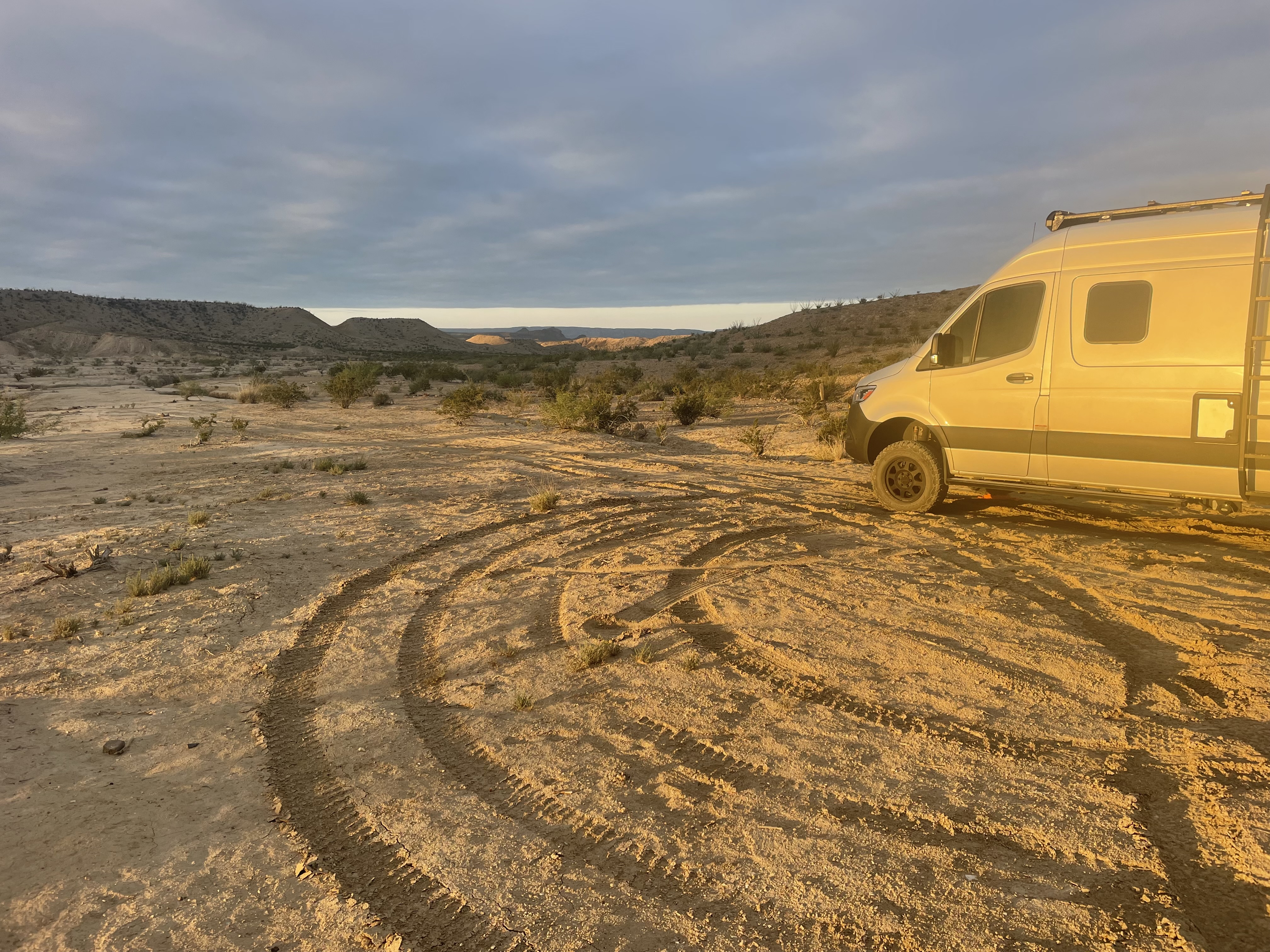
And I just sat for 7 straight days in a mobile home park in the van.
It was miserable.
I woke up hot each morning— not just on account of my fever, but also, the unrelenting heat and blanket-like humidity outside. It was so blazing out, the sink inside the van started to smell like dampness. The rank odor, combined with the fact that I was having to forego showers in order not to get anyone else sick? Made for an ‘interesting’ combination.
It’s never fun to be sick in the van. But it’s ZERO fun to have COVID in the van.
Do I have any pictures of myself or the van during this time? Absolutely not. And even if I did, would you even want to see them? I THINK NOT.
I am happy to report that Mac actually had a great time at the trailer park during this downtime— there were squirrels all around in the big gnarled trees, and he scampered after them in the morning and evening. Poor guy hadn’t seen a proper squirrel all winter— and was ready to battle.
Needless to say, I was counting the days until I tested negative.
Once both of us were testing properly negative, my friend and I set out for an outdoor destination, where we could continue to distance from people (just in case): the white sand beaches of Alabama’s Gulf Coast. And wow, were these beaches gorgeous.


Having lived in Australia and seen the famed Gold Coast beaches while overseas, I was not expecting beaches of similar beauty to be found off the coast of Mobile. But the beaches were as pristine as many other FAR more well-known beaches in the world– and I suspect Alabamans like it that way.
Honestly, just one visit had me wondering why on EARTH Florida is more visited for its beaches– Florida’s beaches being generally overcrowded, overlittered, and overdeveloped. These Alabama Gulf Coast beaches were underutilized, clean, and underdeveloped by contrast.
Being at Alabama’s white sand beaches made Florida seem like the older fraternity brother that just won’t quit partying even though he’s long past his prime years.
Case in point: it was 80-plus degrees and sunny, and this beach cafe was tame and chill. Granted, it wasn’t yet the high season, but late spring was hardly the low season.


My goodness, it was the most peaceful beach town I’ve been to in awhile. And the water was warm and wonderful– plus, it’s only a short drive from downtown, so easy to make a day trip.
Also, did you know that Mobile, Alabama– NOT New Orleans, invented Mardi Gras?
Well, I certainly didn’t. Until I went to the charming Mobile Carnival Museum. (Though, I would not blame you if you found the sculptures outside this museum a bit frightening. I would totally understand that.)


Inside, I was greeted by a delightful volunteer, who informed me that a 20-minute video would be the right place to start. This video was… clearly from the 1980s. It explained that the first Mardi Gras was just a drunken romp way back in the late 1690s– apparently, these were stationary festivals for a hundred years, and parading was not introduced until 1831.
Why then? Well, a dude was wasted with a few friends and thought it would be funny to steal a few items from an all-night hardware store, and form a ‘procession’ down the main street of the city making a ruckus with mop handles, pots and pans. Thus, the revelers began the Mardi Gras tradition of parading with a “mystic society”– a group of friends who selectively invited others to join their marauding.
(Not exactly an inspiring story, but a fitting one (and according to the video, a true one).
The museum was mostly made of outfits the revelers had used in the past– ESPECIALLY those of the King and Queen. Apparently, the King (always named Felix no matter his real name) and the Queen wear elaborately-designed capes and trains. The designs were so complex, it is a bona fide profession in Mobile to design and make them!


Each mystic society had its own section of the museum– and given how closed the “mystic societies” were (invite-only) for years, it became clear at some point that the photos of the past were almost exclusively of patrician white folks. And that started to feel more and more strange. In a geography like Mobile that is so ethnically diverse, the finery of Mardi Gras had clearly been very white and very wealthy for most of its existence.


Case in-point: these wild portraits that former Kings and Queens had commissioned.

I overheard a tour guide saying to another guest, “In Mobile, if your grandma and grandpa did it, then we do it today. It’s all about tradition.” And that stuck out to my ear– in the south, ‘tradition’ and looking backward for inspiration on how to live– well, that is typically more pleasant for one race than the other. To say the LEAST.
There are (still) TWO SEPARATE coronations in Mobile’s Mardi Gras– one for the white King and Queen, and one for the Black King and Queen. This was documented in the film “The Order of Myths” — a documentary from Margaret Brown about these separate mystic societies and their separate events.
Read more about the documentary here (it’s available on Netflix!):
https://itvs.org/about/pressroom/press-release/the-order-of-myths-reveals-parallel-black/
The attire below were examples from the Black mystical order, and were some of the best-decorated capes and trains in the museum. It was stunning to see the mystic orders still cut on color lines in 2023, and I honestly left the museum more unsettled than when I walked in.
The “tradition” of Mardi Gras seemed dated, and constricting.


Mobile had a lot of churches– some quite small and humble, and others quite large. Interestingly, my friend’s family pointed out that an overlarge sculpture of The Bible was placed outside of the art museum. (by the city, no less). It was a stark reminder that religious life can be the center of life in some places– where “Where do you go to church?” was often an opening line in conversation.


Did I mention that Mobile also has boiled peanuts at farm stands, as around the rest of the South?
They DO. And I LOVE boiled peanuts– especially the Cajun kind. Which I am pretty sure are boiled in chicken broth (not exactly vegetarian), but I let it slip by, as they were delicious.
Never had a boiled peanut? Well, they are polarizing– the texture isn’t mushy, but it is soft– not at all what you might be expecting from a nut. They are boiled in salty, briny water, so they are definitely salty– and taste nearly of the sea.


Which brings me to another of my other Southern favorites I could not wait to get– Fried Green Tomatoes. The Maple Street Biscuit Company in Mobile was ready to accommodate my needs, with freshly-breaded and fried green tomatoes that were perfectly-seasoned (look at that crisp breading). The house-made ranch was buttery and full of fresh dill, and the combination was phenomenal.
(Sadly, I can’t say the same about Maple Street’s namesake biscuits, which were disappointing).


The thing I will remember most about Mobile in the Spring was the magnolia trees– they were the tallest and biggest I had ever seen. And produced the most exquisite flowers.


The best place to see magnolia trees in town was also a graveyard, aptly named Magnolia Cemetery. It was unexpectedly, also a Confederate Cemetery– though that should not have surprised me, in retrospect. There were sections that pre-dated the war, and were even war dead from World War 1, so it was not exclusive to The Confederacy– but the section with Confederate soldiers was large.


Wild story on the placard– let me paraphrase it, since it’s small in the photos.
Basically, a monument of a confederate soldier was erected in 1876, and then in 1931, a lightning strike shattered the statue to pieces. The weather gods CLEARLY decided that too much reverence for a racist cause was not cool– the bust was all that was salvaged, and is still displayed onsite.
Till the next lightning storm, I guess.


I headed to downtown Mobile one day and got a plate of delicious Southern favorites (made vegetarian-friendly), at The Noble South, on recommendation from my buddy’s family. The Brussels sprouts, mac n’ cheese, and southern beans were incredible, and well-portioned for lunchtime.


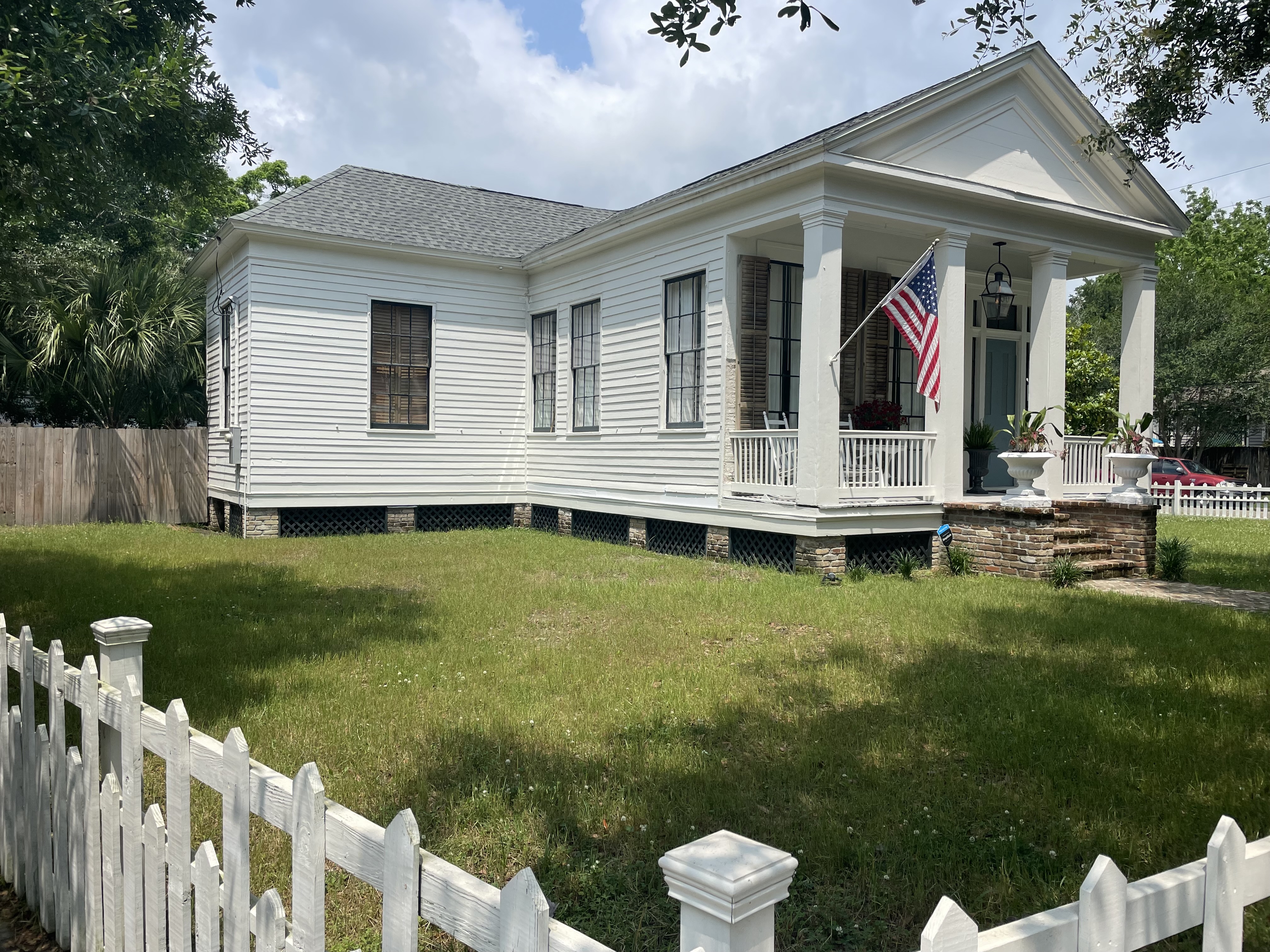
Walking around after lunch, I strolled through the neighborhoods with Mac. The houses and cottages were lovely, and the springtime flowers gave the place some real charm.


There was also poverty in Mobile. And if you have read this blog in the past, you know I am totally against “poverty porn” and will generally not photograph structures or homes that are dilapidated for the ‘art’ of doing so. In this case, Mobile was such an example of extremes, side-by-side, that I couldn’t write a blog depicting Mobile without talking about just that: extreme wealth next to those just barely scraping by.


The wealthy sections of town were VERY wealthy– steeped in the tradition of what is called “antebellum architecture”– AKA, plantation-style architecture. It was hard to think these mansions were anything-but owned by people that had some wealth gained either directly or indirectly from the slave trade, or ownership of enslaved people– as Mobile had a sprawling cotton business.
One of these gentry houses, The Bragg-Mitchell Mansion, declares on its website, “With the grace and elegance of traditional Southern entertaining, the Mansion is available for weddings, receptions, parties, showers, dinners and corporate functions… the Bragg-Mitchell Mansion is an architectural icon representing the Old South, an image that evokes a time of gracious living and socializing.”
Well, if you think ‘socializing’ was what the ‘Old South’ was about, rather than normalizing torture– then perhaps this would be appealing. But otherwise, seeing these places was grim.
In my travels, I have a “no plantations” rule– I won’t pay to walk the grounds or hear about the families that lived in them. It’s a serious crime of omission.


Were these homes beautiful, architecturally? Absolutely.
Did they also put a gorgeous facade on one of the most heinous acts of human history? Yes.
Walking around Mobile in May, the green Spanish moss was hanging everywhere– a plant that requires heaps of humidity, this was a visual reminder of the sub-tropical conditions I waded– I mean strolled– through. Mac was often exhausted by the heat after walking just a few steps, and so was I.


Spending time in Mobile, Alabama– while truncated by having COVID– was a fascinating stint. The place was distinct, between the heavy and humid air, the Mardi Gras dynamic, the mix between mighty-rich and very-poor, and the moral tinge of religiosity. As well as the volatile weather– seeing BOTH tornado AND hurricane warning magnets on the same fridge was new to me.
Also, Mac must have done something wild to get those Mardi Gras beads– he was looking so sheepish while wearing them. What the heck, Mac?!


Posted by Sun


