
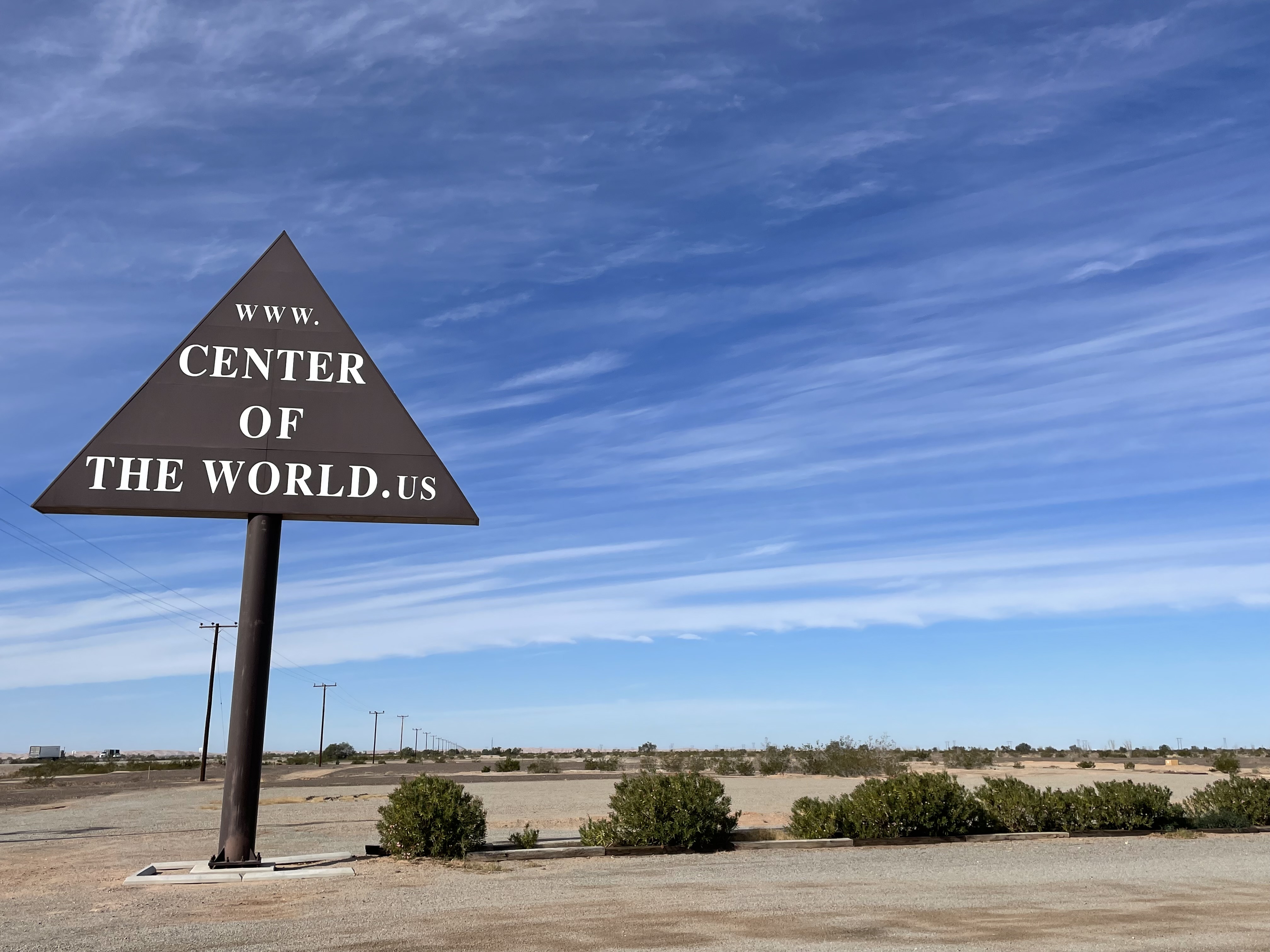
Traveling east from Southern California to Arizona, you will pass “The Center of the World.”
There’s no mistaking it– a massive black triangle sign beckons from the highway, and begs the natural question: What the…?! Flabbergasted but intrigued (the perfect combination of feelings about a potential roadside stop), we jerked the wheel toward the nearest exit ramp.
As we approached The Center of the World (also known as the Museum of History in Granite), it felt like entering an otherworldly place, as initially, the only visible structures were a granite pyramid and a white chapel high on a hill in the distance. It was unclear what we were supposed to do there– so we wandered about the grounds for a few minutes, before an employee approached.


“It’s $7 for the tour, and $3 to go into the pyramid and stand on the official Center of the World.”
Moon must have hesitated briefly.
“You’ll get a official certificate listing the exact time and date that you touched the spot, on which you’ll make a wish.”
Moon couldn’t have agreed faster.


The employee unlocked the pyramid without ceremony, and Moon and I entered the space, which was letting in slats of light everywhere. She carried a clipboard with 2 certificates, on which she dutifully printed our full names, and then pulled a pocketwatch with a sweeping second hand from her pocket.
She was clearly waiting for the moment we stepped onto the circle. But neither Moon nor I had formulated a wish– we hastily came up with one each, after reflecting quietly. Moon was first to step onto the bronze plate marked “Official Center of the World,” as the employee noted the time– down to the second– on the certificate. Next, it was my turn.
But the mysteries of this place were just unfolding– after stepping out of the pyramid, we saw a vast number of marble slabs.
All of the marble slabs were arranged in a pattern leading to the chapel. We set off to explore the contents.


The Museum of History in Granite was just as ambitious of a project as it sounded. The slabs contained “The History of the United States of America,” “The History of Humanity,” “The History of California,” The History of Arizona,” and surprisingly, fairly good reproductions of the most famous artworks of all time (mostly Renissance), all carved painstakingly into granite slabs.
The impact was both beautiful and strange– given that granite slabs tend to be arbiters of a death, to see human culture displayed in this way was unnerving. It felt magnificent to see all of history assembled in one place, but also– seemed to foreshadow a time in the future in which humanity would need to be remembered or rediscovered, due to a natural mortality for all things.
Being that we had seen so many roadside attractions that put forth a fanatical or skewed version of some event, it was refreshing to see an even-handed, factual portrayal of civilizations old and new. While the task of choosing what to include felt overwhelming, the broad strokes of information given in such limited space on each panel, still felt fairly comprehensive– and shockingly, didn’t reveal bias. The creator of these seemed to be working hard to represent history as accurately as possible.


As we ventured further in, we saw a piece of granite with letters and numbers in many key languages around them– and a dedication saying “On behalf of the people of the world, this monument is designed as a key for visitors of the far distant future to understand our writings”– the person who made this place literally made a modern Rosetta Stone. Something for others to find, so they could interpret not just our language, but our history.
How ambitious is that? A guide to all of human history and our understanding, from the planets, to animals, to the stars, to wars, to empires, to food, to culture, to art– for… some other visitor to see in the far-flung future. Just in case we’re not here, or can’t communicate with them? A strange, but ultimately non-problematic, way to spend a fortune, I guess.
Western cultures seemed to be slightly over-represented, as were men and their historical contributions. But many histories have contained the same omissions. We only detected a few panels that had a hilarious (but harmless) bias to them: the crustaceans panel was labeled “Tasty Crustaceans,” the Monkey panel inexplicably said “Baby monkeys are charming, grown-ups less so” and the panel “And Cheese” caused us to burst out laughing in agreement, as we thought cheese was pretty important to document, too.


The non-denominational chapel at the top of the exhibit was quiet and reflective.
The strangest thing of all about The Center of the World is the story of how it was deemed as-such. A man, Jacques-Andre Istel, founded a “town” and named it after his wife, Felicia– the town was called Felicity. He then proceeded to petition governments to have his parcel of land dedicated as the central point of the world, and was told that a designation would have to be based on a textual reference. So, he wrote a children’s book about a fictional dragon, and used that as a precursor for his claim. Then, Imperial County recognized his land as The Center of the World.
Even better, Jacques is the mayor of the town of Felicity– he won his election 3 votes to none– him and his wife being 2 of the votes, and the other being a vote from the fictional dragon in his story. I promise, I am not kidding you. See this article in Roadside America as documentation: https://www.roadsideamerica.com/story/2036.
Ultimately, we would heartily recommend a stop at The Center of the World. Being out on the road, we’d never seen anything like it: a love letter to humanity and the earth, inscribed in a semi-permanent material for posterity.
I’ll leave you with a video I took as we approached the non-denominational chapel, about to climb the voluminous amount of steps. Whatever you think of The Center of the World– in such desolate surrounds, this odd monument to humanity and our planet could feel both comforting and deeply unsettling.

Posted by Sun


