


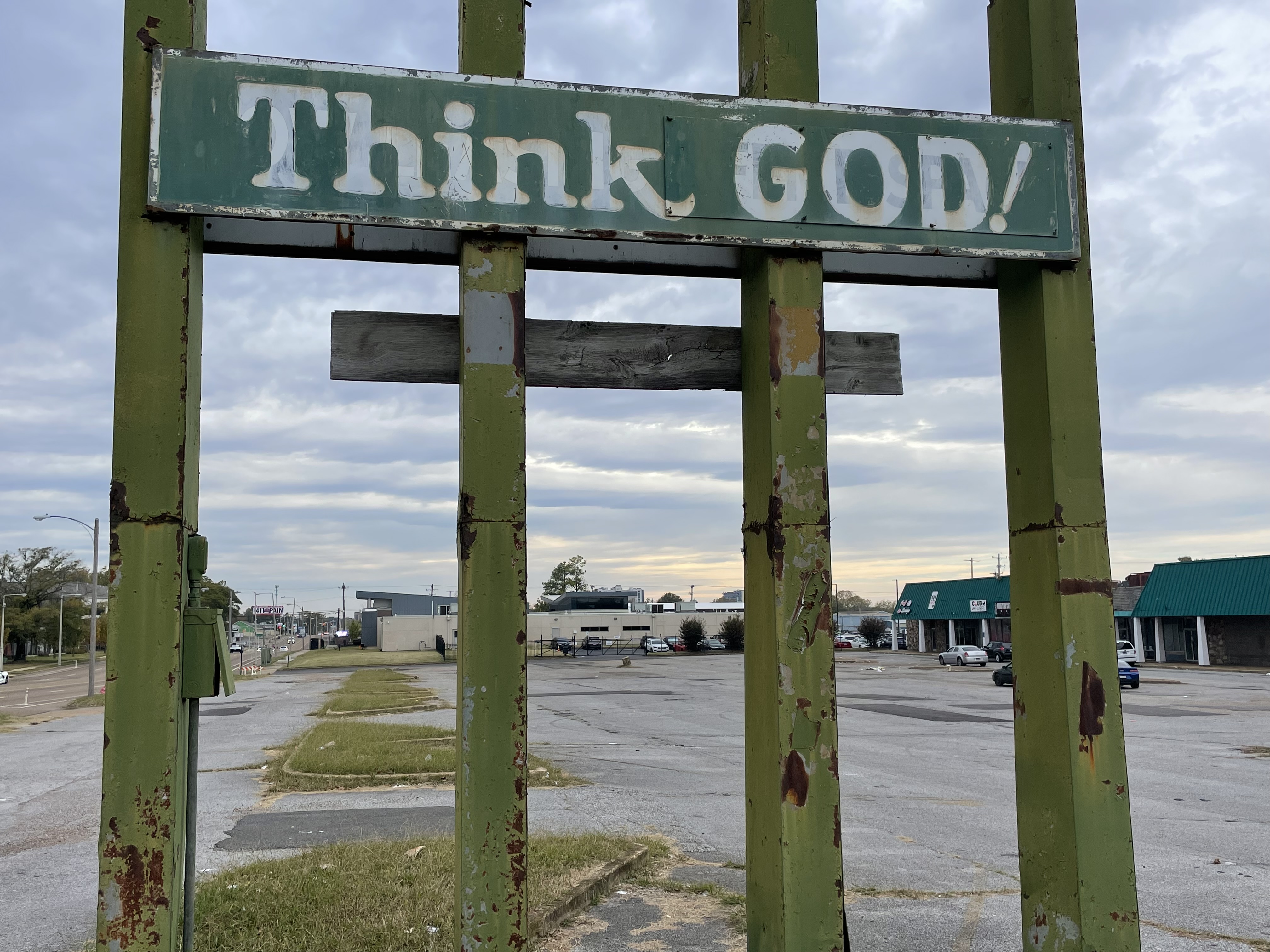
One of the most historically-significant cities in history, Memphis has a ton to offer to visitors who are keen to soak up the past in order to help make sense of the present. Right on the banks of the critical vein of the Mississippi, Memphis had a huge role to play in the growth of the nation, and was setting to some of the most consequential moments in our past.
And therefore– like history itself, Memphis was extremely complicated, and visiting brought up a lot of complex feelings.
Almost everything from the past in Memphis was fraught in the same way– the racial discrimination and enforced tiering of society by race in the South were unmistakable at every turn– from the prominent cotton fields visible on the drive into the city, to the Cotton Exchange and Museum, to the National Civil Rights Museum, to an underground railroad house, to Beale Street, to Graceland itself– all of these places had a collective theme: the abuse and mistreatment of Black people was an undercurrent running through the entire past of the place, as key to the city as the Mississippi itself.
Our first stop was the Cotton Museum– the building that housed the Cotton Exchange, a bustling marketplace where those with crop to sell would trade with buyers, merchants basing their pricing on the relative quality of a sample. This industry made up the bulk of the Memphis economy, and the trading floor (for men only), was a place where fortunes were made or busted, sometimes within the same day– according to the audio tour.


Back in the pre-electricity days, trades could only be made on sunny days, and on the top floor of the building, which featured an elaborate series of skylights to ensure maximal brightness for the best quality evaluations. The museum provided examples of different quality markers, with “Good Middling” being the highest-possible standard to achieve.
It’s not that the Cotton Museum left out the subject of the origin of the cotton– slave plantations– they touched on it briefly in a few videos at a terminal. But the focus of this particular museum was on the goings-on in the trade, the building, and the ways that cotton influenced Memphis society– read: white society.
Some of the most unsettling exhibits in the Cotton Museum were that of the way high society revolved around the pageantry of wealth achieved through cotton sales– for instance, the Cotton Carnival, and Cotton Carnival court. Yes, there was a Cotton King and Cotton Queen — crowned for decades at a ball, and several of the ornate cotton-based outfits they wore were displayed in the museum, along with pictures of the striking (and strikingly patrician and white) courts of the past.
It left a gnawing feeling in the stomach to see the smiles of wealthy white folks, who earned their societal and monetary status entirely on the forced labor of slaves, soaking in praise as if they themselves had achieved something.
It presented this importance of the crop to society as-it-was, but also was a clear tale of two different societies– one in which wealthy white people cavorted at balls carrying cotton-batch bouquets, and one in which slaves were worked within an inch of their lives to produce those same batches. In that context, the smiles of the individuals in the displays could look grotesque.
The Cotton Carnival– now called Carnival Memphis– still persists today: it benefits charity.
From there, we went to another complicated and somewhat problematic historical place: Graceland.


From the moment you arrive at Graceland, it looks a tollbooth from the exterior, with a huge “Graceland” sign that is reminiscent of the more famed “Hollywood” sign, and effect that felt transporting. We were told a video would start our visit– and the video whipped the mood into a frenzy with Elvis montages and important milestones in his life and career.
A short tram ride to the home– the actual Graceland estate, was next– but first, we were fitted with tablet audio guides (with most of the tour being made up of Boomers, this took a little more explaining than typical). Surprisingly, “Hi, I’m John Stamos” greeted us as the voice of the audio tour (we later found out his character on Full House was named after Elvis’ twin, who passed away at-birth). Perhaps that was reason enough for most, but it still struck us as an odd choice.
But then, odd choices would become the theme of the day.


Elvis had a real eye for design. and decorating Graceland was a hobby of his (along with others, including watching TV– he had one in every room, and no less than 3 in his den area).
The famous “Jungle Room” offered a green shag carpet, tiki statues, and fake plants that draped along everything. Elaborately- carved chairs the size of thrones dotted the space. Another room featured thousands of yards of expertly-draped fabric that gathered to one central point, like a circus tent. And his den featured strange statues and lots of reflective mirrors. The peacock stained glass in the living area served as an outrageous greeting to the space.
The John-Stamos-led, family-approved tour of the house and grounds was best-described as “sanitized,” keeping the focus on the decor and happy memories within the estate. It mentioned his death as if it was a mystery (not touching on Elvis’ long use of prescription drugs), and did not mention the fracturing of his relationship with Priscilla at all, as if it hadn’t happened).
Elvis’ outfits were a big draw for Moon. Almost exclusively designed by one man– Bill Belew. Mr. Belew was a costume designer who perfected Elvis’ look, including the wide collars and jumpsuits that became his signature. Thinking about it, Bill Belew had a lot to do with Elvis’ reign as the “King”– his unique style was easily half the appeal.


Whenever Moon and I hear a story being presented in a way that lacks blemish or marks, we endeavor to find the truth beyond that narrative. Our first place to go was straight to a primary source: we bought and began reading Priscilla Presley’s book, “Elvis and Me.” Published not too long after he died, Priscilla didn’t hold back on the relationship she maintained with the most famous man in the world. Elvis was definitively cheating on her for most of their marriage, rather brazenly– and was constantly putting constraints on Priscilla, dictating what she wore, how she did her makeup, and what she did (he forbade her from working, controlled her friendships, etc.).
Highly-volatile due to the mix of sleeping pills and amphetamines he was taking, Elvis was at-once loving and mean, but it was clear based on her book that Priscilla was a comfort object to him: one he felt he very much owned. He even plotted to kill a man that Priscilla was having a relationship with, making detailed arrangements he only called-off at the last minute.
The visitors at Graceland were resoundingly, noticeably, white.
Later the same week in Memphis, I had a conversation with a Black man in a blues club about Graceland. “Do Black people visit Graceland? Do you take guests there when they come to town?”. He smiled at the question: “No”.
There isn’t a definitive word out there about Elvis and race– to hear some tell it, he was a brave white teen who bucked the system of the time to embrace Black gospel music and maintained a host of Black mentors and friends throughout his life. To hear others speak of it, he was a low-talent face who siphoned off the music of Black people to become a “King” of a discipline that he popularized but had no real hand in creating.
When in doubt, I always defer to listening to Black voices on these contentious issues– and prominent artists from Big Momma Thornton to Little Richard to Ray Charles were clear about speaking what was undeniable– Elvis achieved astronomical success because of his palatability– his whiteness– and often re-recorded Black blues artists that barely made a penny for their trouble.
Big Momma Thornton used to begin her (original) version of “Hound Dog” by saying: “This is the record I made Elvis Presley rich on” and Ray Charles said, ““He was doing our kind of music… so what the hell am I supposed to get so excited about?”.
Elvis was an extremely flawed man, presented in deified version at Graceland, a stop which continued the Memphis refrain of exposing some ugly and complex race issues.
Next, it was time to go to the National Civil Rights Museum to absorb as much as we could.


Many spaces are either intentionally or unintentionally engineered around the comfort of white people, and the National Civil Rights Museum was NOT one of those places. Which was necessary and refreshing– both the text of the museum exhibits and the demeanor of the personnel did not mince words– they didn’t soften or cushion or beat around the bush. The exhibits presented were not concerned with softening a blow that was never softened for the ancestors of those brought as human chattel from Africa.
The museum was spectacular at presenting information– letting the activists speak for themselves in video displays or quotes, and allowing the profundity of their own statements to shine. The exhibits were both deeply-contextualized and pithy, a rare combination that kept information from becoming overwhelming, even when the raw emotions could become overwhelming.
For those who have not been, the National Civil Rights Museum is built into the former site of the Lorraine Motel, the instantly-recognizable front of the motel being where Dr. Martin Luther King Jr. was shot and killed. Walking up to the museum, the image is clearly one the mind crystallized, remembering a million photos in textbooks– a horrifying kind of postcard.
The room that Dr. King slept in the night before his murder was preserved, and marked the morose end of this particular museum– signs which highlighted the strike of the Memphis sanitation workers that had brought Dr. King to speak: a reminder that he was turning his attention more and more to systemic poverty as he approached the untimely end of his life.
The National Civil Rights Museum covers one of the most contentious periods in racial history in the United States, but also makes clear that most white Americans (not a racist few) consistently opposed even the most basic of freedoms for Black Americans — from their ability to eat in public, to travel unharmed, to work in a profession, to ride alongside the rest of their fellow humans. And that the prospect of any political or civic or educational access for Black Americans was perceived as an affront or threat to white people, who literally fought to preserve the status quo.
I remember being shocked by my ‘History of the 1960s’ course in college– wondering how the nation was only a few decades removed from this violent display of hatred to uphold an unjust caste system. But that was luxury of my privilege, and my subsequent deeper learning unraveled any sense that racial turmoil in America was a thing of the past or recent past.
It IS a thing of the present.
Having read and internalized the words of scholars and thinkers like Clint Smith, Ijeoma Oluo, Isabelle Wilkerson, Michelle Alexander, and so many others, I had come prepared to face the above fact. But the abuses and wrongdoing came seemingly-fresh every time, and the systemic oppression felt heavy, heavier with each added piece of wisdom one gleaned.
Our last past or our journey in Memphis was also an emotionally-devastating one.


The Burkle house was a stop on the Underground Railroad– a fact never discovered until a granddaughter of the original owner of the home finally divulged the estate’s secret near her death. Called “Slave Haven Museum”– tours beginning each hour.
The director and tour guide were fantastic at conveying a huge amount of information in pointed terms– never shying away from the brutality of slavery, refusing to allow guests to be coddled by nice stories, despite the hopefulness of escape for the few through this very house.
They shared facts about the Underground Railroad I barely knew, including the use of quilts decorated in a particular color or pattern to indicate wayfinding or to communicate messages to those on the path to escape. They shared the reality of the likelihood of escape (it was unlikely), and how ingrained slavery was in everyday life for white Americans. Hardly confined to slave markets, storefronts on main streets existed that carried “stock” and “inventory” of humans for sale. The “Negro Depot” flyer above was reproduced from a newspaper ad, advertising such an establishment.
It was horrifying to see.
The spaces in which enslaved people hid within the Burkle house were tight and unlit basement crawl spaces, meaning they might wait days or months for safe passage in the equivalent of an earthen hole.
The proprietors of the museum talked about Mr. Burkle, who was a German immigrant appalled by slavery. He kept up respectability in town by employing a Black “slave” who was actually an operative helping people to the North. She eventually ‘escaped’– quite intentionally– and Mr. Burkle pretended to search for her, without doing so.
The story was one of slim hope, and impossible odds– one not engineered to be a film-style narrative, but a mortifying magnifying glass held to an atrocity on an unthinkable scale.
I’d be lying if I didn’t acknowledge the clench in one’s stomach after bearing witness to so much cruelty and hatred– of course, Moon and I wanted to sit with– but not stew– in these uncomfortable and painful truths. We headed to Beale Street one night for a little release, and to hear the blues.


The drinks were welcome, and though the mood was a little somber, that suited the blues just fine.

Our visit to Memphis was extremely informative, and brought up a ton of emotions that we honestly spent weeks sifting through.
As Moon said in summary, “There are two different ways to look at Memphis– black and white.” A tale of two parallel and unequal societies within one city, that collided in front of our eyes again, and again, and again as we discovered the city.


Posted by Sun


