
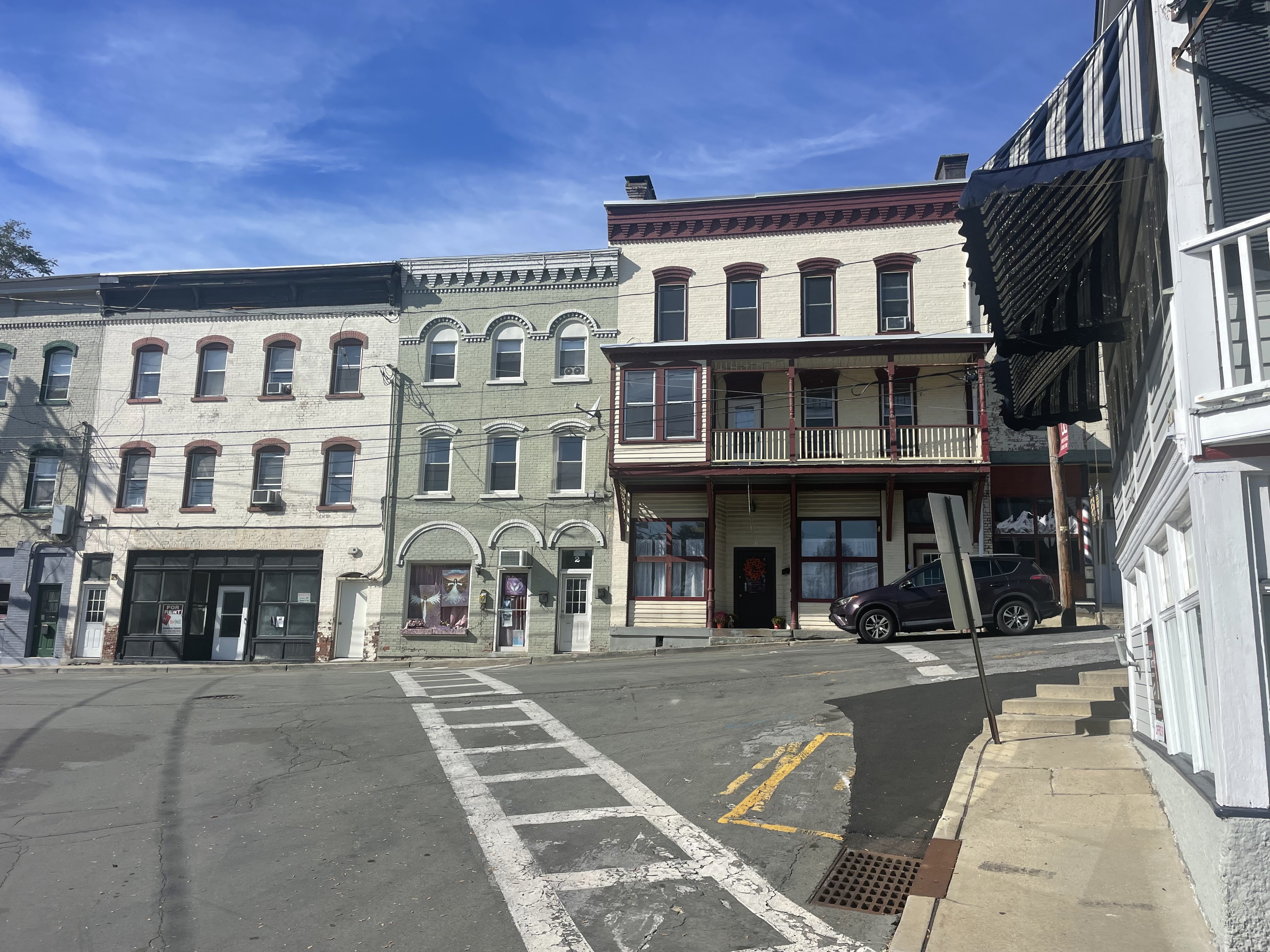

I decided to spend a day in Buffalo, New York, to spend a little time in an American city that used to be at the very center of goings-on in the country, but faded in the post-industrial era– a city damaged by outsourcing in the 70s and 80s that never quite recovered from the hit.
(Also, a friend wanted to meet up there for the day, so there was that motivation, too).
There’s a lot of folks out there that only hear about the “Rust Belt” when politicians drop in every four years to ask for votes, or when journalists from the coasts drive in from an airport for an afternoon to interview people at the “town diner” about foreign policy.
Being from the Midwest and a post-industrial-boom-to-bust-town myself, I don’t blame anyone for how one-dimensionally these places are portrayed, but I do know these cities and towns have a beating heart of culture that most would never guess at.
I started my day at Undergrounds, a coffee shop in the bowels of a former funeral home. To me, this spoke to the spirit of these places that is often unreported on. Yes, there are closures and small businesses that can’t stay afloat as population leaves, but there have also been tons of committed locals (and yes, even younger locals) who find a way to create something in the wake. (*’wake’! See what I did there? Eh? Eh? Funeral?).
Anyway…


Back to Undergrounds, a coffee shop with a menu organized by sandwiches and breakfast bowls named for awesome people like “The Russert” and “The William Wallace” and “Rick James Wrap” and “Maria Callas Wrap” to name a few. With loads of healthy options to pick from, I loved my breakfast bowl– but ALSO loved they named their coffee blends after badasses too. Their “Simply the Best” blend featured an ever-perfect Tina Turner on its label.
My buddy definitely picked up a “Simply The Best” blend and said it was exceptional.


Our next stop was also a bit macabre, the sight where the 25th President of the U.S., William McKinley, was assassinated on September 6th, 1901. After speaking to a crowd at a reception, he was approached by a crowd of mostly well-wishers. The assassin, Leon Czolgosz, had his hand wrapped in a handkerchief as he approached the President. His Secret Service guards normally would have flagged this as suspicious, but as it was a hot day, many carried kerchiefs and some security personnel assumed the cloth covered a war wound.
Czolgosz fired twice, and would have fired a third– but was stopped. The President was operated on by a rather unskilled surgeon, who left a bullet inside him, thinking it would do no harm. Gangrene eventually killed McKinley a few days later– while advancements like the X-Ray had been invented to make it easier to find bullets, one was never used on the president.
McKinley famously knew he was dying at the end, saying “”It is useless, gentlemen. I think we ought to have prayer.” Which is further proof that people were simply more eloquent in the past than today. As I would have had some nastier last words for my state, and probably the surgeon, as well.
The unfortunate (or fortunate) wording on the monument caught my eye– “This Shaft Was Erected” read the first line. A more mature traveler would have kept it together, but reader, I am not that traveler. My friend and I burst into laughter. (Luckily, no one was around to wonder why we were cracking up at the site where a president was killed).
Photographic evidence of the phrasing below:

After this medical mishap cost the president his life, Teddy Roosevelt was sworn in. That was the next stop of our little tour of historic Buffalo– the patrician home where Roosevelt stayed while he awaited news of McKinley, and where he was solemnly inaugurated in a small library within.


Tended by the National Park Service, this historic home did not belong to Roosevelt or his family, but to a wealthy friend, who did Roosevelt a solid by letting him bunk there.
The short guided tour of the Theodore Roosevelt Inaugural National Historic Site started with a cringeworthy video that featured a Teddy impersonator welcoming us. This actor did his best, but it was deeply odd to have a park ranger press play on a video of a two-bit actor playing the part of the long-dead President. This was a reminder that the park service doesn’t always “nail it.”


The Pan-American Exposition (a World’s Fair of Sorts) was the setting for McKinley’s visit– in 1901, the huge wonder was the exposition being lit up at night with electric bulbs– this extensive use of outdoor lighting was a marvel of the time. The quotes describing the awe of the lit-up night were lovely to read, and a reminder never to take anything for granted.
The tour culminated in a reproduction of Teddy’s Oval Office, which held a huge globe that Roosevelt liked to use as he thought about world affairs. The park rangers described that to see information on Roosevelt’s foreign policy achievements, we ought to look for the “Red Flags” on the globe.


Again, the park service is not always up on the lingo of the youth.
Next, we had lunch at an Indian restaurant that was so delicious, I forgot to photograph it– before we headed to the storied art museum: The Albright-Knox Art Gallery, or AKG, for short.


The interior of the lobby space was just beautifully-designed.

Even I was a bit surprised at how seminal of a museum the AKG was: the docent revealed that the AKG was the 8th art museum built in the young country, and was opened in 1905. She explained that Abraham Lincoln had visited there, and that the museum prided itself on collecting masterworks of well-known artists– she then circled several places on the map we’d find famous works.
This made for an experience that was different than a typical art museum.


It was certainly a head-turning experience: pieces of art that were familiar thanks to their inclusion in loads of history and art history books, placed all around. I honestly had trouble remembering if there were groupings of years or eras or styles of art, as it felt a bit like a pile-up instead: it all made for a disjointed experience.
The works themselves were lovely to see, of course, as this museum clearly took pains to include every artist a person was likely to get exposure to in American elementary and middle schools: Picasso, Matisse, Miro, Mondrian, Rothko, Johns, Warhol, and so on. There was one of the most well-known Khalo portraits that I’d seen in a million books. Though they also included more contemporary and slightly lesser-known artists like Jenny Holzer (who’s still pretty known), the gallery felt like a “Best Of” short story collection or a movie soundtrack album with ultra-famous bands.
There wasn’t a through line, so while each story or track on the metaphorical album was a hit, there wasn’t much holding them together. And that felt a little odd, like an endless Tik Tok scroll of great content, but one that leaves your head spinning as it tries to frame the un-framable.
I was glad to have spent an afternoon at The AKG Museum, as some of these works were mind-shattering to see in-person. If you appreciate art, you’ll love how the same works you saw on a two-dimensional page come brilliantly to-life when staring at the real deal.
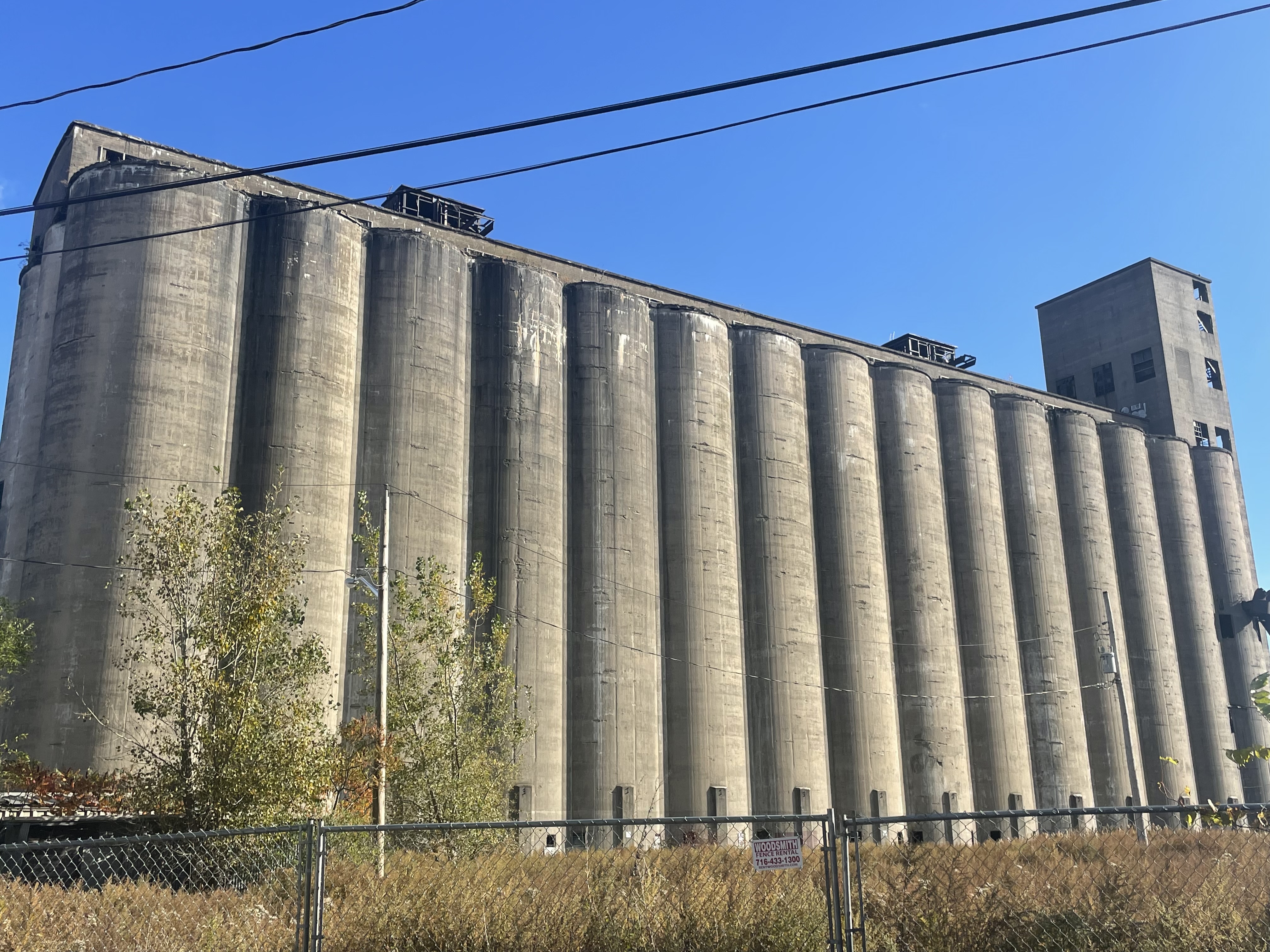
I had heard of an area in Buffalo called Silo City, and as late afternoon approached, we headed there.


Aptly named, Silo City is a district that (clearly) was the epicenter of the grain trade on the rivers running through Buffalo. A 501c3 has since taken over the area, and has begun the task of revitalizing it, bringing arts and nightlife to the area. And weddings– of course. (For those of you familiar with Cleveland’s Flats, this sounds similar).
These concrete grain silos and grain elevators were in-operation as late as 2017, but were built in the early 1900s as Buffalo boomed. This was another indicator of what is often-overlooked about cities that have been declared long-dead– I’m happy to say that reports of their ‘death’ are overstated.


A bar was tucked back in the middle of these Silos– called Duende, this charming bar and grill had delightful food, a great (local) tap list, and featured a live jazz band– The Wazmopolitans were playing the day we visited, and the sounds of live jazz filled the cozy space.


Buffalo has a lot to offer– perhaps contrary to popular opinion. Despite loads of flight after American-based manufacturing industries folded, people who stayed have made a point to build something new. They simply HAD to get creative, roll up their sleeves, and produce. Not to mention, because Buffalo and cities like it don’t have soaring housing costs the way other cities do, artists and makers can still afford to live there– and continue to transform the place.
Emblematic of that? A very weird sculpture the city just loves– called “Shark Girl,” this sculpture by artist Casey Riordan in 2004, was commissioned by the AKG Gallery and was so beloved, it was recently restored under the watchful eye of the artist.
Play the video below to see the absolutely ridiculous song that was playing over a loudspeaker at the nearby Children’s Museum when we were there: it really sets a tone.
Don’t overlook Buffalo in your travels– it’s got way more going for it than people think.

Posted by Sun


