

When you hear the words ‘Oklahoma City,’ what do you think of? I’ll wait.
If you were born in the 80s or before, you might think of the heinous bombing in the 90s first.
Oklahoma seemed to be a state known for terrible acts of the past– just as Tulsa was associated with unspeakable crime of the Tulsa Race Massacre, Oklahoma City — at least in my mind– was linked strongly to the horrifying tragedy of the Oklahoma City Bombing.
Perhaps because as a young teenager, this event was the first time my sense of security was shattered– being insulated in the Midwest within the powerful United States, I just didn’t think of being reached by the kind of violence that flashed across the rest of the world.
Until April of 1995.
But as it was so many years ago, my memory of the event was fuzzy– remembered as a terrible and sorrowful day, but not much else. I wanted to re-learn the history of this important event, so I went to the Oklahoma City National Memorial and Museum.


I wasn’t prepared for how affecting it would be. Off the bat, coming up the walk, one could see a wall of colorful handprints decorating a series of tiles lining the approach to the museum– that’s right, I remembered– dozens of children were killed. I had totally forgotten that a low-floor daycare in the building had absorbed much of the blast, instantly killing children as young as just months old.
These handprints put a visitor on-notice: this was going to be a wrenching stop, from start to finish.
When entering the memorial, which was chock full of visitors, we received a strange welcome– Oklahoma native and actress Kristin Chenoweth greeted the assembled crowd via video, imploring us to feel the gravity of the day that “began like any other.” It felt like an extremely odd choice to me, to include a famed actress as the voice of the museum. While I was a bit stunned by that, I admittedly had no knowledge of what it would be to be an Oklahoma resident during this, and I deferred further judgment.
As we released into the next room, I was struck– hadn’t realized was that an audio recording of the EXACT moment the bomb went off– something I had simply never known. We were placed into a room marked “Water Resources Board” to note the exact moment the recorded meeting of the water board began on that day. The tape of the actual meeting began to play.
It was 9 AM in the audio– a very mundane governmental meeting was being called to order. As 2 agonizingly long minutes passed, everyone around me had a sick look on their faces … waiting for what we knew would come next.


Then– a mid-sentence blast.
After that, we were taken into a room that depicted sheer carnage and chaos, but managed to do so in a way that was not graphic in itself. There was a barrage of audio consisting of confused and frightened news reports, and we were surrounded by glass cases with items — some items from the buildings, some items owned by those killed in the blast: eyeglasses, keys, briefcases, a wall clock that stopped cold at the exact time of the explosion.
Projected onto the glass were gut-wrenching quotes from first responders, the first people inside to call for help, and eyewitnesses. A melange of broken office mugs caught me in the throat– reminding me of many mornings spent chatting around the coffee pot with my own co-workers over the years.


The image of the federal building after the explosion was familiar, but that didn’t make it any less jarring to see again– the entire facade of the building was gone, and fully half of the building was in rubble– it looked like someone had sliced this massive concrete building in half with a hot knife.

Another part of this lived history that had faded from my mind was how many people were buried in the rubble, and lived on. Thus, the search went on for many days– the site had been an active search-and-rescue zone for nearly two weeks, before the building was declared too unstable to continue (May 5th), and hope for any survivors had receded. In the end, all dead bodies (except for 3) were recovered before the work had to cease due to unsafe working conditions.
I was struck by how astonished the news personalities like Peter Jennings and Katie Couric seemed on-air, trying to piece together how or why this had happened. I remembered that before 9-11, it would have been anathema to have a mass-casualty event like this. Many of the news reports played in the exhibits assumed foreign terrorists had carried out the bombing, based on assumptions from the 1991 World Trade Center bombing.
(The below are the only sections of the rubble left untouched, to provide a visual of the damage).


The footage from news reports, and the photographs of desperate families waiting outside the building for word of the fate of their loved ones, were heavy to take in. The Oklahoma City bombing was not just a moment, but a marathon of weeks of waiting and worrying and weariness for the city and the nation.


There was an interactive display that featured testimonies from first-responders and search crews. These were absolutely devastating in nature– skip these if you’re feeling overwhelmed. In one, there was an officer describing how his search dog, Gunny, had found bodies rather than live persons– and had begun to get display real emotions around his work. And one described the difficulty in identifying remains– with a garish depiction of how mangled remains made victims tough to I.D.– even kids.


It had also long slipped my memory that the perpetrator (whose name we know, but why name him here?) very nearly got away. He was pulled over as he drove away– fully 90 minutes from the bombing site– for lacking a license plate. That fluky (and lucky) traffic stop resulted in the suspect going to a holding cell, where evidence began to be discovered over the next days to book him for further charges.


I won’t spill any ink about the men who carried this bombing out– other than to remind us of the motive. White nationalist beliefs and conspiracy theories about Ruby Ridge drove them to murder 168 people (and dozens of children) to make what they believed was a salient point. And reading defiant quotes from the two men throughout their trials, it was very clear that at least the main perpetrator was never sorry.
The community of Oklahoma City showed pride in the way they came together during the tragedy– over 12,000 citizens participated in relief and rescue efforts. Displays showed that when local newspapers printed requests for items like gauze, toilet paper, or scissors, thousands of residents would show up with the needed items. The exhibits pressed the viewers to remember the way the community rose up and helped one another when faced with tragedy.
The museum had a fairly-clear guided track throughout two floors, but the end of the museum footprint was a bit confusing– and I nearly missed (as many visitors did) the hall of remembrance set to commemorate the lives of the victims. This was by-far the most difficult room to be in– but I forced myself to walk along the photographs, looking at each, even when my eyes began to water.


Families had given a few favorite objects to the museum to show a little of the personality of each person killed– the children’s toys were just exceedingly, mind-shatteringly, painful to look at: Lion King figurines, teddy bears, even pacifiers (nineteen of the victims were kids). For adults, military service medals, crochet squares, Bibles, watches, gave a little window into the life of the person in the photograph.
Outside the museum, I was struck by the simple beauty of the reflecting pool and the ’empty chair’ sculptural motif. Oklahoma City architects Hans and Torrey Butzer and Sven Berg were the designers of this lovely tribute– completed and dedicated just 5 years after the bombing. The most striking bit of the grounds were the ‘gates’ at the end of the reflecting pools, which depicted the time “9:01” and “9:03” the moment just before and after the blast, with the pool representing the fateful time.
The children’s empty chairs were forged to be smaller than those of the adults.


It was surreal to see the “survivor tree” — an Elm tree that was right next to the federal building, but defied logic and survived the bombing. Having been on the spot since the 1920s, the tree became a symbol of resilience — it was not untouched by the blast: it had lost its branches in the blast, glass was buried in its trunk, and it was blackened by fire– but somehow, it kept on living.
There was a lot to reconcile as I left the Oklahoma City National Memorial– my overwhelming sadness was balanced with a lingering question: namely, whose deaths do we deem worthy of commemorating on a grand scale?
How do we reconcile this sad event, which cost hundreds of lives– with more current and pressing awfulness that caused so much more death (such as eventually, Covid, or 9-11)– and also historical mass killings swept under the rug, like the displacement and near-genocide the government inflicted on Native Americans in this country?
Whose lives do we mourn? Whose lives do we build a memorial that stretches an entire city block to commemorate? Whose loss of life is tragic, vs. those deemed just a matter of policy?
Nobody wants to, or should, compare tragedies– but this juxtaposition felt like placing my head into a vice clamp. I ate lunch to refuel, and held these questions in my mind as I headed to my next stop– the “FAM Museum”– the First Americans Museum, located just a few miles away in Oklahoma City.
The “FAM Museum” opened in 2021, an ambitious project in which 39 tribes coordinated efforts to bring the museum to-life, recognizing key differences between the tribes, but also bringing them together based on similarities connecting back, founders had said– through Mother Nature.
The first thing I noticed when pulling into the parking lot of FAM was how few people were there, compared to the previous stop. I was one of a handful of cars in the lot, which was a meaningful difference to the site I had just visited.
The second thing I noticed was the design of the building and grounds– like many ancient structures created by native people, these grounds and buildings traced the seasons and movement of the sun. One of the ‘buildings’ of the museum is an earthen mound, to honor the dirt mound works of previous generations. The arches and circular and spiral patterns throughout reflect sacred symbols and shapes (if one looks at the building from above, it’s a spiral). The belief was that corners can cause spirits to get stuck in structures– thus, roundness was preferred.


The entryway featured a large-scale video screen that projected video of the various tribes that had coordinated to form the museum, which visitors could watch while purchasing a ticket. The orientation of the museum was almost ‘chronological’– starting with the creation stories of major tribes, and heading into modern day by the finish.


Notably, there was a restaurant in the museum to spotlight native cuisine– but it was closed on the day I was there. It might be worth planning your visit around its opening hours, as the cuisine is extremely highly-rated by other visitors.
The creation story theater was truly a spectacular sight– surrounding the viewer in a dark theater with multiple stories from different tribes depicting the creation of life. Fusing the natural world and the spiritual world, these origin tales involved humans emerging for the first time from the earth itself, urged by a wolf to go to the surface– and other interactions between animals, gods, and human life.


The artwork on the digital displays was based in each tribe’s aesthetic works, and in a screen that went nearly 360-degrees around, it was an immersive experience that drew out huge amounts of wonder. I was almost bummed when the 20-minute video was over, as it was so beautiful (and instructive).


The exhibits that unfolded from there started with a clear reminder– “This has always been Indian Country”— the ultimate land acknowledgment– and in the timeline depicted, maps of North America showed what was formerly Native territory vs. what became Native territory after forced removals, war, disease, and decimation of the natural land the people depended on.


Being here in Oklahoma, the Trail of Tears was not far from my mind, as this was one of the few things in my grade school curriculum that covered native people. The museum was stark and clear– the Indian Removal Act– passed by the avowed racist President Andrew Jackson, defied the judicial branch’s insistence on tribal sovereignty, and forced 100,000 native folks off their land by the butt of a gun.


Voiding all previous treaties between settlers and native people, this broad sweep of people off the lands they’d known for hundreds of years was systematic and swift, forcing people to walk tens of miles a day in which they were vulnerable to disease and death. The Choctaw were the first to be removed– the old and young were most vulnerable to dying of preventable causes like exposure, starvation, and disease.
There was a video of a descendent of an elderly female leader who was forcibly removed from her home in the middle of the night during one of these roundups of tribes– for the rest of her life, her progeny stated, the old woman always slept with her moccasins on. Just in case she had to wake up and run.
One of the three major guides appointed to lead removals was incompetent, and got lost in the swamps, resulting in more death and disease. The Choctaw suffered 2,500-6,000 deaths in their tribe alone during the removal. The Cherokee suffered about 4,000 deaths as they marched toward Oklahoma, a journey that took 3 months on foot. The Creek are estimated to have lost 3,500-4,500 people during their forced relocation. Knowing these are merely estimates, the numbers are still impossible to take in.
Many scholars use the word “genocide” to describe what happened to native people during the 1800s– others use the term “ethnic cleansing” and the relocation, commonly called “death marches” by historians. And yet still, when President Andrew Jackson is depicted, this genocide doesn’t ever make the first few sentences– this lede is buried behind “an American planter, lawyer, and general and statesman who served…” (Wikipedia). The ‘Trail of Tears’ Wikipedia does better, saying “Indian removal was Jackson’s top legislative priority upon taking office”– let’s have that sink in for a minute.
We’re all familiar with the term ‘Manifest Destiny’ as the philosophical cause of this– why aren’t we as familiar with the term ‘American Genocide’ in its stead? One term rides in stealth while the other is plain. There are still defenders of Jackson, making rather idiotic and paternalistic arguments that removal “saved” the tribes and the people from being wiped out. I don’t know what twisted logic might be required to maintain this belief, but to this day– a minority of historians make this claim.
The American President whose TOP PRIORITY was removing native people from 25 million acres of their own land… presiding over an intentional death march which led to an ethnic cleansing… is still memorialized on our 20-dollar bill that we use every day.
What came next in the timeline at the museum were re-education camps… I mean, white-led schooling. Native children were ripped from their families, and deposited into schools were they were forbidden to speak their language, and their dress was conformed to white standards. The crushing of the native way of life was so complete, that a matrilineal society became patrilineal in the process.


Of course, abuse ran rampant in these schools, as noted in the Pulitzer-Prize winning podcast “Surviving St. Michael’s”– created by Connie Walker, this is a must-listen to truly understand the horror of these places that supposedly purported to work in the best interest of native children.
“The Indian must be imbued with the exalting egoism of American civilization so that he will say ‘I’ instead of ‘we’ and ‘This is mine’ instead of ‘This is ours'”– the “Commissioner of Indian Affairs” John Oberly declared in 1888. This, and its more famous quote of “Kill the Indian, save the man”– a grossly haughty sentiment about crushing an entire culture and people’s history in an effort to make the native people carbon-copies of whites, including forced conversions to white religions.


This section of the museum was nauseating as all get-out, but was well-presented, with videos from native people themselves who descended from the people affected by this madness.
The museum’s timeline continued on, out of the historical trauma and into present day. The museum’s position is clear– this is not just a place commemorating past injustice, but a place documenting the tribes as they exist today. A delightful exhibit documenting a ‘road trip’ throughout all the cultural festivals and pow-wows that still continue onward was an informative section with an instructive video accompanying it.


One of the most powerful exhibits was that of re-patriated items. We’ve all heard a lot lately about the return of native property and artifacts to tribes, and how new federal law has even required museums to examine their own collections for stolen items– mandating their return. This display was the first time I’d seen fruits of that recent labor.


Not only were the items exquisitely-crafted, but they were reclaimed from a “collection”– yes, a white man’s collection– a practice that was widespread for wealthy whites back in the day. This particular man, whose name I just won’t use here– but you can see it below in this account of his “travels” to 31 tribes to buy their items and ship them to himself.
Lest you think for one moment that Harrington wanted to preserve these items for historical posterity, or that he somehow had noble intent, he said that his dealings “benefit the Indians in two ways, first by giving them good prices for their old relics and second by getting the old things, which tend to make them keep up their old ways, out of their hands.”
This is astonishingly gross.


That the items were returned to the tribes for display and use (by force, in an ironic twist)– was the only justice in this ugly story of “collecting.”
Some politicians, even today, insist that native folks didn’t have a culture of their own, before white men came to North America. The museum proved them forever wrong, by sharing all the parts of our own culture today that derive from native culture.
One of these instances I found fascinating was that the game of stickball (lacrosse or field hockey equivalent) was not just invented by tribes, but was sometimes used to resolve conflicts between warring factions (as an alternate to war). This puts a new spin on the term ‘war games’– the winning tribe would have their way, with no bloodshed.


Some estimate that native tribes lost 90% of their people in the period of the 1800s and 1900s– a fact that continued to rattle around in my mind as I drove back to my campsite for the night.
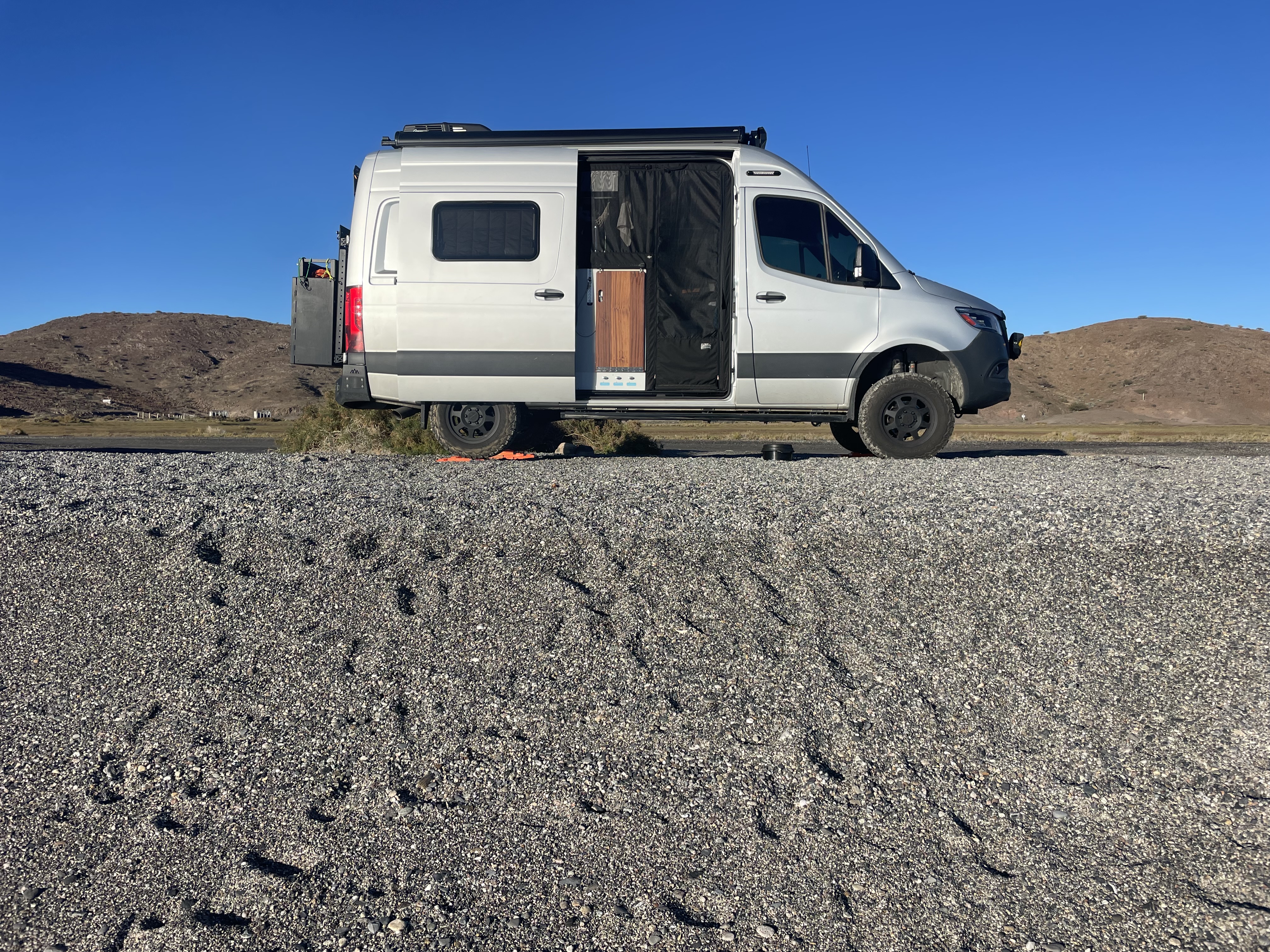
When I got back to my site, I found that I spent a lot of time just staring straight ahead. It was one of those days in the course of van living that could feel crushing– yes, it was my choice to visit two sites that were historical, but painful– but the mental lode of carrying what I’d learned over the course of the day was heavy. And a late-fall rain was pouring from the sky.
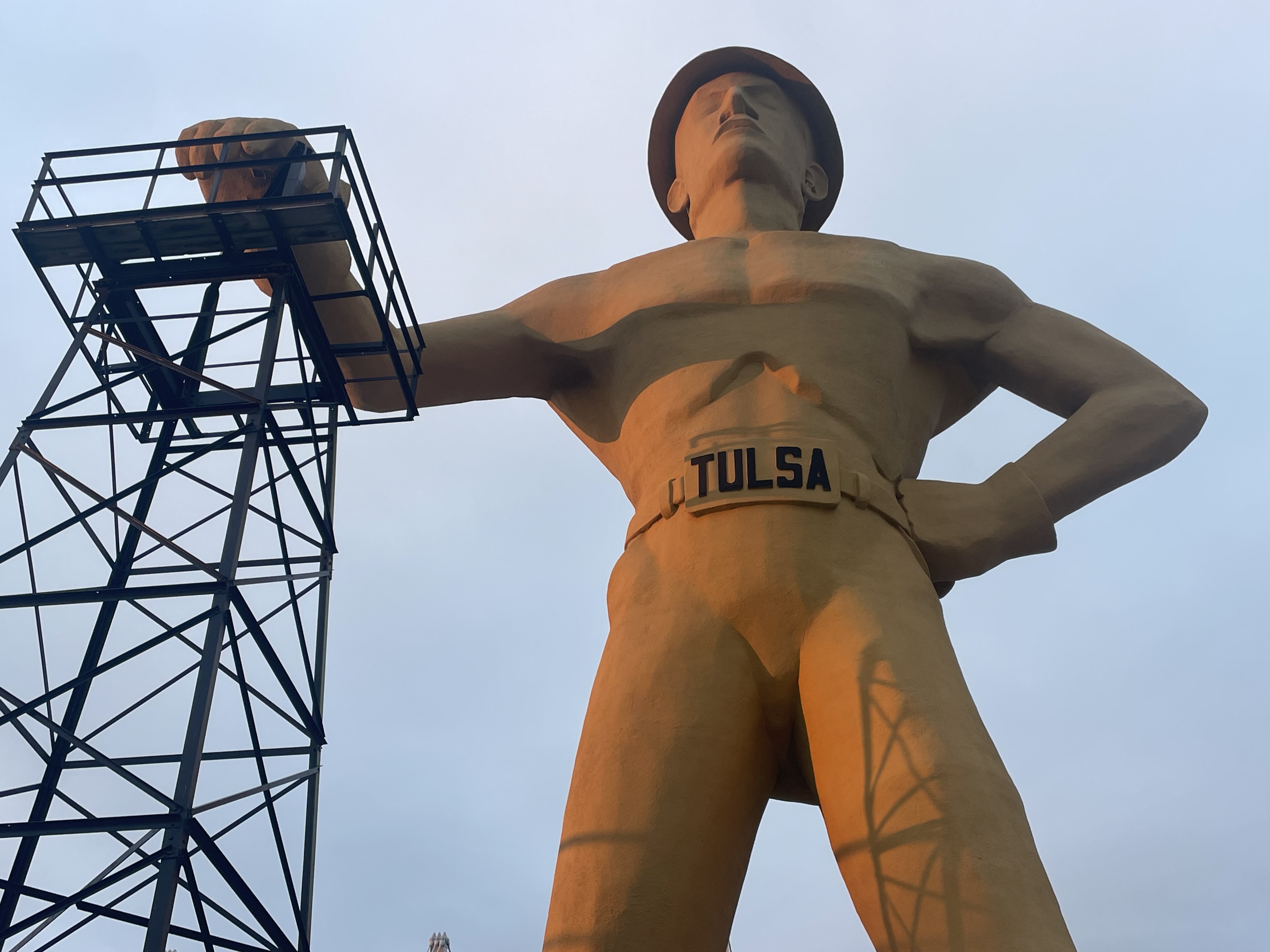
I decided that being by myself wasn’t a great idea, and sought some connection and community by heading to one of Oklahoma’s 4 lesbian bars– if you read the Tulsa post, you’ll remember that where the community is less accepted, the queer bars can be a refuge– making them more important than in more progressive cities or markets. This one was no exception.


The folks gathered were instantly friendly– I found Oklahomans to be so kind to strangers. One of the few states where being ‘new’ would be totally temporary, as you’d be spoken to and absorbed within minutes of arrival. It was comforting to join the circle of folks sitting around the bar, and to hear and participate in the banter, which took the edge off the difficult day.
I only wish I’d had more time in Oklahoma City– to experience more of the day-to-day life of the place, having already taken in the tough histories to learn about. But the weather was telling me it was time to leave NOW– late-fall storms were getting more serious, and ice storms were predicted in the next day or so. Oftentimes in the van, the weather determines your departure– so off I went down the road.

Posted by Sun


