
What is Arcosanti? It’s an experimental architectural community sandwiched between Phoenix and Sedona, found down a long, uneven dirt road on top of a wide mesa.
I’d never heard of Arcosanti before a friend recommended it. And since there’s little signage on the road, my guess is millions drive by it every year and don’t even know of its existence. Which is a shame, as it was even trippier than I expected.
The first thing we noticed when stepping onto the property at Arcosanti was the metallic clangs of bells of different sizes, which magnified when the wind picked up. We quickly spotted the origin of the noises– bells formed of clay, with metallic ringers dangling from long chains within. The bells lined the path to the entrance.


We had signed up for a tour, which happen about every 2 hours or so, all year long. It was an absolutely frigid winter morning, and standing on this exposed mesa, looking at all the massive concrete structures in front of me, I wondered how the occupants kept warm inside them– and how the heating could possibly be efficient.
My question was partly answered when we found our tour guide completely bundled up in layers. Head to toe, plus gloves, a scarf, and hat– inside. I asked my question about heat, and her blunt answer was: it’s very hard to heat concrete in the winter. She checked us in, and we were seated to await the start of a video to kick things off.
The waiting area for tours was a sight to see– huge circular windows out to the desert landscape were on every side, circles within a cube– and the openings let a ton of natural light into the space. The circular aperture seemed to bring the landscape inward more than a conventional rectangular window– perhaps because they were so vast, the field of vision was wider.


The video began– billed as The World’s First Arcology Prototype, the community was the brainchild of Paolo Soleri– a (complicated, we’d find out) Italian-American architect who believed in combining architecture and ecology (thus, ‘Arcology’). His goal was to maximize the way cities were built, bringing people together rather than separating them, as did the common architecture practices during the building period of the 70s (the separation and solitude of the suburbs).
Paolo’s community was constructed starting in 1970–not to be some kind of utopia– the video stressed this point. It was not some kind of separatist faction or hippie commune either– instead, it was about using architecture to offer people a more condensed, walkable, high-quality of life living structure, with plenty of gathering spaces and community-use resources.
The video featured some original residents– some of whom were still living on-premise, and detailed the way artists and scholars had utilized the way-of-life offered (free studio space, low-cost living) to come create for a few years at a time. Once the video closed, we were eager to see the place.
Our first stop? The source of those clay bells.


The first work area was bustling with energy as a few volunteers worked their way through a series of tasks. Stacking molds, cutting open others, and creating wet clay shapes that would later become bells. The tour guide broke down the process– showing us the clay sediment under the work area’s countertops– then showing us each step the artisans made.
Then, she asked us to take a step back and notice something– the winter rays of the sun were illuminating the work area of the artisans and warming them on a cold day– this was no accident. This building was designed to maximize winter light– matched exactly to the angle of the winter sun. This brilliant use of the natural resources reminded me of the Gila Cliff Dwellings and the Taos Earthships– a way to utilize what nature provided to take the edge off winter.

Our guide revealed that the sale of the bells basically funded the entire community– or, used to. Sales used to be more brisk, ostensibly when Arcosanti was more of a destination or fascination. Given the slowdown, the Cosanti Foundation (the non-profit organization that runs Arcosanti) was looking into alternative sources of income.
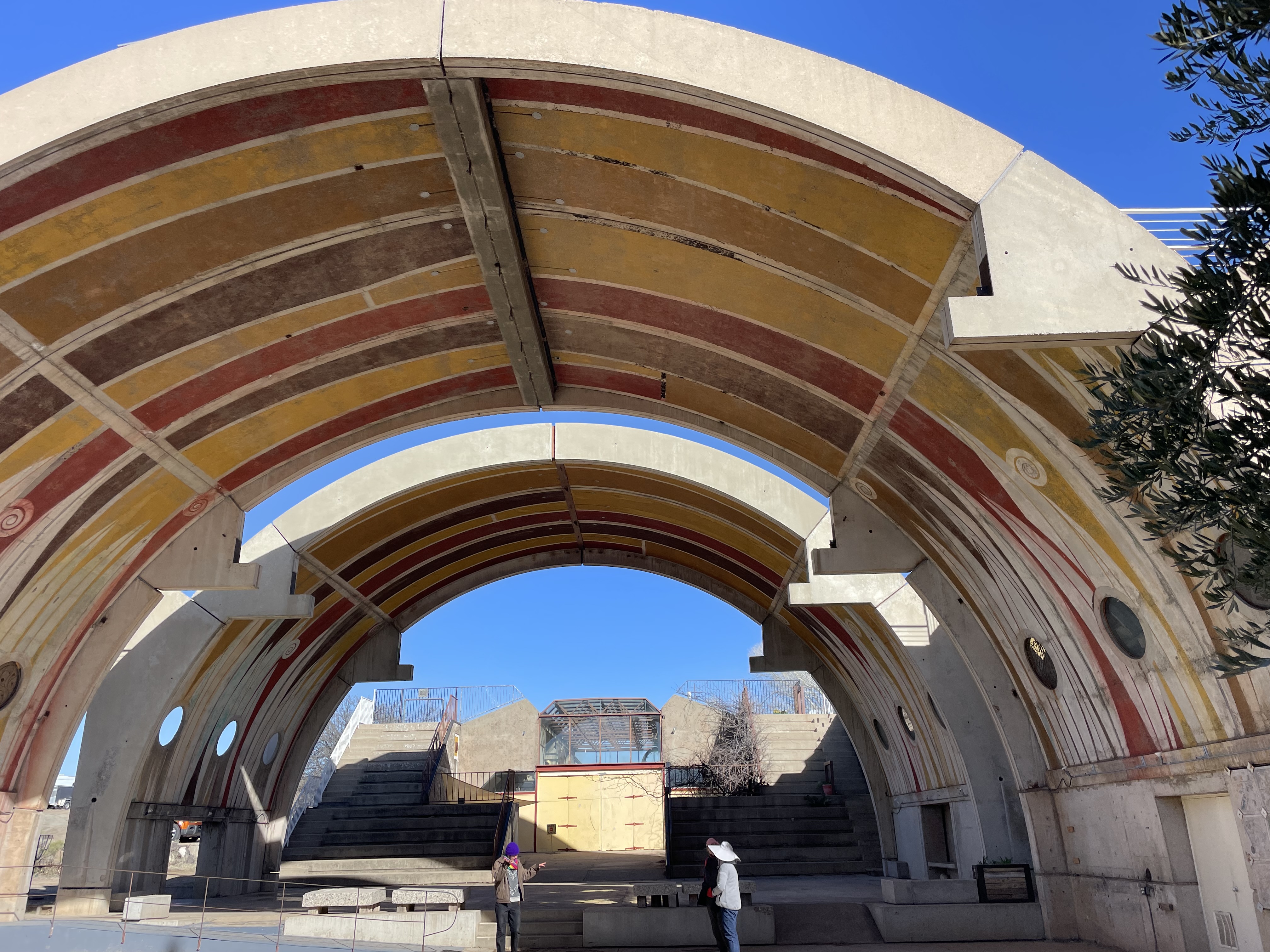
Off we went to the next area– a gathering space, a multi-use area with wide arches overhead. The concrete had been painted way back, and almost looked like it had gotten a patina over time. The entrances to the greenhouse-warmed artists studios were at the end of the tunnel vault– they could be used for free by residents all year to create jewelry, pottery, or other art.
They most recently had a potluck and karaoke party in the space.


Only about 150 residents have ever lived at Arcosanti– though it was originally intended to house 5,000. As with the Earthships, they ran into issues with local authorities– who wanted them to follow traditional building rules and regulations. This meant it was difficult to get more septic systems installed than current, which made it hard to add more residents.
They also would have been required to pave the road into the community to accommodate more folks– something that would have required a budget far beyond that of the non-profit.
We asked how one became a resident of Arcosanti. One could be come a volunteer for a few months, then apply using a “letter of intent of commitment” to ask the council for approval. The council sounded fairly democratic, made up of current residents.


As we went beyond the residence area, I asked the guide how this much poured concrete could possible be sustainable– as water would run off and did not seem to be collected in any way, despite the aridness of the mesa. She was clear that even though ‘ecology’ was part of the Paolo-created term ‘Arcology’– that even she had been surprised about how unsustainable the community was, upon moving there.
While some gardens were on-property, residents relied on outside food from grocers, and outside power, as there was no original design for solar, shockingly for Arizona. (Something the community is now looking to remedy through expanded solar panel farms near the river, and accelerating their food production).
The most refreshing thing about our tour guide was her candor– where I expected an acolyte, I got a philosopher– she was hopeful the community could become more self-sustaining, but even though minimizing damage to the planet was part of the goal– the ecological standards were not very advanced.
She reminded us that Paolo was an architect, thinking mostly about people and their flow through buildings and communities– he was not nearly as versed in the environment.
Then, we headed to the foundry.


The foundry was where the magic happened, and the bells came to-life. Overlooking the mesa, the foundry had other volunteers working at the different stations– after the clay bells solidified and were fired, the foundry added color and texture via different patina methods. They never entirely knew what color the bells would emerge as, due to the chemical process being different every time. The workstation was illuminated beautifully by the sun– and the nearly-finished bells were marvelous to see.
Arcosanti had an unsettling feeling overlaying it– it felt both empty and populated, like an experiment that was abandoned long ago, but persisted anyway– the concrete had a way of showing decay that made the material seem like it was from another time. It was desolate out there on the mesa– and the 100 or so residents overcame that by living and working together, and selling their bells in hopes of creating something better in the future.
Which I admired, but also– with the founder long gone, it felt like Arcosanti’s best days were behind it.


That’s when the tour guide mentioned that Paolo himself was “problematic”– something I inquired gently about. She said he was an Italian narcissist as much as a genius, who was credibly accused of sexual abuse by his daughter in an event that nearly destroyed the community entirely. Many of the top community leaders had apparently continued to support him despite knowing of the abuse.
The community had to rethink itself, and re-orient itself, around the premise that they might have been formed by a very smart man who had a vision for a better way for humans to live together, while making it impossible for members of his own family to live with him. It was a sad end to a strange day at Arcosanti– the decaying remains of a fallen “visionary.”

Posted by Sun


