
The idea to go to Anza Borrego Desert State Park came from my 78-year-old father. HE got the idea from Kelly Ripa, the daytime talk show host– whose show he watches nearly every day. She did a segment outlining a few lesser-known natural places to visit in California, and he remembered I was in the state.
The rest was history– he wrote the name down on a post-it note, and a week later, I was there.
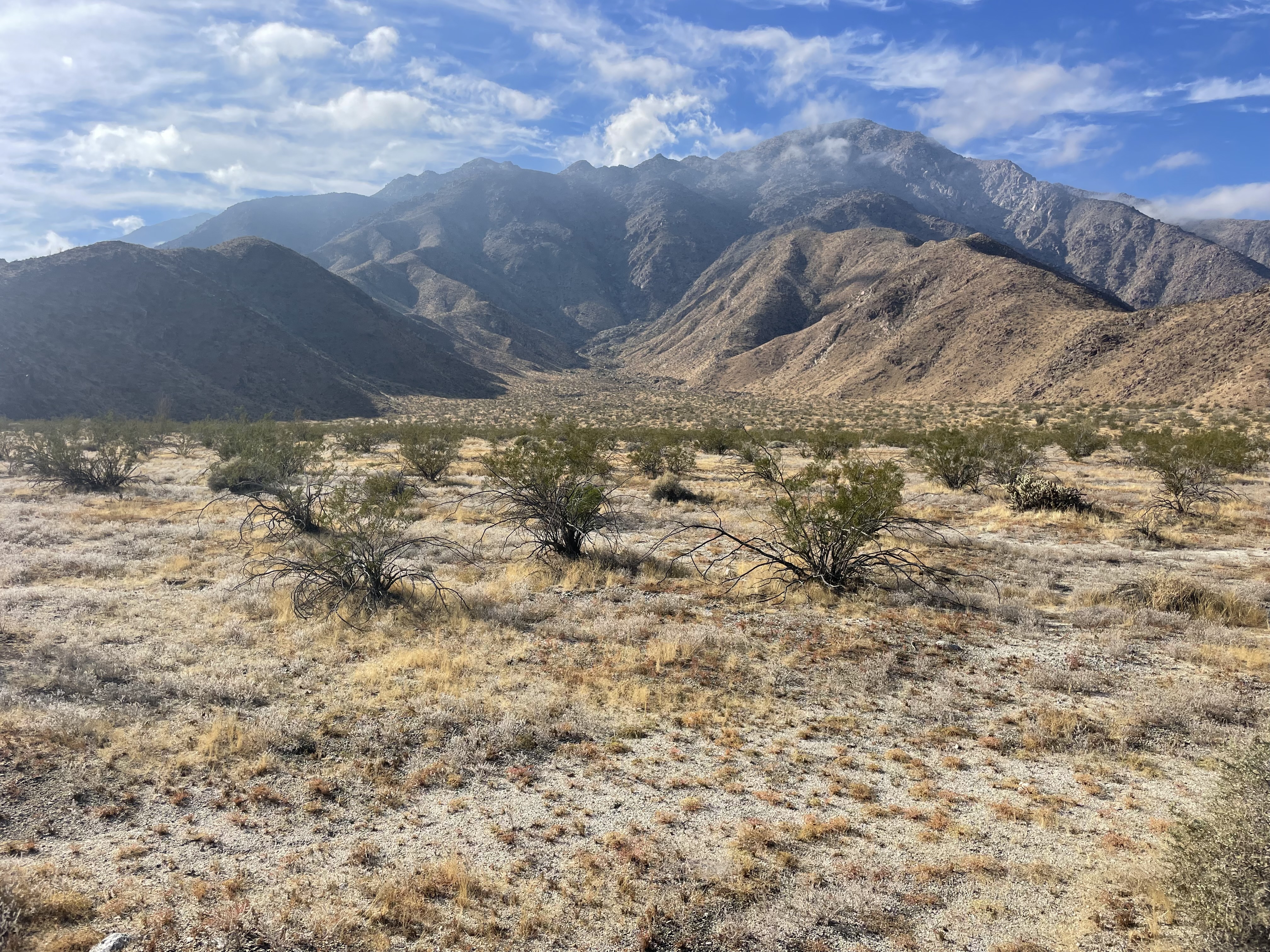
Anza Borrego feels so remote and desolate, it’s hard to imagine that San Diego is only a few hours away. The drive was twisty, and with every mile, less and less vegetation appeared as the road went inland.


There isn’t much in Anza Borrego– AT ALL– and this is not a throwaway statement. Anza Borrego is a dangerously desolate and recklessly self-guided place– the roads are often unpaved, the trailhead and trails are often unmarked (!), and the entire place is hot enough to fry you most of the year.
It was November-December timeframe when I visited, and I’m fairly sure I had early signs of heat stroke on a day in which: I hiked ONLY in the morning, drank a ton of water with electrolytes added, and kept my level of strain minimal. In fact, April to October provided a wide swath of “extreme” heat warning months, according to signs scattered liberally about.
Basically, *DO NOT MESS WITH THE HEAT HERE*. Halve the number of miles you would typically hike, even if it’s morning or evening. Oh, and you will not have a scrap of cell reception: Starlink is the only way I got by– so, be wise and download offline maps before you leave home.


A quick visit to the state park ranger station, or the natural history association, is really a must when arriving, especially if you haven’t done a ton of homework on the area When I talked with a ranger, he mapped out a few manageable hikes and easy routes for me to take with my 4×4 van– including to a sunset lookout point called Fonts Point (later, I was immensely glad he did).
To me, the most fascinating part of Anza Borrego area was the giant metal sculptures that dotted the landscape– all done by just one folk artist, Ricardo Brecada. Lacking formal training, this man taught himself metalworking and developed a passion for it– to the tune of creating 130 huge sculptures! A local wealthy man donated land, and the sculptures were placed on acreage around Anza Borrego.
The first of these Mac and I happened upon resembled and elephant or mammoth– but it’s worth noting right here that Brecada’s sculptures might gesture at real animals, yet are really more mythical than representative. Looking at the closer-up shot below, you can see the metal panels that he fused together to create different textures– if you happen to go, don’t stay in the car: get out stand right under them– appreciate the scale, and look closely at the details.


I got a little addicted to seeing these sculptures out in their environments– most people visit one cluster or two, but I visited many of the groupings over the course of my weeklong stay. Each cluster is about 15-30 minutes from the last, so there’s a bit of driving involved to see them. The scale of the bigger works was just mind-boggling, as poor Mac is demonstrating below.


One of the most popular sculptures was a striking dragon– seeming to slither right out of the desert sand, this one was pretty darn epic. It was a magnificently-rendered one, especially for an artist who taught himself his craft. (There are maps to the sculptures available online).


Being a first-timer, I camped at Borrego Springs Campground, which was convenient and right at the base of a few hikes. A very well-developed campground, each site thankfully offered a shade structure (Mac took full advantage), and the restrooms and showers were practically new.


Not to mention, the location of the campground meant fantastic sunsets each night, as most of the desert bugs and snakes and rodents and mammals came alive each night (and Mac’s ears went into overdrive listening to wild things I could not even hear). During the weekends, the grounds could get crowded, but during the week, it was so quiet you could hear a stone drop.


Anza Borrego is known for stargazing, as it is very far ‘out there’ in the desert. That said, a hot tip– if you camp in the official campground, which is “Borrego Springs”– there is a bit of light pollution from the campground itself and the nearby ‘town’ (the few buildings of ‘downtown’ that exist). These will make the night sky slightly less visible.
If you’re going all that way, and you can– I’d suggest boondocking instead. Just a few miles out, the bands of the Milky Way were much more clearly visible.


This is probably the time to mention that I don’t know the first thing about shooting the night sky with an iPhone, but picked up some tips online and from friends– the shambolic result is above. Other than professionally-snapped pictures, I am not sure anything could really capture the wonder of the night sky in this place– which didn’t quite eclipse (but rivaled) some of the famed stargazing places I’ve been lucky to see on the Tropic of Capricorn, in the Atacama Desert (Chile) and in the Red Centre (Australia).
Hiking in the morning, I did a little scamper into a valley to see a proper desert oasis. Though bighorns have been known to inhabit the area, I didn’t see any during my visit. This hike was less than 4 miles total, and yet could feel labored under the sun.


The oasis was beautiful and lush, with plenty of insects and animals living and nesting within a tight radius of it. Mac and I noticed an immediate uptick in bug and wildlife activity as we approached. The vegetation on the hike was super-strange, even for a person who frequents the desert– I definitely saw some varietals of plants that I hadn’t seen before.
There was a fog that passed through the desert (purely a winter phenomenon there, as you can imagine) while I was at camp. This sight was odd enough that it drew the rangers out with their phones to snap images, so I considered myself lucky to have seen it. The affect was beautiful– the photos below show the sharp edges of the desert, seemingly softened by the wispy clouds and hanging mists.


Because of the moisture, the creosote bushes were so fragrant– the scent opened my nostrils every morning and was heavy when I hiked in the early hours.
One of the most popular hikes in the area was a slot canyon hike– perhaps unsurprisingly, given how Instagram-oriented nature destinations have become lately. I went to this slot hike early to avoid the harshest rays of the sun, knowing the light would not be great for photographs. This was a choice for Mac and myself to stay cool, so you’ll note the photos are lacking. The EXPERIENCE was excellent– the canyon walls began to dwarf Mac and I, and the slots got so tight at one point, I had to shimmy completely sideways to make it through.


My last night in Anza Borrego, I went to catch the sunset at Font’s Point, the place the ranger had recommended. He said there would be a “dirt road” for 4 miles in, and 4 miles out– reader: this was not a dirt road. It was a ‘wash’– which is “desert-speak” for a place in the landscape where runoff gathers or rushes to create… deep sand over time.

The problem with sand being, even with a good off-road vehicle, it’s easy to get stuck. Even for experienced hands, it’s hard to tell by sight when sand is becoming deeper. And once it’s quite deep, well, you better have rescue and recovery gear (which I do). While the ranger had said 4×4 was required, he hadn’t said it was going to be SAND driving.
I tossed the van in high range 4×4 to keep momentum going, and nervously began to follow the tire tracks. Luckily, the sand was firm and held (it hadn’t rained in a bit). These photos were just at the beginning, it got gnarly enough where I wasn’t exactly stopping for photos 🙂

At varying points, I saw vehicles littered on the path– sensing danger with the sand, people had just gotten out of their vehicles and begun to walk the four miles instead. In fact, I even picked up a few on the way back and drove them back to their vehicles. If you’re going to Font’s Point, you’ll need 4×4, a high clearance vehicle, and might want some experience driving in sand under your belt.
After white-knuckling a bit over the 4 miles in, I relaxed immediately when I saw the view at Font’s Point. Holy cow, it was really epic– reminding me of a mix between The Badlands and Death Valley (turns out, it was designated as badlands, geologically). The setting sun made the dirt and sand and stone glow a yellow-orange hue, and the texture of the layers popped out immensely thanks to the shadows.


Getting back to camp after dusk, I was so glad I’d taken the chance to see Font’s Point, and was glad I’d taken a chance (on a lark) to visit a place my dad saw on television.
On the morning I left Anza Borrego, a rare, thick fog had rolled in, blanketing the area in a mist that made an already-desolate landscape seem even more foreboding. Thus, the sculptures I passed on my way out of town were bathed in a more eerie feeling– and left me looking at the subjects almost as if they’d been stranded out there…. and I was a little glad to be leaving before meeting the same fate.
I guess Kelly Ripa was right– Anza Borrego was a heck of a cool place– I’d recommend it, with the caveat that it is a brutal natural environment– be wise about how you approach it.


Posted by Sun


