
Texas is in the dead center of the South, and that means if you live on wheels, you are going to have to drive through it. Especially if you want to go from the West to the East in optimal weather, a route that is the warmest possible in the contiguous 48, that also avoids the blowing winds of Kansas, and the cold, unpredictable weather of the Dakotas and Oklahoma (ice storms, anyone?).
All this to say, I have driven through Texas at least 5 times in the last year and a half.
I always try to pick a different route– to minimize the boredom of re-treading old routes, and because Texas is a vast place that has a million different micro-cultures and attitudes to it. And there’s a ton of historical sites and museums to explore there, since Texas was so central to the development of the United States as a nation.
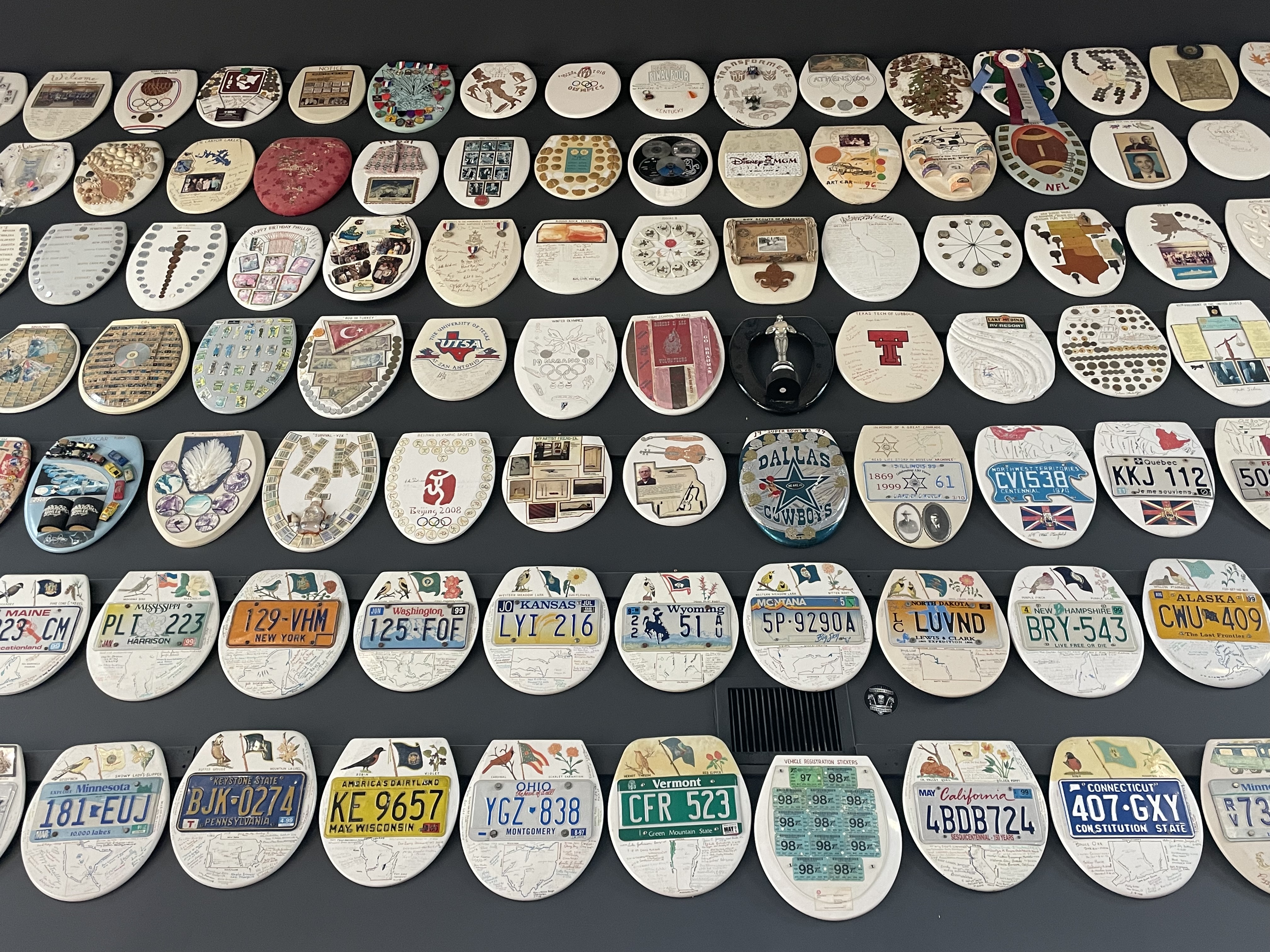
Lastly, Texas also contains a lot of roadside attractions, too (Toilet Seat Museum anyone?)– so it’s never dull when I rock up to a local museum or two in the towns I roll through. Often, when driving through the state, I’ll stop at a landmark or museum that looks interesting, to stretch my legs a bit. This is why the following post will seem incredibly disjointed, bouncing around the state– it wasn’t part of a linear trip, but is made up of different crossings through Texas.
**BIG Caveat on this post– I’ve been going to Texas on and off for work for the past 13 years, so racked up the major tourist sites in those years before living in my van. Consider this a “deep cuts” post– what to do in Texas when you’ve ALREADY seen the major attractions in the major cities**.
(For instance, if you’ve not spent a lot of time in Texas, you should go to The Sixth Floor Museum in Dallas to see the former site of the book depository where John F. Kennedy was shot from– there is a stirring and somber museum there. Please, do this BEFORE the Toilet Seat Museum).
First up: The National Cowgirl Museum and Hall of Fame in Fort Worth.


The front of this museum looked so promising– this gorgeous statue, by the artist Mehl Lawson, strangely called “High Desert Princess” was astonishingly beautiful. The easy, carefree and confident pose of the female cowgirl felt visceral, like an encapsulation of the freedom of the American West.
It was not a feeling that I’d feel again, for the rest of the museum.
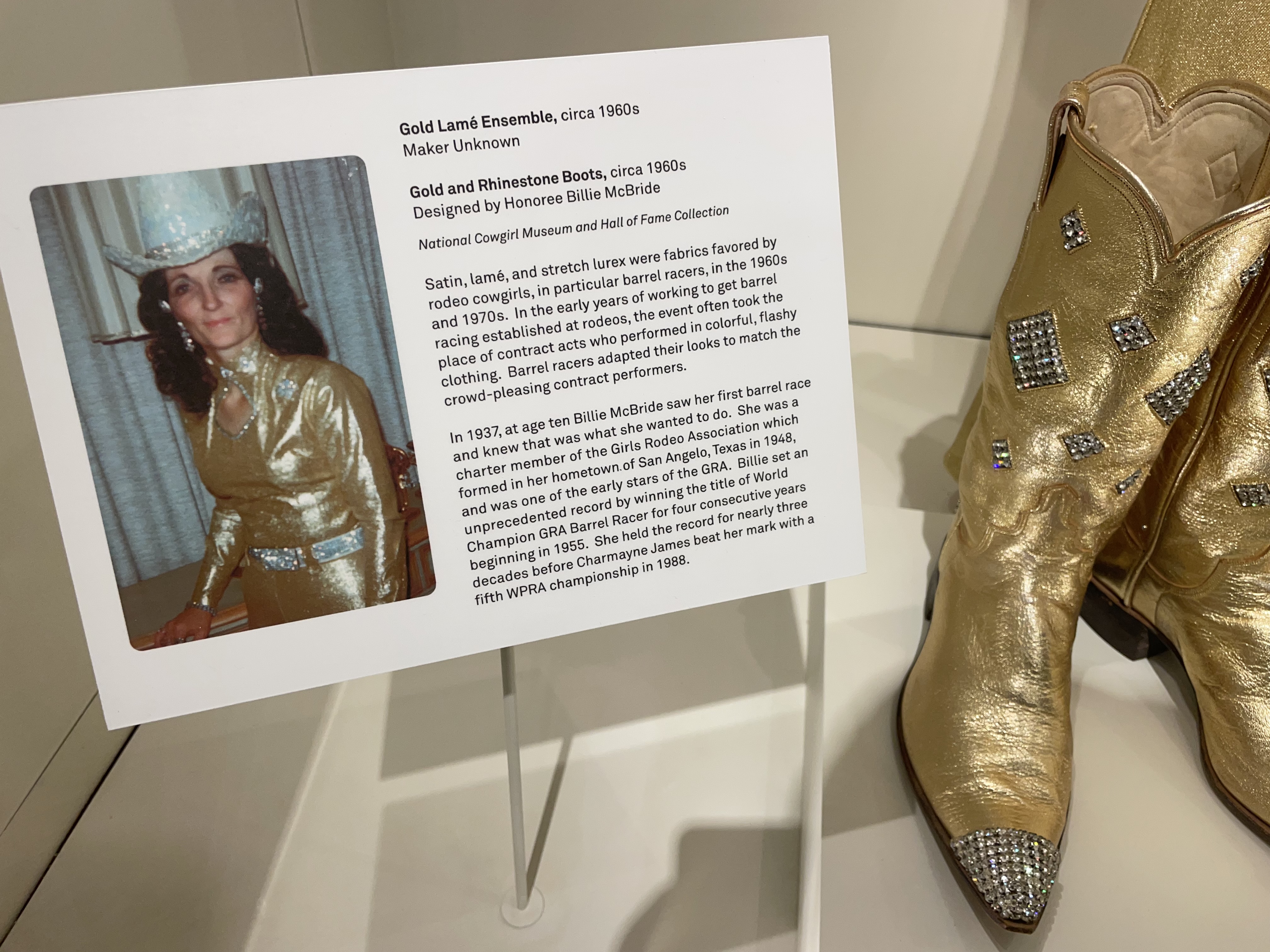
As soon as I paid my entry fee and turned toward the first exhibit, I realized I was in for something entirely different than advertised. Called “Dare to Wear”– sparkly and spangly outfits of rodeo queens greeted me, rather than the rustic women I’d expected to encounter.


The outfits were studded and rhinestoned to within an inch of their lives. Now, even I can recognize some fine artistry and workmanship, but that wasn’t why I was here. I wanted to explore the history of cowgirls in America, and pushed on.
The majority of the rest of the exhibits were reproductions of photographs from the 1800s– and while it made sense that most of those photographed were rodeo stars and performers, as they had the reason and resources to be photographed– I was still hoping for some real cowhand memorabilia.


Of course, there was a volume of Annie Oakley items– an old traveling trunk carved with her initials, reproductions of flyers from her events– and charmingly, a ‘calling card’ — Annie used to have a calling card with a heart on it, one she’d shot through from an impressive distance. The one on display was an original, kept as a keepsake all these years.
Weirdly, there was also a hologram of an actress playing Annie Oakley? If that’s your thing.
The most engaging displays (in my book), were the ones in which impressive stuntwomen and notable cowgirls of the time (e.g. Miss Norma Saunders, ‘America’s Only Girl Auctioneer’) were remembered. Note the photograph of Mamie Frances Hafley on the right, as she jumps her horse off a platform high in the air, to the delight of crowds.


Because there was not a ton of information on real cowgirls, the art in the museum had to do more heavy-lifting. There were a few lovely paintings of horsewomen, and a cute sculpture that commemorated the transition of women riding sidesaddle to cross-saddle.


For something called The National Cowgirl Museum and Hall of Fame, I expected far more learning than I got out of the experience– even the gift shop was dismal. When I saw a little pad of paper with a sassy cowgirl on front that I thought my niece might like, the back had the ‘Little Lady’ baking a pie and ‘Gussying Up’ for a square dance– not exactly rugged!
You can skip the The National Cowgirl Museum and Hall of Fame. You’re welcome.


The Museum of Funerary History (in Houston) was a trippy experience. Walking in, one of the first things you see is a Double Casket– yes, a casket made for two. Goths unite!


Funerary carriages (hearse precursors) from days of-old were all around, including those of various faiths. Their condition on was remarkably well-kept up, despite being worn in some places (as they were from the 1800s and 1900s).
The strangest exhibit of all– one I could not get out of my head if I tried– was that of the Post-Mortem Photography. Back in the 1830s, when the daguerrotype was invented– through the 1930s, it was common to take photos of a loved one AFTER their death, especially if the deceased was a child. This was often done as there were no photos taken of them living, and a memento was desired.


There’s a reason I did not take close-ups of this particular display– it was pretty ghastly. For those of you who enjoy dark things, go ahead and Google ‘Post Mortem Photography’ and satisfy your questions that way. Needless to say, the images were haunting– often, the eyes were glassy in expression and situated a little too far toward the horizon.
But strangely, due to the living also needing to sit still for these photos, sometimes it was hard to tell which were post-mortem and which were taken in-life! Very odd, and not for the faint of heart.
Speaking of odd, the museum of funerary history also had a section devoted to Presidential funerals.


The “Selfie Spot” with a reproduction of Lincoln’s casket was a really special choice. Apparently the museum of funerary history is trying to appeal to those Gen Z kids who want to say “Look! Here I am with a reproduction of Abraham Lincoln’s funerary casket!”.
They also had Lincoln’s death mask. Which I didn’t take a photo of, as I didn’t want to share something so creepy. I honestly don’t know who this exhibit was for.
Perhaps the most educational section of this museum was one that talked about the culture of mourning and how that has changed over time. These displays were weird, to be sure– as they were diorama-like (mannequins and all). One showed the evolution of women’s mourning garments in the 19th Century, which reminded me– since when was there a custom for men’s mourning garments?
Right, there wasn’t. The customs around dressing ‘for the man you are mourning’ was so pervasive, that one slip-up could cost her social standing, or worse. Yikes.


The last thing I saw on the way out of the Funerary Museum was the sponsor of it– the National Funeral Directors of America helped to put this on, which made clear the odd way that cremation facts had been shared (as well as a helpful chart on process), and why urns were available for sale right in the gift shop (?)– come for the exhibits, stay for planning your own funeral?!
Yes, there was a gift shop.
Sadly– no, it didn’t have awesome merch. Which was a giant, giant missed opportunity.


The National Buffalo Soldiers Museum in Houston was a museum dedicated to Black soldiers, that was created by a veteran with a passion for collecting. Captain Paul Matthews, a Vietnam veteran, and his wife Barbara started the museum recently– in 2001, and dedicated it to Black soldiers and their legacy.


The mural outside was pretty stunning, and the exhibits inside were eye-opening.
Starting with this– a letter written by a former (now emancipated) slave, in response to his previous owner’s request that the slave return to work on the plantation. The letter reads: “Now, if you will write me and say what wages you will give me, I will better decide if it will be in my advantage to move back again… we have concluded to test your sincerity by asking you to send us our wages for the time we served you. This will make us forget and forgive old scores… I served you faithfully for 32 years… our earnings would amount to $11,680. Add to this the interest for the time our wages have been kept back…” — you get the idea.
Today, we would call this ‘shade’– the kind of polite, kiss-off response that many wish they had the opportunity to send, but rarely do. If the text isn’t too small, it’s worth reading the whole thing.


The recruitment poster replicas from the Civil War were stirring, as were the pictures of distinguished young graduates, like the Black graduate of West Point. They also had a full buffalo coat from the Buffalo Soldiers, placing it atop a replica uniform from the famed unit.


One of the exhibits was a punch in the gut — it detailed a case I had never heard of.
The case was one of the largest murder trials in history– IN HISTORY, with 110 defendants. A number which caused me to do a double take. How could a trial have 110 defendants, and be fair to any of them?


Way back in 1917, there was a Buffalo Soldiers unit– the 24th Infantry– that was moved from the north and stationed in Houston in a fort called Camp Logan. On arrival, they were shocked at the overt racism they faced from white townspeople– as their former station had not been in the South, they were not previously as bothered.
Here in Houston, two of their regimen were beaten and threatened, purportedly in defense of a black woman being harassed and arrested b the police. It didn’t take long for rumors to swirl, and threats met the ears of the all-Black regimen. On August 23rd, 150+ members of the regimen set out from the base– armed– which was acknowledged to be a violation of protocol. Once they got to town, a clash with townspeople broke out, and 19 people were killed– most of them white.
The court martial and murder trial that followed were hasty– it was deemed a ‘riot’ by the papers, and no witnesses were called at the trial. In the end, 19 of the soldiers were executed– most of them hanged IN SECRECY. The military convicted the rest of the 90+ men on trial, and sentenced them to long prison terms. These were the same lopsided convictions that Jim Crow produced around the South– whenever violence erupted, the people who bore the punishment were always Black folks, no matter who instigated that clash– and the word ‘riot’ seems to have been applied by the newspapers (hardly without bias at the time) to sway the public.
After visiting the museum, I learned that in 2023, these men were ALL pardoned by the U.S. Army. “After a thorough review, the Board has found that these Soldiers were wrongly treated because of their race and were not given fair trials,” said Secretary of the Army Christine Wormuth, just this November.


I didn’t take a ton of pictures of the rest of the memorabilia, as it was often military-museum-grade stuff like antique guns and swords and uniforms and the like, stuff that is only of mild interest to me. But the wall of Black astronauts from NASA over the years was incredible to see– given NASA was just down the road from the museum in Houston, it seemed fitting to see service defined in this way, also.
Once, when going through Austin, I stopped at the Lyndon B. Johnson Ranch.
The little town where LBJ was born and lived in this ranch– even hosting dignitaries at his ranch during his presidency– renamed itself Johnson City for its most famous resident.
The ranch itself was sprawling and open– miles of prairie grasses extended. Not many people are born on the same patch of land they died on– but LBJ’s connection to this place represented a complete circle. Born in the small house pictured below (it’s a replica, the original was torn down), LBJ loved stewarding the land and caring for it.


The ranch itself was a self-guided experience– there was no rangers on-site, and the visitors center was miles away in the heart of Johnson City. But there were helpful signs that pointed me onto a ‘scenic drive’ and also well-kept historical markers that provided good information.


The ranch was still technically a working ranch– as designated by LBJ in his will when he turned over the ranch to the U.S. government to run. His favorite were Red Holstein cows– and I saw a handful, maybe a couple dozen– poking around the wide pastures. Just enough to not violate the terms of the trust.
It was already a hot day, and they were taking any shade they could find in the trees dotting the landscape. The Texas dryness seemed punishing, but these cattle were hardy beasts.


The ranger station and museum in Johnson City were up next, and I enjoyed pursuing the exhibits– a replica of LBJ’s working office at the ranch, and one of his favorite pillows reading “This is my ranch and I do as I damn please.” But historically, these were incredibly lightweight and small compared to the material available in the Presidential Library for Lyndon B. Johnson, which is on the campus of the University of Texas in Austin.
Having seen the latter on a different visit, I’d recommend the Library if you only have a day to delve into LBJ history– the library gets into detail about the most critical decisions of his Presidency on Vietnam and The Great Society and many other topics.
The ranch was a mere compendium piece– a reason to take a drive 30 minutes outside of Austin, but not a visit that will accelerate your learning about one of the most effective Presidents in history.
The bottom line of Texas history museums is: go, and find out– the state and private citizens there take their history quite seriously, and there’s always something to learn.


Posted by Sun


