
I will start out by saying that I am not a ‘Civil War Guy.’
If you’ve spent any time at sights that were critical to this bloody and epic American war, then you know exactly who I am talking about: they have silver hair, silver beards, nice wristwatches, and are ready to ‘mansplain’ to anyone the intricacies of the terrain of battlefields, down to the makeup of the topsoil.
They will compare generals by name and have strong opinions about which general had the best tactics for his situation. They will pour over the exact times that one battalion fought for ground that was four feet to the left. They will forcefully correct tour guides and make everything awkward.
Yes. Those guys that have made war a hobby.
I cannot really fathom this as a personal interest, but I knew that I’d run into these dudes when I stopped at Gettysburg National Military Park. And I guessed that a good amount of the content of the museum and the content and signage within the battlefields would be mostly focused on these ‘War Fans’ as their target audience (and I was right about that).
So I didn’t stay terribly long.


But I hadn’t been to Gettysburg since I was a child, and I am always curious about seeing the parts of American history I’d seen as a kid, through my adult eyes. Unsurprisingly, it had changed.
When I arrived, there was a huge electronic “menu” board of sorts– with lots of different ticket packages and prices. I blinked. I thought this was a national park? I never remembered seeing ticket sales for entry unless a site was a very protected or endangered one.
The gentleman who greeted me noted my confusion, so he broke it down for me: while the sites themselves were free and part of the park system, the collection of the museum and the Cyclorama (a huge-scale painting done of the Gettysburg battles) belonged to the American Battlefield Trust, and that’s who I was paying my ticket fees to.
Of course, I asked who the heck the American Battlefield Trust was, and got a lot of mumbles back about how it was a non-profit ‘501c3’ dedicated to preserving… and so on. Apparently, this organization is acquiring battlefield land around the country, which it is using private donations to help fund– and then they take stewardship of those sites, including 1,200 acres of Gettysburg.


Now, I inherently trust the people and rangers and historians associated with The National Park Service to tell an even-keeled, historically-accurate story at each of its sites. I read (or even pour over) their written materials and put a lot of stock in ranger talks. But this organization? I didn’t know if what they were printing in their museum would be accurate, or have a slight slant to it.
I started with the Cyclorama, having little idea what I was getting into. Stepping into a darkened room, I was shocked– surrounded by what looked like a huge painting, but at that scale– my mind couldn’t quite square that as a possibility.
Turns out, it absolutely was a painting.


The Cyclorama was a historical trend– huge panoramic paintings that often traveled around to different towns and cities, if they were popular. Often narrated or set to music, these were storytelling devices as much as works of art. American battlefield scenes were often sent overseas, with a depiction of Vicksburg making it all the way to Paris.
This particular painting was done by French artist Paul Dominique Philippoteaux — showing the fateful day of Pickett’s Charge, the most important moment in the fighting at Gettysburg– which a recorded voice beautifully narrated. Lights on the painting told the eye where to focus as the story unfolded– sound effects came through the speakers as well. It was engaging, but I just kept thinking, how big is this painting, and how did they DO it?
At 279 feet long and 22 feet tall, Philippoteaux needed 5 assistants (plus his dad) to help him create the scenes. He did his homework, interviewing survivors of the battle, and reviewing photographs, as well as visiting the sites he eventually painted. It opened in Chicago in 1883 and was an instant success– so realistic, that veterans were said to have cried when laying eyes on it.
The Cyclorama, it turns out, had just reopened after extensive restoration. I felt lucky to have seen it– and honestly, it was the best thing I saw all day.


As I spilled out of the Cyclorama into the museum, I was quiet– reminded that over 11,000 men had died on the ground beneath us. I was appreciative of the signs throughout the historic park asking for quiet and silence– the people who died here made this hallowed ground deserving of reverence. And luckily, most heeded this request.


There was tons of artifacts on display in the museum– a dizzying amount. I found myself drawn most to the large quotes that were painted on the wall. Perhaps because the guns and the ordinance and the uniforms and the bayonets interested me very little, I was fascinated by the real words of those who lived in such an upside-down and awful time, such as the above quote from a general who was felled in Pickett’s Charge, describing his orders thusly: “This is a desperate thing to attempt.”
He was sadly prescient.


My favorite quote in the whole museum was from a women who had been inspired to bake cookies for the men on the front lines, and dispatched them, hoping her side was still in control of the disputed territory and would give them to wounded men. Her attached note to the tin read “These cookies are expressly for the sick soldiers, and if anyone else eats them, I hope they will choke him.” Sassy.
Another was from a sergeant talking about how during long marches, soldiers would just drop heavy goods they had brought along out of fatigue. Right on the side of the road, there would be long stashes of kettles and books that soldiers grew tired of carrying from place to place.
There was a section of the museum devoted to what life was like in the surrounding town of Gettysburg during the siege. I had never seen time devoted to the witness accounts of civilians AROUND battlefields– so often, we focus on the generals (always the generals) and their words. It was an interesting exhibit, showing chests of drawers with bullet holes, and shared personal testimonies about how difficult it was to be tasked with burying 11,000 corpses left behind.

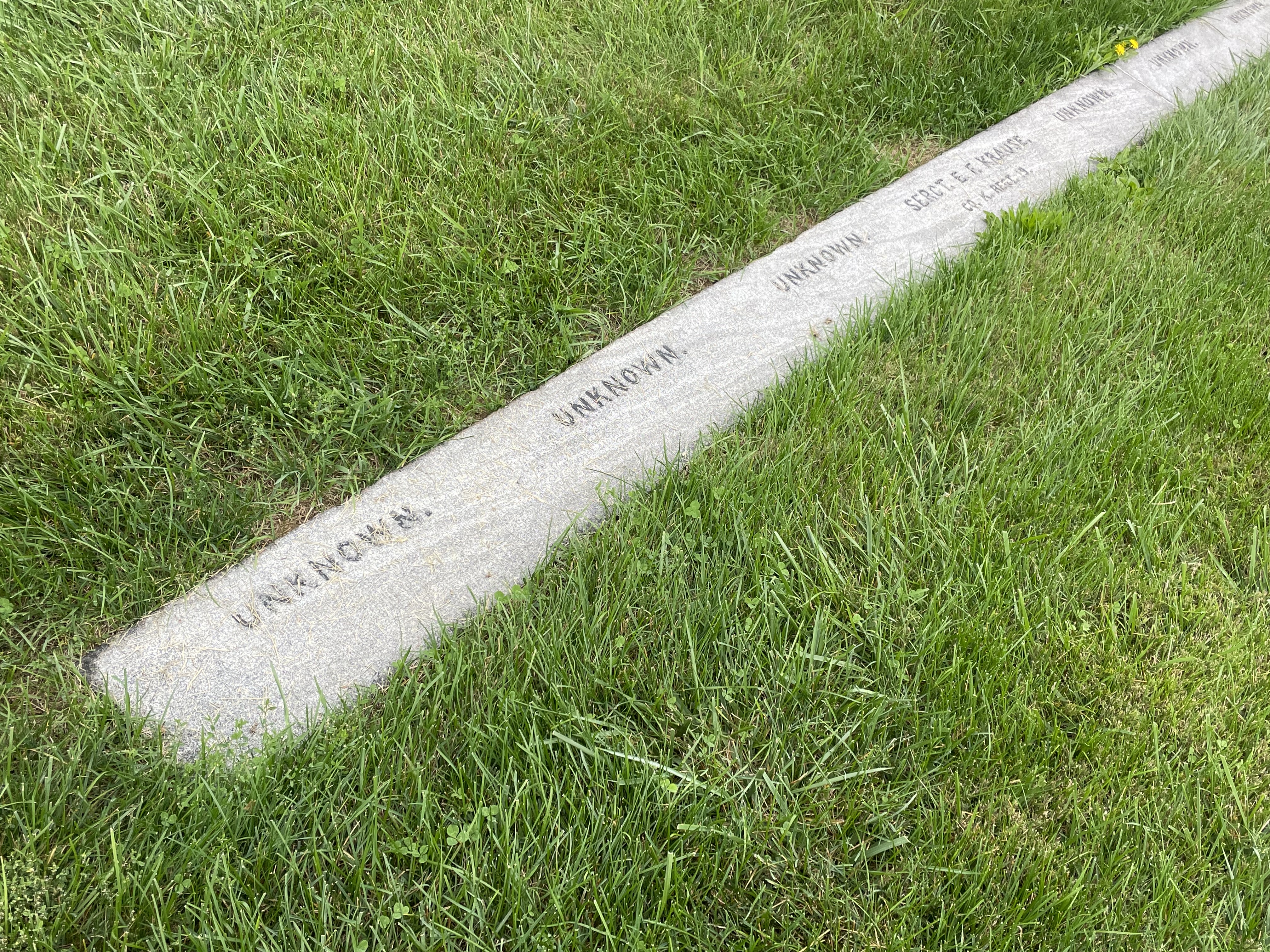
It was easy to become emotional when faced with the portraits of the men themselves– the soldiers who came to Gettysburg and largely, fell there. The impossibility of identifying remains was discussed in the museum, including a stark example of rudimentary ways of trying to leave notice upon the dead– a ‘tag’ made of wood, declaring the dead soldier’s name, was left (presumably by a friend) in hopes he would eventually be identified.


As most museums around battlefields go, there was a ton of times, dates, and maps of battlefield advancements and retreats– this bored me stiff, but this level of detail must have excited the real Civil War Buffs in attendance. I exited the museum to drive around the battlefield grounds themselves.


It had become a cloudy and rainy day, which seemed appropriate for such a somber action.
If you’ve been to a battlefield of significance, you know that the grounds are well-kept and tend to be full of memorial stones and placards gifted by each of the states, to remember their state’s fallen soldiers and to note their regimen’s efforts in the battles.
While some of the status are beautiful, they do get repetitive over hundreds of acres. There are over 1,000 said sculptures and stones placed around the grounds at Gettysburg.
I drove for a bit to see them and pay homage, before heading to the main cemetery for Gettysburg (named Cemetery Hill), also the site where Lincoln famously gave the shortest (and maybe greatest) address of all time: the Gettysburg Address.


On November 19th, 1863 Lincoln stood on this spot above, marked by his bust– to deliver his 271 words. What I didn’t remember from history class was that the president was very frail when giving his speech, suffering from a mild case of smallpox. I also did not realize the text of the speech was disputed, as its exact wording is not entirely known.
Scholars now use the text that Lincoln later signed as the definitive text of the speech. Which, seems like a proper way to close this blog post on Gettysburg:
“Four score and seven years ago our fathers brought forth on this continent, a new nation, conceived in Liberty, and dedicated to the proposition that all men are created equal.
Now we are engaged in a great civil war, testing whether that nation, or any nation so conceived and so dedicated, can long endure. We are met on a great battle-field of that war. We have come to dedicate a portion of that field, as a final resting place for those who here gave their lives that that nation might live. It is altogether fitting and proper that we should do this.
But, in a larger sense, we can not dedicate—we can not consecrate—we can not hallow—this ground. The brave men, living and dead, who struggled here, have consecrated it, far above our poor power to add or detract. The world will little note, nor long remember what we say here, but it can never forget what they did here. It is for us the living, rather, to be dedicated here to the unfinished work which they who fought here have thus far so nobly advanced. It is rather for us to be here dedicated to the great task remaining before us—that from these honored dead we take increased devotion to that cause for which they gave the last full measure of devotion—that we here highly resolve that these dead shall not have died in vain—that this nation, under God, shall have a new birth of freedom—and that government of the people, by the people, for the people, shall not perish from the earth.”
— Abraham Lincoln

Posted by Sun


