


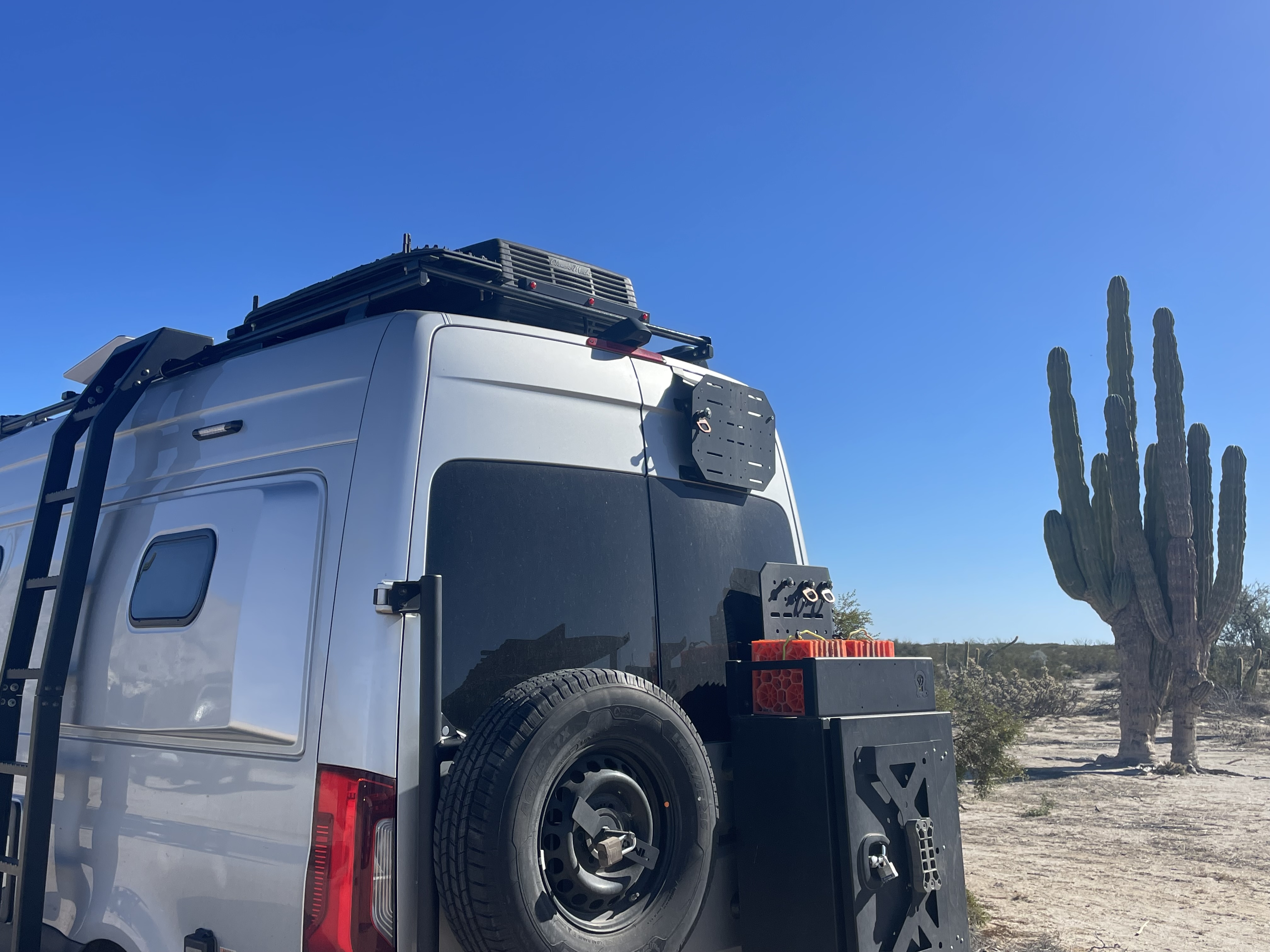
(This is Chapter Four in my “Thoughts on Van Life” series of posts, in which I discuss that every upside of van living carries a defined downside. Check out Chapter One , Chapter Two , and Chapter Three if you haven’t already).
UPSIDE AND DOWNSIDE: CULTURES FAR DIFFERENT THAN YOUR OWN
Upsides: Having all your own resources on-board means you can REALLY wander
A seemingly-obvious upside of living in a van means having all your necessities and supplies with you always— and this brings a certain amount of flexibility into one’s life.
This means a person can slow down and explore a bit more— when there’s no need to ‘get to’ that end-destination like a hotel or a restaurant at a certain time, just to fulfill the basic needs of sleeping or eating, time relaxes a bit.
Without having to have fixed hotel reservations, the days become freer— if a day in which I’d hoped to hike became cloudy and rainy unexpectedly, I can just divert plans and stay another day, to do the same hike in the sunshine. The possibilities open, and the schedule becomes tentative— as all the resources to sustain life being at arm’s length.
This opens up the ability to take any back road for any length or distance, not particularly caring if there’s a decent lodging or restaurant option down the way— since cooking and sleeping can be taken care of at the drop-of-a-hat when you’re self-contained. This is much more explorative and interesting than using toll roads or major highways, trust me.
There’s comfort in knowing you can sleep or eat anytime, anyplace. There’s also no need to pay for a Starbucks coffee to use the toilet, or to ask to use one at a store, as you have a potty with you all the time (which friends of mine have even used… while I’ve been driving!).
Generating my own power with solar panels has been particularly delightful— it’s a good feeling to be living entirely off lithium batteries, not drawing from city power docks and not having to utilize more resources than needed. While the solar panels are not perfect solutions, they also charge when I drive, which means I generate energy through daily functioning.
Starlink has been a huge addition to my ability to truly wander. (YES, I also despise Elon Musk, but it’s the only satellite-based internet currently operable). Having the ability to generate my own internet signal (literally) anywhere has been the greatest untethering— as running my business from the van pre-Starlink meant scrambling toward the center of towns for better signal (which is the last thing I wanted to do in a van— I’d MUCH prefer to be out in nature).
Now, I can take flawless video calls from the middle of the desert or on top of a mountain.
Beyond daily resource necessities, there’s even more solace in being ready-equipped with the smallest things. If you scrape yourself on a hike while vacationing, you might not have packed bandages— but with the van, there’s no need to sprint to the next pharmacy— the first-aid kid is tucked neatly into a cabinet.
In this unscheduled, untethered way, van life is far more flexible than typical vacationing— in which an ‘itinerary’ has been created and must be stuck to (or a financial penalty of some sort will result, like cancellation fees or airfare change fees). In fact, it actually took me some time to ‘let go’ of the stridency of scheduling typical trips, as it’s an entire re-wiring on the idea of “destinations” or “end points”— in the van, there is no need to have a particular timeline.
The greatest gift of this lack of hard-and-fast schedule is the ability to take fellow travelers up on tips or suggestions, diverting to gems I hadn’t heard of before talking with them. Having everything I need on-board, all the time, is a wonder in this way.
Downside— You have limited capacity for basic resources and ALWAYS have to manage them
When I say that you do everything inside the van. I mean… everything.
So, in just a few days, a dump station will be required to empty the waste you’ve accumulated in the cassette toilet, and eventually, ‘grey water’ (e.g. sink drainage) needs to be emptied, too.
Trust me, I never once thought about the volume of waste coming from my body before having a van— and I was glad for that ignorance. Now, it’s something I have to think about constantly.
This sounds weird, but living in a van means you get-to-know the ratio of the liquid that goes into you and comes out of you. That sounds gross, but hear me out— you have to keep tabs on both the amount of water you have in your tanks vs. what you consume for drinking, and then keep tabs on your wastewater to make sure you emptying your tanks on time.
I even have to pay attention to how much water Mac is consuming, to know how to plan water fillips when I’ll need it. Drier climate? Better plan to refill the water more often.
This is just ONE of the resources that need to be managed, and if you’ve been camping, or backpacking, you probably get the theory of this. Now imagine doing these same resource tasks for two straight years. YEAH, so if you’re wondering, that can really get old.
Here’s some of the more unsavory, not-exactly-Instagram-worthy moments that resource-management brings:
You HAVE a toilet, but never miss an opportunity to use someone ELSE’S toilet. In fact, Sprouts grocery stores get my business on the road consistently because of their grocery quality, but ALSO because they have clean, nice restrooms right up front in the store. (A clean, semi-private bathroom stall is nothing to scoff at when you’re on the road, and you just don’t want to have to empty yours as-often).
Your bowels will be blocked a lot of the time. I once talked to a non-full-time vanner (who just used his vehicle for adventures) talk about his ‘daily constitution’ and at-risk of oversharing, I remember being like, ‘dang, it’s been awhile since I had that.’ There’s only so much tank room, and only so much one can do to dissipate smell in a 19-foot space, so everything kinda… clenches right up. It’s not great. If I’m honest.
Grey water (sink waste) can start to smell if it’s carried for too long, or if it’s humid— as a friend and I discovered as we traveled through the humid American Southeast last spring. The sink smelled like curdling milk. (Half a cup of bleach works wonders in a sink, come-to-find). Hot tip taken, and now I never go out in the van without bleach.
Physically dumping waste is pretty nasty task, and some of the dump stations are even nastier— and despite the lack of evidence from “Van Lifers” of this task on social media, this has to be done fairly often when living in your vehicle full-time (every couple days, really). Holes in the ground where people deposit their waste are not exactly stunning places to be— and yet, it’s part of van living.
That’s probably too much information about the shedding of resources.
Obtaining them can be just as tough— thinking about whether I have enough food, water, dogfood, for the task ahead— takes up a huge amount of my mental capacity every day.
You might be thinking, ‘but Megan— I also think about things like this in my day.’ Kinda? But maybe not the most basic necessities— you probably don’t have to fill your home’s water tank up in order to use it, for example.
Water is finite in the van, and clean water to fill the tanks is harder to find than one might think— so if you don’t want to use a hose outside of a Chevron to fill up with questionable-quality water (I did, and it gave me a stomach bug), it’s just easier to use less. Which results in a stunning amount of conservation— including not ever turning the van tap on fully, but easing it forward in the most judicious way possible and immediately (frantically even) turning it off.
It also means I have chosen never to use my on-board shower, instead showering at truck stops, campgrounds, or community centers for a small fee (not glamorous at all!). Some of these are beautifully-kept, and others have been really grimy (looking at you, campgrounds).
Even the onboard batteries are a finite resource that need to be recharged— and if I need to charge my devices, or cook a few times on my induction stove, or use Starlink for a long time during the day, I’ve got to make sure I am not draining too much. There’s only so much power in reserve, so plugging anything in or turning anything ‘on’ occupies brain space.
Luckily, living in the United States means these resources are largely available and not too hard to come by, once I decide that I need them. But that doesn’t mean that resources are obtainable with just a typical 5-to-10 minute stop: heck no, here’s why errand-day in the van isn’t as easy as errand-day in an SUV in the suburbs.
Dump stations are often spaced far apart, and thus require a special trip— and often have waiting lines for use. And one might be closed when you arrive, meaning it’s time to drive 30 minutes in a different direction (cause if you’re full, you can’t wait).
Any grocery store trip has to include putting EVERY SINGLE grocery away securely before leaving the parking lot, adding bunches of time to what could otherwise be a quick task. Sometimes this even means taking extra time to re-package items to make them unspillable, or smaller in volume (removing cardboard packaging boxes)— while bewildered people look on in the parking lot.
Even clean clothes are a finite resource in the van, in a way they aren’t in a bigger home. Laundry day is a half-day endeavor— it’s got to be done at a laundromat, and if you want to hang anything to dry— this requires putting out a clothesline in the parking lot or at a campsite and waiting for a few hours (stationary) before moving anywhere to do anything else. Also, it requires loads of quarters (and if you think every laundromat has a functioning change machine, you haven’t been to many of them).
This is all to say: obtaining (or dumping) resources for the van takes up a huge amount of mental and physical energy when living in a van. And doing any of the above tasks takes FAR longer than any series of errands being run when one has a steady, un-moving home.
Procuring supplies for our very basic needs is more than a chore, and those days are among Mac’s (and my) LEAST favorite days in the van.
Metering out every resource used, vs. every resource taken in, is also a drain on the brain. Something the Instagrammers likely never say, but one of the biggest contributors to mental fatigue in #vanlife.

Posted by Sun


