
Billboards are STILL one of the best ways to find cool stuff to do in new places. Period-full-stop.
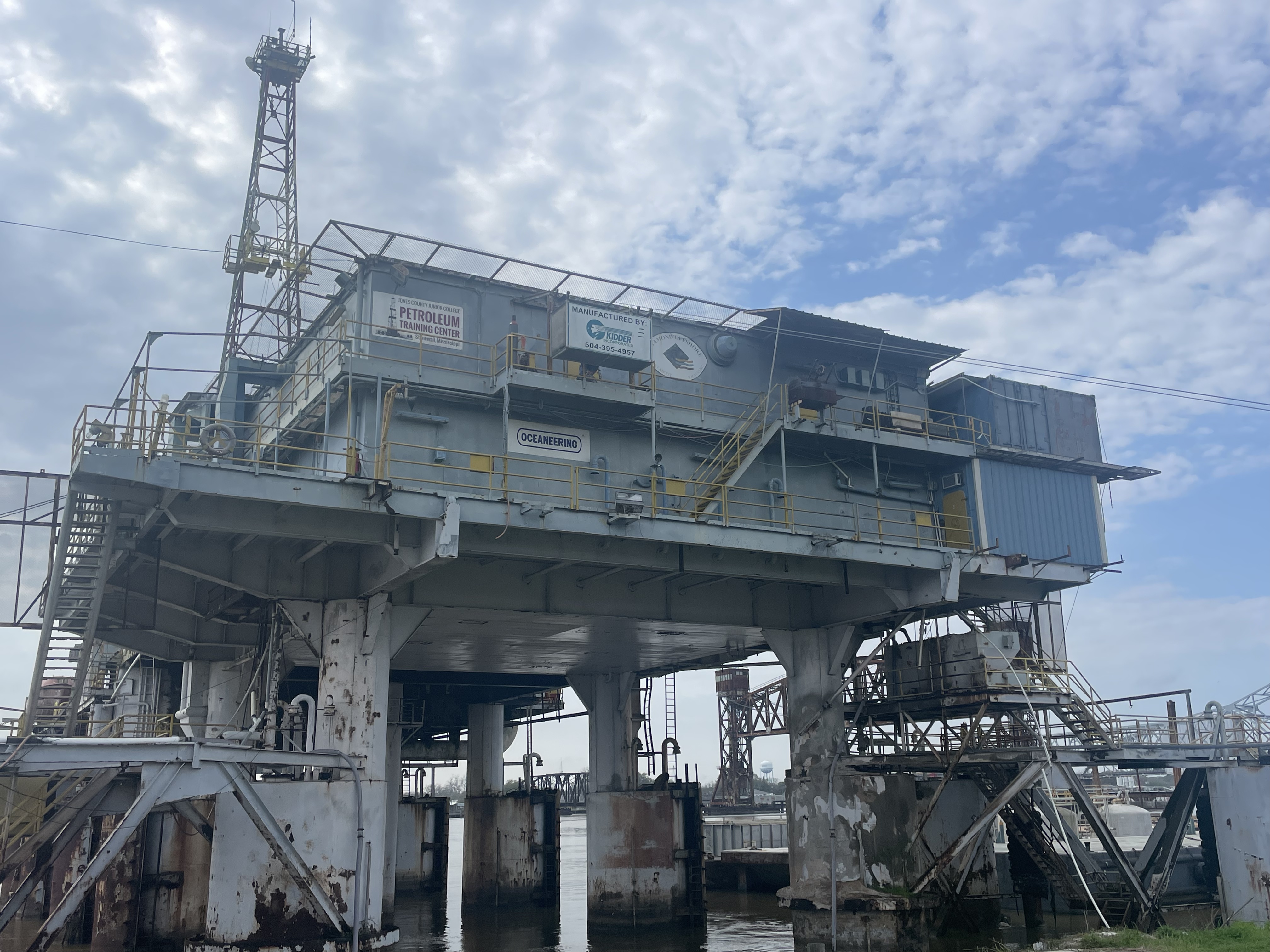
A billboard is how I ended up stepping foot on my first offshore drilling rig.
I arrived at “Mr. Charlie” around lunchtime on a weekday, and phoned the random telephone number posted while standing on the grass that served as a parking lot.
“Uh, I’d like to do a tour.”
“When?”
“Uh… maybe right now?”
“Great. I’m currently giving a tour. I’ll be right over to get you, just climb up the stairs.”


THOSE stairs? Those metal stairs with nothing underneath them but hundreds of feet of air dropping into the Atchafalaya river?
Let’s just say I held onto the hand railing when climbing up to the metal door (resembling a submarine door) that the tour guide opened.


He was a grey-haired man, a veteran of drilling rigs, and he was already about 10 minutes into his introduction about oil rigs when I joined. Standing in front of various scale models of drilling rigs, he was explaining the history of offshore drilling— and the technical advancements made over the years as rigs advanced (basically, better tech meant deeper drilling).
Turns out, “Mr. Charlie”— the very rig I was standing on, was the first-EVER offshore rig design.


It could only drill to about 40 feet deep— but it revolutionized the oil industry to be able to dig underwater for oil, economically despite being miles from shore. Housing its crew entirely onboard (Mr. Charlie had a crew capacity of 58), this storied rig had served for 38 years.
In its nearly 4 decades of service, Mr. Charlie drilled between 100 and 200 wells— from the Mississippi River to out into the Gulf of Mexico.
Explaining the basic anatomy of an oil rig, our guide talked about the floating barges underneath the platform that made it seaworthy, and then giant metal ‘legs’ — which are full of conduits for utility use like water and power— also connect the barge and the platform.
The next stop was the mess hall. Workers would work 12 hour shifts on Mr. Charlie, and food would be served all day in the cafeteria for 4 meals a day (!!)— as the workers needed huge amounts of calories to keep going.


The guide shared that if an employee was sleeping at breakfast time, that person would likely still wake up to eat and get their meal in before going right back to bed. The rig served red beans and rice on Mondays, and tacos on (say it with me!) Taco Tuesday.


Then, we headed up to the drilling platform itself. Walking past piles of pipe, and lengths of drill bits, the scale of this operation was hard to fathom. The sheer engineering and mechanics required to extract oil from underwater locales was something I just hadn’t thought that too hard about before— and the logistics of that task, piled up on this floating deck, was something to behold.


The guide stopped at the massive crane to explain how the pipe and drill bits would be assembled, lowered, and then winched back up to lengthen with new pipe, once maximum depth had been reached. The actual drill dropped through a tight valve the guide stood above while explaining the huge amounts of manpower required to raise and lower the drill.


Nothing about being exposed on this deck felt the least bit cushy— rusted metal surfaces surrounded me, and each task described seemed to have a thin margin for error. On all sides, barely a railing was there to keep one from falling down into the river— or worse— bouncing down the metal rails of the legs en route.
Even the way employees arrived onto the rig was daunting as f*ck, if I’m honest: the “elevator” to transfer men from a ship to the rig was basically no more substantial than a few poles to hold onto, while dangling in the actual wind during transfers. This shaky contraption looked like it would barely pass a basic safety test— and yet, for the entire 40 years of its operation, everyone who stepped on or off Mr. Charlie had to hang on for this wild ride.
LOOK AT THIS THING (on the left)!! AHHHHHHH!!!


If one was hoping the living quarters were more plush than the working deck— nope, not so.


Granted, this rig was built in the 1950s, the living area very much matched that era aesthetically. Lots of stark lines, and loads of browns and whites and tans around the interior. The functional, structural vibes were utterly devoid of creature comforts or any sense of ‘home.’ These guys were here to work, and living on a moving structure meant everything had to be bolted down (even their tiny desks were connected to the walls).
I sincerely hope the beds were more comfortable than they looked.
The guide took questions from the group— one of whom asked about ‘blowouts’— like what happened to the Deepwater Horizon rig. He acknowledged that stuff could easily go wrong given the number of elements at-play on any day— which is why most rigs kept emergency crews right on-hand on the rigs, rather than take the chance of losing days to transit.


The engineers who fixed broken drill bits always had to be on-hand to keep things running, since the rigs were so profitable and key to maintaining supply— that even a single “down day” while helicoptering a technician out to the rig was untenable.
One of the questions directed at the guide was about whether he believed what he did was also contributing to the harm to the planet— and his answer surprised me.
He was quick with his response, but gentle— he said, “I believe God gave us our resources.” And then even disputed the source and origin of oil— saying that some drills were now capable of drilling over 40,000 meters down, where “no fossils are.”
He was defiant than the planet would ever run out of oil. And honestly, based on his life experience, I could see why he felt that way— he’d seen the industry grow capable of reaching ever-further-and-ever-further deposits of newly-discovered oil sources for his whole career.
Why would he NOT think there were yet-more deposits to be found, and yet-more technologies to reach and extract from those spots?
I thanked him, and tipped him for his expertise (always tip your tour guides!), and departed. DOWN that same terrifying ladder, folks.


One of the interactions I had with another of the guest on the tour stuck in my brain. After learning I was a “van lifer,” he said, incredulous: “Why’d you come here?”— almost surprised that I would find any value in Morgan City, Louisiana.
I fobbed off the comment, saying I was passing through, but later— when exploring Morgan City a little further, understood his query.
The poverty in areas of the American Southeast can be crushing. If you’re a reader of this blog, you know I refuse to participate in “poverty porn,” and thus, I will only post a few photos below of what I saw, and won’t include photos of people in them.


Being from a Rust Belt town myself, I am familiar with the sight of towns that were left high and dry after being bypassed by highways, or forgotten once jobs were outsourced in the 90s, or got laid-into by the scourge of fentanyl. Morgan City might have been all of the above— a once-proud hamlet that led to the Gulf waters, this town seemed post-industrial in every way.
In Morgan City, my van was literally turning heads— being a fairly sweet ride, this van looked every bit out of place in a town that clearly made older cars run for as long as possible. The van got gawked at quite a bit as I drove around town to find lunch and get some supplies.
Which got me thinking… in general, even I was more likely to see fellow vans in areas that were wealthy. I once had a van lifer tell me they ‘stayed away from New Mexico’ because they felt it was too impoverished, and therefore, somehow desperate or unsafe (?). Associations between poverty and danger are simply associations I choose not to make.
And yet, in Morgan City I remembered that in a van like this, it’s impossible to be inconspicuous where people have almost never seen something like it before. The more people gaped at the sight of the van, the more I realized their town was not one of the towns people in “fancy” vans generally came to or thorough.
Because those vans are likely to be at a mountain biking trailhead in Boulder, or staying in a campground in Yellowstone, or even parked in a ski resort parking lot— “van living” is a term we assign to the privileged few who have hideously-expensive vans and drive them to some of the most iconic wild lands and cityscapes in the country.
And it occurred to me that spending time where I DON’T see other vans actually meant getting closer to reality and away from the fantasy-vacation-life that van people have who don’t venture out to the places where no other vans plan to go.
For so many van Instagrammers, it’s the remote location in a national forest with a view. Not a bypassed town in Louisiana whose best days were not only behind it, but well behind it.
It turns out (I researched a bit later), that about 21% of Morgan City’s residents fall below the poverty line, and the per capita income in the city was about $14,000— household about $36,000. Our vans cost several multiples of that. I wasn’t worried about my van, or my safety— I simply had concern that my conspicuous consumption was quite rude to display.


I had lunch at a small cafe in town called Rita Mae’s, named after the mother of the current proprietor. The menu board was one of those black-and-white signs with stadium-concession lettering, and lots of Gulf seafood was rightly on the menu.
Being vegetarian, I couldn’t sample the local Cajun fare, but I got some vegetable soup and a scoop of potato salad. This meal was not award-winning, or Zagat-rated, but was wholesome, home-prepared, and filling.
The restaurant was a family affair— with a young kid taking my order who appeared to be the kiddo of the second-generation owner and cook. There were prayer cards framed throughout the restaurant, which was a space that contained chairs and tables that didn’t match, but had been hodgepodge-d together over the years.
The entire thing was the kind of business politicians talk about— and during election season— go eat at for a photo opportunity. But of course, nothing about Morgan City implied that restaurants like these actually benefit from the kinds of proposals these politicians tend to support.


I can’t imagine many politicians would post-up in Morgan City— safely ‘red,’ Louisiana does not get the kinds of attention that Pennsylvania or Michigan get— but for all the ink spilled about the “Rust Belt,” there’s a thousand other industrial towns (in this case, fishing and oil) that got the short end of the stick as CEO-pay rose, jobs were outsourced, and the previously-solid promises of pensions and healthcare by corporations were snatched away.
I left Morgan City wishing we paid more attention to states not in the electoral line-of-sight, and wishing that we cared more about our small towns on life support. I also remember thinking that I would have liked to have seen more places like Morgan City in my travels— had I not prioritized the ‘epic’ over the regular lives of people, who were just living another day in a former paradise gone sharply south.


Posted by Sun


