
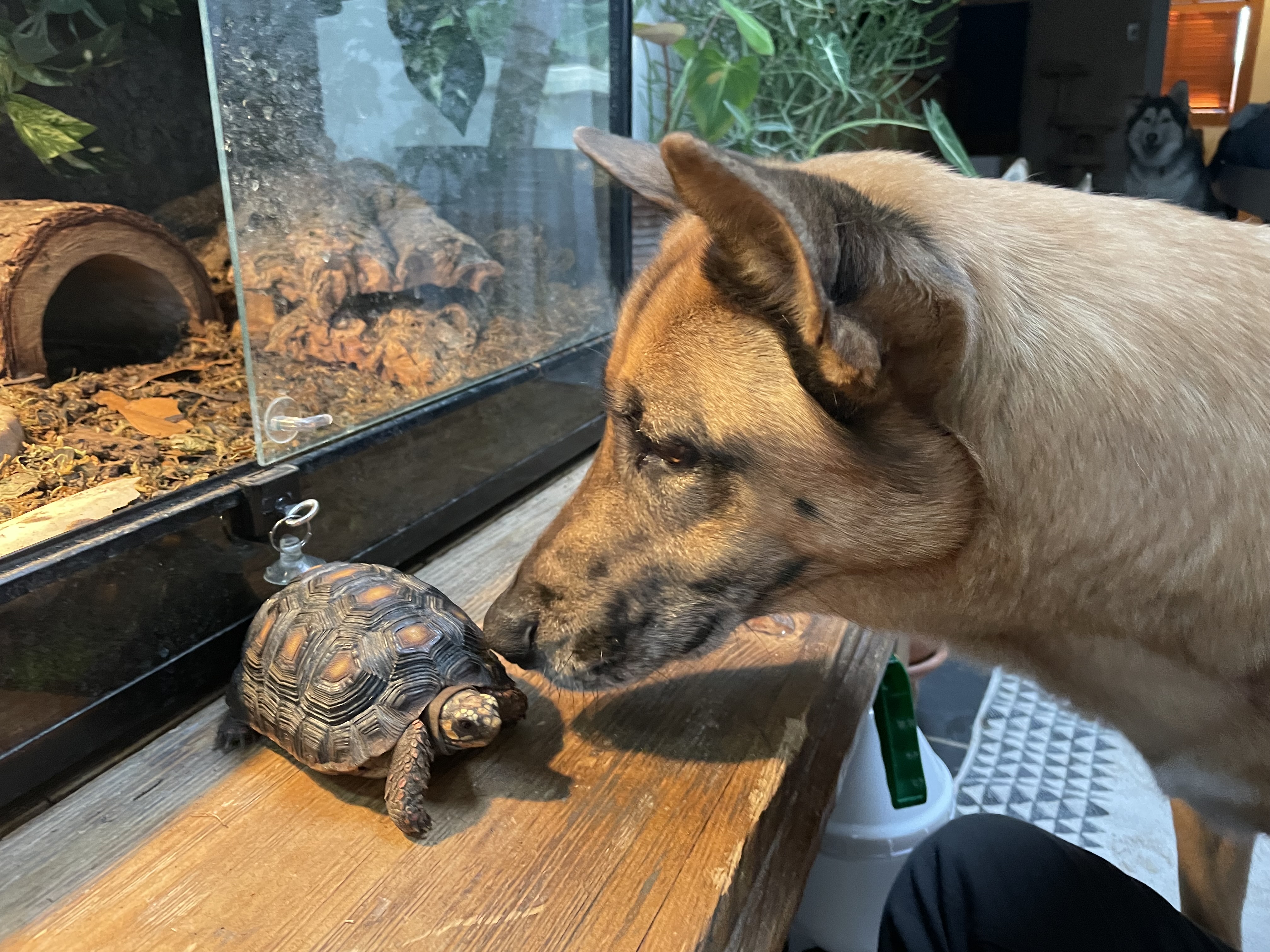


We came to Taos to pet-sit, and thus spent most of our time with the animals we were caring for– so we didn’t get to see much of Taos– but luckily, being a small hamlet tucked onto the side of a mountain, there’s not much of Taos TO see.
The town is known for its art, and its quirks– and that’s generally the kind of town that I like. It is also known for its skiing, which I generally avoid for the people it brings, but Taos’ ski area is (mercifully) far out from the town center.
I think Taos’ fame as a tourist destination makes it seem over-large, but the town has only 1,200 full-time residents. The ski resort has about 32,000 — so that’s where the tourists tend to hang. And that’s fine by me.
I found I was fascinated by the sleepy parts of Taos, which felt like a Southwestern outpost town that had barely changed from its founding. And that had far more charm than a chair lift.


Heck, everything about the place was disarming– from the adobe one-story dwellings to the scent of the pinon logs burning in the kivas. That scent of the pinon seemed to bury further into my lungs than other scent, feeling like it reached deep within me. It felt like a smell that a million people might try to re-create in perfumes or scented candles, only to fail– so incredibly natural and of the earth to be beyond artificial reproduction.

In Taos, one can leisurely stroll among the restaurants and shops and find things you never knew you wanted or needed in your life– but they are so damn cool, that you are persuaded.
Many of the products we saw in the stores were so incredibly handmade, they contained handwritten, hand-designed labels. In Taos, you can often buy directly from the people who make the items, which is always our favorite way to shop. We bought a balm and “live” chocolate directly from the makers at a market (the chocolate had bee pollen and all sorts of active ingredients, needing to be refrigerated).


Taos is a strange mix of traditional and modern– the history of the place is apparent in the architecture, but the contemporary and modern style of working artists is everywhere. The handprints of history and the future disruptors of that history are both present.
Taos’ art chops go back to 1899, and formalized in 1915 with a league of artists banding together just after the city was incorporated officially. The town was named for a Spanish colonizer of Pueblo people and lands, which is unfortunate, but the Pueblo and Hispano native communities remain strong today.
Every minute, Taos continued its charm offensive. When driving around town, tuning the radio dial led me to a true, bonafide local radio station. I could tell because the DJ said, “I walked outside this morning…” and told a story about this very day in Taos. Turns out that KNCE is entirely volunteer-run, with 100 different on-air local personalities. It felt like the old days of radio– with real DJs from the community telling stories, repping events in the area, and sharing WHY they personally loved the songs they played.
With no yuck-yuck filler, KNCE was one of my favorite things about being in Taos, and totally fit the hand-hewn vibe of the place.


The food in Taos has a reputation for being pretty incredible, and the Farmhouse Cafe and Bakery was one of the closest to the farm-to-table tradition in town. Breakfast there was so popular, there was a line out the door before the place even opened. The benedict I had was made beautifully, plated with asparagus that was grilled perfectly.
Because everything in Taos was paired with art, looking out the window of the cafe, there were various handmade metal creatures and spindly pinwheels meant to turn calmly in the wind. They were a mesmerizing way to start the day.


I ate my way through Taos, trying the divine downtown chocolate shop and the excellent food at Taos Mesa Brewing– their pilsner was incredible, and their handmade bread singed in their wood-fired ovens was way above the standard for breweries. This town may not ‘have’ much, but what they do have is made beautifully.


The awkwardly-named “Plant Base Cafe” was 100% vegetarian and vegan, and honestly is one of the best vegetarian meals I’ve eaten, reminding me of the early days of being a vegetarian in New York City. Well-composed dishes, super-fresh ingredients, letting the vegetables shine– all with a killer sauce. I loved it.


The Millicent Rogers Museum was noted as one of the most prominent art museums in town, so I headed there one afternoon– not realizing that its proprietress was married at one point to Clark Gable. Yeah. The photographs of her near the entryway said “This b*tch” perhaps more than any other portrait ever taken.


Millicent was an early prominent advocate for native artists, especially jewelry makers, and she both bought and commissioned tons of pieces. The museum contains a selection of her jewelry, and her wealth provided a platform to purchase art from ancient native craftwork to modern art being made right in Taos. The breadth of the collection was impressive given the small size of the place, and they were even having an exhibition and public sale in a few of the galleries when I was there.


The museum was a treasure trove of information about native art (mostly Pueblo), and contained exquisite examples of it. And instead of carrying cheap swag in the gift shop, they contracted directly with working native artists and both purchased new items as well as verifying the makers of antique jewelry items, then reselling them with permission.
But the crowning jewel of Taos were the Earthships.
One of the things Moon and I tend to like most about the van is being able to experience different ways to live– as unorthodox ways of living are often the ones you can learn the most from. The Earthship initiative began in 1973, when a man decided he wanted to build: 1. as sustainably as possible, 2. to up-cycle materials to build with, and 3. to use natural sources of energy, and lastly, 4. be something that ANYONE could build, regardless of skill level.
His design used dirt, tires, cans or bottles, and sheets of recycled metals, and the result became known as Earthships.


When you sign up for an Earthship tour, your tour guide will talk you through how easy it is to build one of these structures. In fact, there’s an actual handbook about the process for sale in the gift shop that doesn’t even contain that many pages. They want to share their craft– there is nothing proprietary to hold back– as ideally, they want everyone, everywhere to build them.
The not-so-secret is tires. Packed tires are the primary building material for Earthship houses, discarded tires rammed with dirt in a specific process, that the originator, Michael Reynolds, invented. The homes orient to about 10-15 degrees south of the Sun, in order to maximize sunlight in the winter– and just like the Gila cave dwellings, to create a situation where the hot summer sun rises above the overhangs, thus never overheating the homes in summer.


The buildings get their striking form from the packed tires– sharp angles are nearly impossible to achieve with packed tires as the basis for the walls, so curvilinear shapes emerge, including clever uses of exterior walls to help with both stabilization and runoff. While the original idea was to collect runoff into a pool, that didn’t materialize– too many creatures gathered there.
Which is just one of the many experiments the Earthship Biotecture Institute tried over the years– some of which were successes and others of which were outright, admitted failures. The tour does not gloss over the mistakes, or what was learned from them. Which was refreshing– as there was no illusions, no grand story about building some kind of utopia.


The greenery inside the homes was part of the Earthship premise of sustainability. And it was incredible to see– even in mid-winter, let alone how they must appear in full spring or summer. Inside the structures, right near the windows, grew plants– some functional, like herbs or peppers or other vegetables, and some more decorative and purifying, like the evergreen below.
The fresh oxygen these plants brought even in winter dormancy was palpable, and a reminder that living space feels more alive with plenty of plants inside. Homeowners all chose and worked with different plants, which Moon pointed out would make a heck of a barter system.


As sustainably-built homes, they re-use water for maximum efficiency. The metal plate roofs work as catchment for the sparse rain in the high desert, and the water was filtered naturally using rock and sediment filtration barrels. Then, grey water was recycled to be blackwater, before being flushed out of the system. Given this system, water was used 3 times before being expelled.
There were other clever– and straightforward– solutions to heating and cooling. Because these were down into the earth itself (about 12 feet down), it meant a layer of cool air was available at any given time to release by using a series of latches and hatches. One is pictured below– simply pulling hanging ropes could release the cool air from below, cooling the space above it to keep the home temperate– even in summer. Mostly, Earthships stay at about 59 degrees year-round due to their orientation and build.


The designs of using bottles and cans for structure within the walls was due to seeking plentiful, affordable building materials that would aide the mission of sustainability. Residents of the Earthships recycle their own materials to help build new structures within, and of course– as our tour guide pointed out: trash is everywhere on earth.
These unorthodox building methods– as you might imagine– don’t always rub the officials in the building industry the right way. More than once, the Earthship Biotecture sites were shut down, as they were not up the ‘building codes’ that one must maintain to have a lawful job site. The folks at Earthship weren’t doing anything unsafe or wrong, but the codes were developed for an entirely different system of building– and were not exactly friendly to anyone upending them.
This was not the only time we would hear about officials shutting down construction– the same happened at Arcosanti, another non-traditional living environment we toured later in the month. Building codes that were generated for conventional housing probably shouldn’t apply to totally different construction methods– but sadly, they do. This not only discourages– but can really effectively eliminate– any non-standard building project undertaken.


It would be easy enough to tour the Taos Earthships and snicker at the ‘hippie’ mentality of it all. And some on our tour did.
After all, it’s as unconventional as one can get– but to take wildest ideas seriously actually requires more effort, as it doesn’t dismiss what is different out-of-hand. Moon and I chose to embrace the unorthodox within the Earthships tour– and learned a lot about sustainable ideas in the process.
If you are heading to New Mexico, don’t stop at Santa Fe– take the 90-minute drive to Taos and experience this lovely hamlet.


Posted by Sun


