

Sometimes, you need to do a little exploring in your OWN backyard.
This summer, I got to take my van on mini-adventures around the Pacific Northwest, an area I knew well after approximately 10 years of residence there. But of course, there’s always more to explore— and I couldn’t have been more surprised when I learned that while I’d been on a million hikes in the North Cascade mountains (even living near there at one stage)— I’d never officially been to North Cascades National Park.
I’d even been BEYOND the park’s borders, deeper into the countryside down far rougher forest roads, but somehow never made my way into the park itself. So I set out to correct that oversight (and to get another coveted National Park stamp, of course).
The hike I selected was a fairly easy one— Cascade Pass– since the drive into North Cascades is lengthy even when you start from nearby, I wanted to be sure I left plenty of time to complete my hike in the cool morning. The upper part of the hike was listed as exposed, and at the altitude of the Northwest mountains, that’s not without some strong rays (and winds).


Notably, dogs were not allowed on this hike, not just because typical National Park rules applied, but because black bears were often sighted around the area (peep the warning sign tacked to the trailhead in the photo above). So, while I was bummed out about Mac not being able to join me— it was also for his safety. He had to hang out in the cool van, and though it became sunny, I raised each window shade and switched on my fan to ensure that he was in a temperature about 15-20 degrees cooler than the outside. Being the hike was fairly short, I knew he’d just nap while he waited. Which he did, snuggled up in a circle on his bed.
After I got my hiking gear on, I stepped outside and was stunned: the view from the parking lot was sublime. Which made me even more stoked– and, if you think I was kidding, THIS was the view from the parking lot (van for proof of parking-lot view):


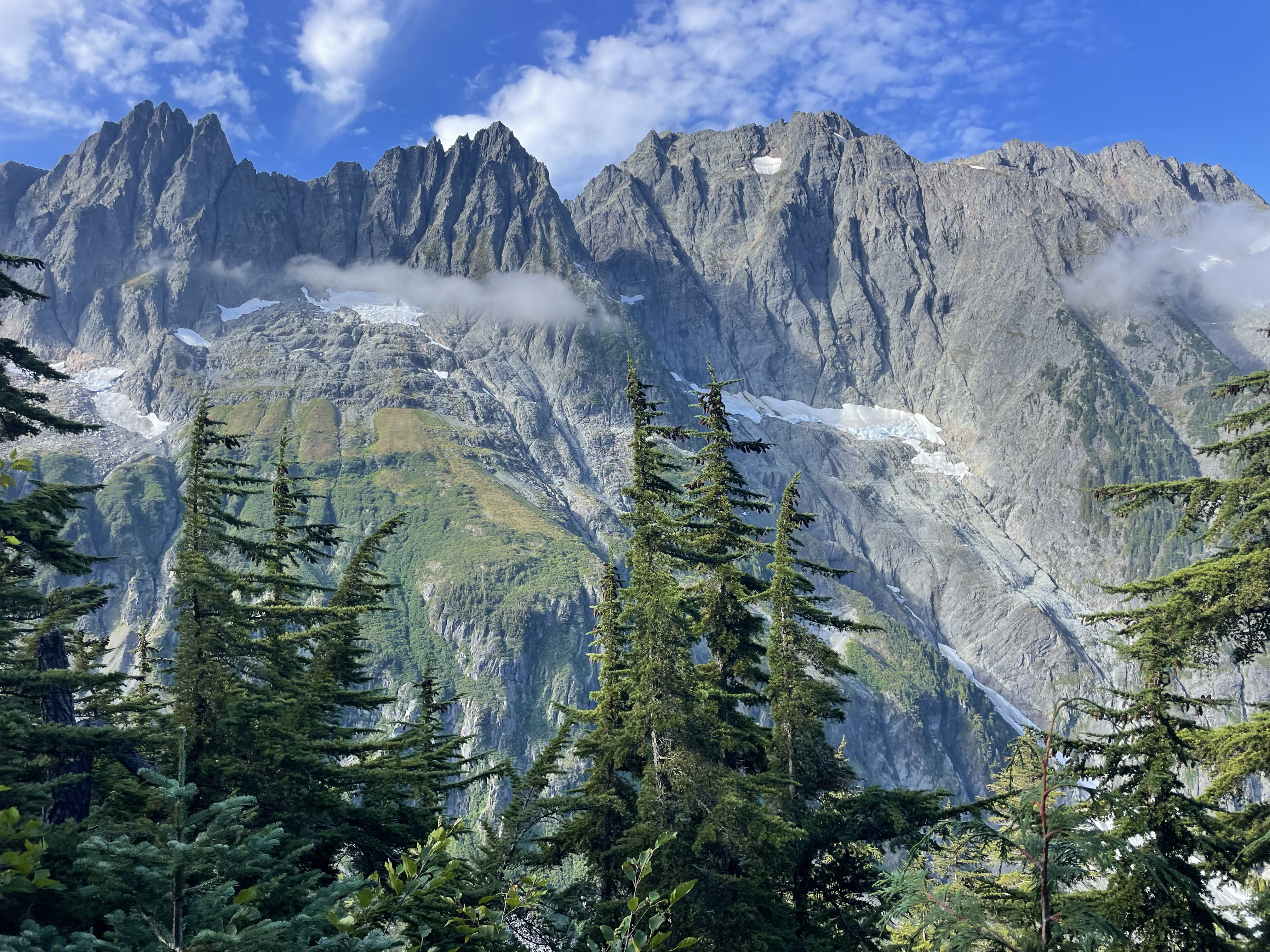
This hike was one of the most stunning I’ve ever done in the Northwest, holding its tremendous views for longer than the typical hike, due to climbing steadily up a switchbacked trail that overlooked an amazing valley. While the trees were tall at-first, they provided peeks of the peaks to-come.


Behind that valley was a backdrop that knocked my socks off— snow-covered mountain peak after snow-covered mountain peak, with icy patches gleaming in the sunshine. The morning sun illuminated the crevices of the mighty mountains in a gorgeous glow, and this made me gape every time I stopped for water.


Once the switchbacks emerged fully from the tree cover, the hike indeed became exposed— though that also revealed the full extent of the mountain range in a view that was unparalleled. The sun beat down, but the cool mountain air balanced the extra solar energy of higher-altitude hiking, and I reached for more water to keep hydrated. But I was’t upset– BAM! — THAT VIEW.


The sound of marmots chirping was pretty obvious as I advanced down the trail in the exposed section. Marmots, more YouTube-famous for their screaming-like-humans when nervous, actually seem pretty chill in the presence of humans on well-groomed, well-traveled trails. These well-fed marmots were sunning themselves on rocks this particular morning, calling to each other as I passed by.
What does a marmot sound like? Here’s a video of the valley from where the trail became exposed, and you can occasionally hear them sounding off to each other, the first just a few seconds in (volume up):
This particularly round marmot was standing right in the center of the trail when I first approached, but he found his way up to a rock to munch on the nearby vegetation, pausing only briefly to regard me, but otherwise paying much more attention to his breakfast.


Marmots look like a combination of a porcupine and a soft marsupial, but are really rodents— weirdly, they are described by Wikipedia as “large ground squirrels, the heaviest of the squirrel family” — a description I just can’t get with, as it seems like body shaming. They mainly eat grass, lichen, and berries, which explains why a field of boulders would actually be the perfect place for them to live– lots of tasty moss and lichen on the rocks, as well as natural dens.


It didn’t take long after passing through a long section of marmot-filled boulders to reach the summit of this particular hike. Notably, this hike connected to other trails, so I could have gone on– but that was not in the cards for me that day— not with Mac waiting in the van, and also, I wasn’t in shape for that kind of burly hike (nor did I bring an overnight backpack, as others did).


There was some dispute on AllTrails as to how far the next junction was— but most said it was far further than reported, and thus I felt VERY at-peace with my decision to descend.
By the time I descended, the morning sun’s rays had begun to fade as the cloud cover increased. I felt extremely lucky that I’d started early, and that I’d gotten to see this valley lit up so strikingly before the clouds of the Northwest resumed their control.

This hike wasn’t all that difficult, but afforded amazing views in payoff— just the kind of small hike that is worthy to tackle in a relaxed morning. I highly recommend this hike, though just like for all mountain hikes in high climates— paying attention to the weather is paramount.
North Cascades National Park contains tons of hikes, but also has been deeply affected by the wildfires consuming Canada and the Northwest in recent years, meaning various trails— or even whole sections of the park— might be closed. Make sure you also check fire maps or smoke maps if you are heading up in the summer or early fall.
But don’t sleep on this park for as long as I did— it’s a wonderful place, and while it can seem formidable thanks to the steep-and-difficult nature of many of the hikes— there are gems that are manageable to bite off as well.

Posted by Sun


