
I was sidetracked, and got to Selma late— but what happened when I arrived became emblematic of all that was good about van living. It was quite literally, one of my best days in my entire two-year stint.

I got waylaid on the road by attending a roadside gun show in a small municipality in Louisiana, and ended up spending several hours talking with the patrons that manned each booth.
So now, I was heading into Selma in the early afternoon rather than early morning.
This story is really about serendipity— the kind of auspicious day that could result from having the equivalent of a turtle shell on one’s back to travel. So pull up a seat, and let me spool this story out.
I had planned to stop in Selma primarily to pay respect to the Edmund Pettis Bridge, the site of the famous “Bloody Sunday” march and subsequent police brutality that played a massive role in defining the civil rights struggle in the 1960s. As my van approached my destination in downtown Selma, I noticed barricade after barricade blocking off streets, meaning Google Maps was forced to re-route me again and again.
I was within a few blocks of the bridge, but was having trouble parking— it seemed like every spot was taken. I was strange to have this much activity downtown on a Sunday— but finally, I found a parking spot.
I popped out of my vehicle, and asked a cop standing by a barricade what was going on.
“Ma’am… the Vice President is here— it’s the anniversary of the Bloody Sunday march,” he said, looking incredulous that I didn’t know.
Holy cow, that was news to me. I silently gaped, so he continued:
“She’s giving a speech in about an hour, and they will be leading a march across the bridge.”
I went back to the van, still a little surprised at my good luck, and made Mac as comfortable as possible given the rising heat— I put up all the window shades, turned on the fan, and as I was doing this, thought to myself: ‘there’s no way this event is open to the public, right?’.
Once my dog was plenty comfortable, I hit the street and looked around.


The entire historic downtown was overrun with folks out and about — people waiting in line at restaurants, standing at booths set up on the street with merchandise, and generally participating in a high degree of revelry. There was music blasting, played by the speakers near tents where Black sororities and fraternities had set up— recognizable by the finery they wore, the sorority sisters and fraternity brothers were decked out for the occasion.

This is where— as a conscientious white person, you gotta ‘check yourself’ to be sure you aren’t an interloper in a space not made for you— so, I looked around to observe whether or not this event was ‘for me’ or whether it was an event that was not exclusive to Black folks, but intended to be an expression particularly for them.
To confirm, I did a quick spot check— there were other white people scattered throughout the event, and they were seemingly welcomed there— and thus, I pulled up to a line in front of a Philippine restaurant. It had been a long time since I’d eaten, so since the line was long, I stuck with it. I was glad I had: the cabbage and rice they served was buttery and delicious, in addition to coming in clutch.


After my quick bite, I walked to get closer to the bridge— and given the presence of the Vice President of the United States, security was tight. I passed through a series of metal detectors (think airport security-style) and walked into the event— a blocked-off long section of the street that stretched just a few blocks from the bridge itself.

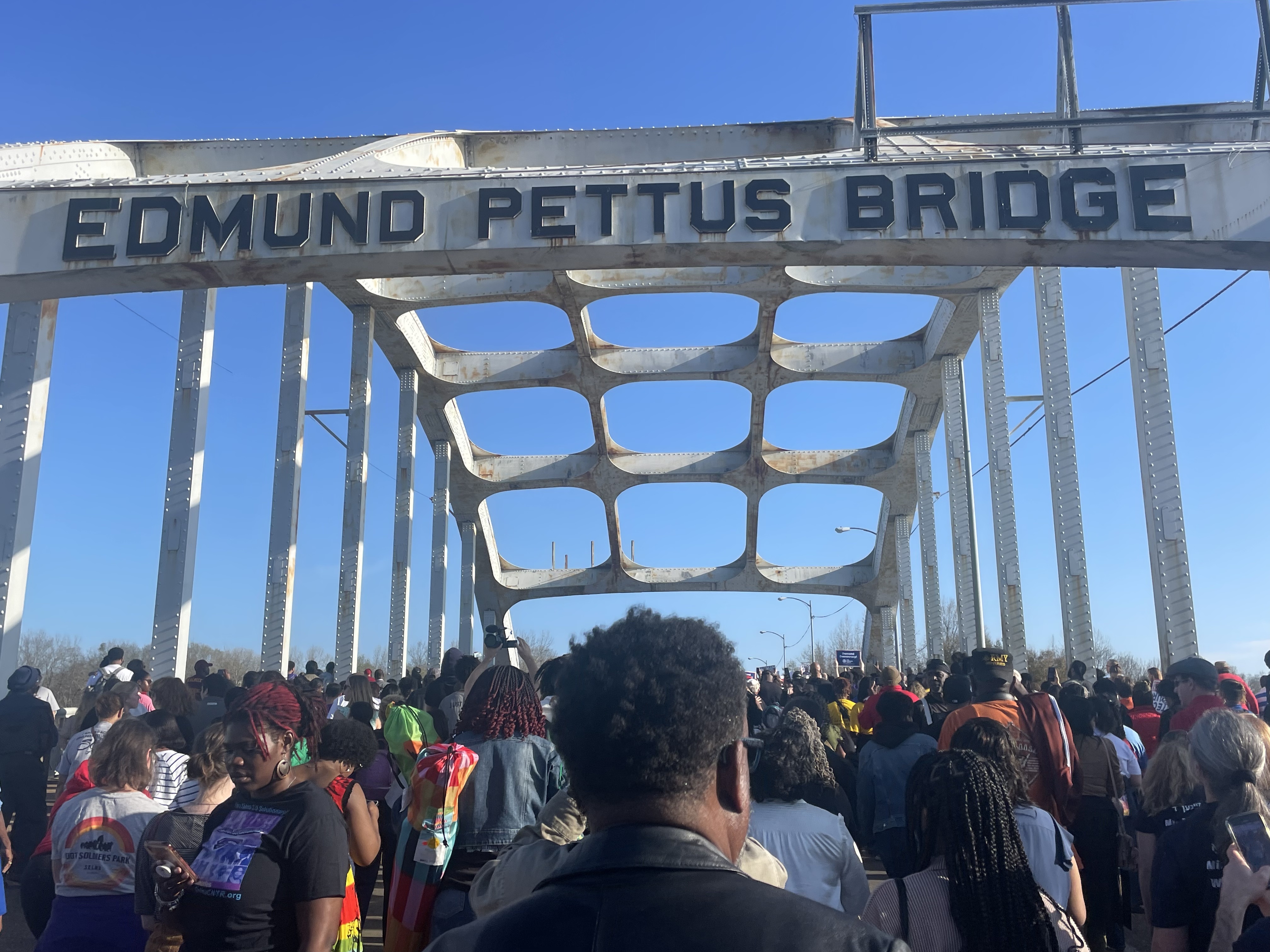
Seeing the bridge for the first time was enough to bring tears to my eyes— I’d seen the steel-framed bridge and its domed girders in every history book I’d read since I was a child. Its spans were so recognizable to me, that it felt overwhelming to see them in three dimensions. This famed bridge was a crucial piece of one of the most hard-fought rights movements in United States history, and its status as ground that was hallowed with the blood of peaceful protestors was not lose on me.
I’d been traveling the “Civil Rights Trail” in the southern United States for the past year or so, which had taken me everywhere from Tuskegee to Memphis to Montgomery to Birmingham— and the significance of being lucky enough to be here on this day as a cap to this hard-but-moving travel, was just sinking in.
As I walked forward to take my place in the forming crowd, I heard a speaker say, “Ladies and Gentlemen, the Vice President of the United States: Kamala Harris!”— and realized my timing that day could not have been more incidental— and also could not have been more perfect.

Screens that hung along the street showed a smiling, confident Madame Vice President as she strode to the podium that awaited her. Dressed in a brown suit, she struck me as looking both strong and radiant, wearing a determined, solemn, half-smile as she began to speak (that’s her on the screen above).
She talked about the struggle for rights, and the pain protesters experienced on this bridge. She also spoke of the late John Lewis, and his bravery on that day leading the march— I saw plenty of signs in the crowd praising Lewis and calling for the passage of the voting rights act named after him, which contained funding and a plan to make voting more accessible (it cannot pass without Republican support, and thus has not).
It was in this speech that a she called for a ceasefire in Gaza— marking the first time an American official so close to the White House had done so. It would later make the top of the New York Times homepage, but for now— the crowd erupted in stunned cheers at the unexpected calls for peace.
As she closed her speech, the assembled crowd cheered excitedly, especially the Black sorority and fraternity members (as VP Harris was famously a vociferous member of one).
Her speech was captured by CSPAN and a few other outlets— if it interests you, it’s HERE in its entirety (YouTube: https://www.youtube.com/watch?v=BRRm_q3uBS8)
Madame Vice President’s next step was going to be to lead us across the bridge— but first, the press had to get their photos of the leaders of the country and the community joining hands to in solidarity. This took far longer than any of us anticipated, but gave the crowd plenty of time to chat among ourselves and reflect on the speech she had given.


After over an hour of waiting in-place, there was a very loud cheer that made its way from the front of the huge crowd to the back— almost in a wave of sorts. This signaled it was time to move! The front of the group was stepping forward to ceremonially recreate the march, and we watched and whooped as they took their steps to begin to cross the bridge.
But very quickly, that initial cheer was replaced by a somber tone— a low and baleful hum began as the group around me started to sing in a near-whisper the tune “We Shall Overcome” as they stepped forward. And then a few feisty folks clipped in with the former Obama slogan “Fired Up! Ready to go!” — which provided a contrast.
I felt solemn too— I remembered the images from my history books: and you likely do, too. Because having seen them, it is difficult to forgot them— of cops decked out in riot gear, crashing their batons onto the skulls of protestors, who were badly beaten for peacefully walking from one place to another. The cruelty of the beatings was ultimately deemed ‘Bloody Sunday’ due to the injuries and deaths brought via the bludgeoning.


As I walked ahead, I remembered the young John Lewis dressed in a formal trench coat, striding with his head held high, walking ahead of the group as its co-organizer— before falling under the blows of a white police officer’s nightstick.

That day was as bleak as could be, and that generational trauma and sadness hung over the crowd as we stepped further forward. Though I was feeling resolute, I wondered if I would have been so brave on that day decades ago— if I was marching towards kitted-out police officers mounted on horseback and with riot shields and helmets.

Though we numbered in the thousands of people, we remained largely quiet as we walked, shoulder-to-shoulder. Occasionally, a song would begin or a rallying cry chanted (about the rights of the people NEVER being defeated)— but mostly, people just walked and reflected.

There was real diversity in the group assembled— unions, youth groups, trade groups, elks clubs, the Black sororities and fraternities, Black motorcycle clubs (recognizable by their leathers), nurses organizations, social justice organizers, and so on. And yes, there were people of every race marching.


After walking across the bridge, many dispersed for the day, while others continued on toward the celebrations further along. Since it was fast approaching sunset, this is where I took my leave from the group and doubled-back to the van, almost disbelieving that I literally stumbled into one of the more meaningful experiences of my travels.
I still had many miles to go to my next campsite, and arrived near dark. But as I tucked into bed that night, I had an absolutely huge smile on my face— as I felt I’d been there for the a tiny act, but one that was part of a story of the history of our nation.


As I pulled up the covers to finally sleep, I called up the New York Times, and the Vice President’s visage was emblazoned on the top accompanying an all-caps headline reporting her surprising call for a ceasefire. This, I realized, was also its own kind of history that I’d witnessed.

I knew this day had entirely been made possible by the way that living on the road could sometimes just WORK OUT— and nearly two years in, I also was well-aware of all the days and ways in which it failed to work out– when everything seemed to backfire, break down, or never come to fruition.
So, I didn’t take for granted that THIS day had been one in which the magic of road living had been with me— the timing had been auspicious, and the result was a near-perfect– and downright historic– day.

Posted by Sun


